Pasar Santa is a traditional market located on Jalan Cipaku, Kebayoran Baru, South Jakarta. The market was left empty for the years. But things started to change. The market managed to attract new kinds of tenants. Since then, Pasar Santa grew in popularity and has now transformed to become one of the most interesting youth scene in Jakarta. We spoke to the man managing the Pasar Santa Market Bambang Sugiarto to understand what’s happened. [continue reading]
business
Film, Politics, Rob Allyn, and Hashim Djojohadikusumo
NewsroomAccording to the movie archive of 21 Cineplex Group, the Trilogi Merdeka (the Freedom Trilogy) produced by Rob Allyn’s Margate House and Hashim Djojohadikusumo’s Media Desa Indonesia was directed by Yadi Gudandi and Conor Allyn. Conor Allyn is Rob Allyn’s son. The cooperation between Rob Allyn and Hashim Djojohadikusumo led many to question the motive of their partnership.[continue reading]
Gusti Kanjeng Ratu Pembayun: the Next Sultan of Yogyakarta?
NewsroomThe eldest daughter of the Sultan of Yogyakarta Gusti Kanjeng Ratu (GKR) Pembayun is rumoured to be the next Sultan of Yogyakarta. If true, this means GKR Pembayun would be the next governor of the special province of Yogyakarta, an insider of the Yogyakarta Sultanate told us on Wednesday (Jul. 16). [Continue reading]
Hashim’s Biofuel Business: Potential Conflict of Interest?
NewsroomOne of the policies proposed by the Great Indonesia Movement Party (Gerindra) in the environment sector is to implement the aren (Arenga pinnata) tree program. The program aims to preserve nature as well as to develop renewable energy program for the nation. This is interesting given that Hashim Djojohadikusumo, the co-founder of Gerindra, through Arsari Group, has expanded expanded his aren tree plantations in various provinces across Indonesia to produce bio-ethanol. [continue reading]
GBPH Prabukusumo: Business & Politics
NewsroomAnyone, who wants to run a business or trying to get a political support from the society in Yogyakarta province, needs to build a relationship with Yogyakarta Sultanate family member. It is because Yogyakarta Sultanate is believed to have a certain power to influence the local authority in the issuance of important business permits as well as influencing local residents in supporting certain political party, where the member of Yogyakarta Sultanate family belong to. [continue reading]
Tropical Fruit Distributor: PT Sewu Segar Nusantara
NewsroomThose of you who’ve recently shopped at one of the major convenience store chain in Jakarta would’ve noticed single banana in plastic packaging. The plastic-wrapped bananas are Sunpride Cavendish bananas. They are often misunderstood as an imported brand. Sunpride is actually a local tropical fruit brand by PT Sewu Segar Nusantara of Gunung Sewu Group. [continue reading]
Ornamental Plants Merchandising: PT Istana Alam Dewi Tara
NewsroomThe “Go Green” campaign has become a popular foundation for the establishment of new businesses ranging from the “green” laundry, “green” car wash, to “green” school. Today, we are going to look into a curious niche called the business of “green” souvenirs by PT Istana Alam Dewi Tara. [continue reading]
Cemeteries to Die For
NewsroomThe business of luxury cemeteries is growing in Indonesia. Today, the Indonesian upper middle class have several options of exclusive real estate to choose from for their final resting place. These cemeteries are far from the image of burial sites as a frightening space. Herein, we will talk about two of such cemeteries. [continue reading]
Indonesia hopes to become world leader in “Sharia tourism”
Khabar Southeast AsiaIndonesia hopes to become world leader in “Sharia tourism”
![Riyanto Sofyan, president-commissioner of the Sofyan Hotel chain, says revenue has increased ahead of the industry as a whole ever since the hotels converted to a Sharia-based system. [Elisabeth Oktofani/Khabar]](https://oktofani.com/wp-content/uploads/2013/03/dsc05459.jpg)
Riyanto Sofyan, president-commissioner of the Sofyan Hotel chain, says revenue has increased ahead of the industry as a whole ever since the hotels converted to a Sharia-based system. [Elisabeth Oktofani/Khabar]
Hoping to tap a burgeoning market among devout Muslims, Indonesia’s government has teamed up with religious leaders to develop “Sharia tourism”, which seeks to provide participants with a holiday experience that is aligned with Islamic values and beliefs.
A key milestone was reached in December when the Ministry of Tourism and Creative Economy (MTCE) signed a Memorandum of Understanding with the Indonesian Ulema Council (Majelis Ulama Indonesia/MUI), on a programme to foster this form of tourism. The government hopes to launch the initiative by June or July.
“Basically Sharia tourism is a concept [involving] leisure accompanied by religious values. It provides facilities and services closest to the values of Islam,” Firmansyah Rahmin, director general of destination development for the MTCE, told Khabar Southeast Asia.
This emerging form of tourism is not the same thing as a religious pilgrimage, a practice that has existed for centuries. Rather, it entails providing a travel environment aligned with Muslim observances.
“It needs to be understood that Sharia tourism is different from a religious trip,” Rahmin said.
Qur’an in each room, no liquor in restaurant
The Sofyan Hotel chain, headed by Riyanto Sofyan, is one of the pioneers behind the concept.
“We provide a Qur’an, Muslim prayer rug and directions for praying in every room. We provide toilets with sprinklers. We also don’t sell any alcohol or pork in our restaurant,” explained Riyanto, who is also chairman of the Indonesian Sharia Hotel and Restaurant Association (AHSIN).
Since converting to a Sharia-based model in 1994, he added, the chain’s revenues have increased by 15% to 20% each year.
“Our revenue is above the growth of the industry, which is only 10% a year,” he told Khabar.
In 1998, Sofyan Hotel closed down its nightclub and discotheque. In 2000, they stopped selling alcohol. And finally in 2002, it started to screen guests to ensure they are not using the hotel for activities prohibited by Islam. For example, unmarried couples are not permitted to stay.
“Guest selection is conducted to determine whether a couple who is going to check in is a married couple, family or an unmarried couple. If they are an unmarried couple and going to stay a short time, we will politely reject them,” Riyanto said.
According to Riyanto, Sofyan Hotel rejects approximately 1,000 to 2,000 guests every year.
Although it adheres to the Sharia code, he said, it welcomes business from members of other faiths who are willing to comply with the guidelines.
“A Sharia hotel is not exclusive for Muslims only. It’s open to anyone, whatever their race, religion or ethnicity as long as their activities do not violate any regulation,” he said.
Increased prospects as industry booms
Businesses such as Sofyan Hotel are benefitting from what appears to be a growing international trend, according to industry data.
According to Crescentrating, a halal-friendly travel and tourism consultant, the world’s Muslim travellers contributed as much as $930 billion to the tourism industry in 2009 (the latest).
According to country’s Directorate General of Marketing, meanwhile, approximately 1.3 million foreign Muslims visited Indonesia in 2010. Riyanto said 18% of those were interested in Sharia tourism.
“Interestingly most Muslim travellers were not only coming from the Middle East but also Europe, Australia, Japan, and China. The potential Sharia market in the tourism industry remains virtually untapped,” he said.
An MUI representative contacted by Khabar said the Islamic organisation is excited about the trend, but cautioned that Indonesia’s religious diversity must be taken into account.
“MUI is very supportive of the development of the tourism business,” said the representative, Slamet Effendy Yusuf.
But Sharia tourism, he added, is not appropriate for all parts of Indonesia because of cultural differences.
“Definitely Sharia tourism cannot be implemented in Bali or Manado (where Muslims are in the minority). However, it can be implemented in places such as East Java or Lombok. Therefore, we should be wise in implementing it,” Slamet said.
According to Zoraida Ibrahim, the director of the tourism industry at the MTCE, following the Sharia code is a “lifestyle” that is proving more and more popular.
She stressed, however, that there is no obligation in Indonesia for all tourism-related businesses to follow Sharia-based practices, despite the growing trend.
Small change is good business ahead of Lebaran
Khabar Southeast AsiaSmall change is good business ahead of Lebaran
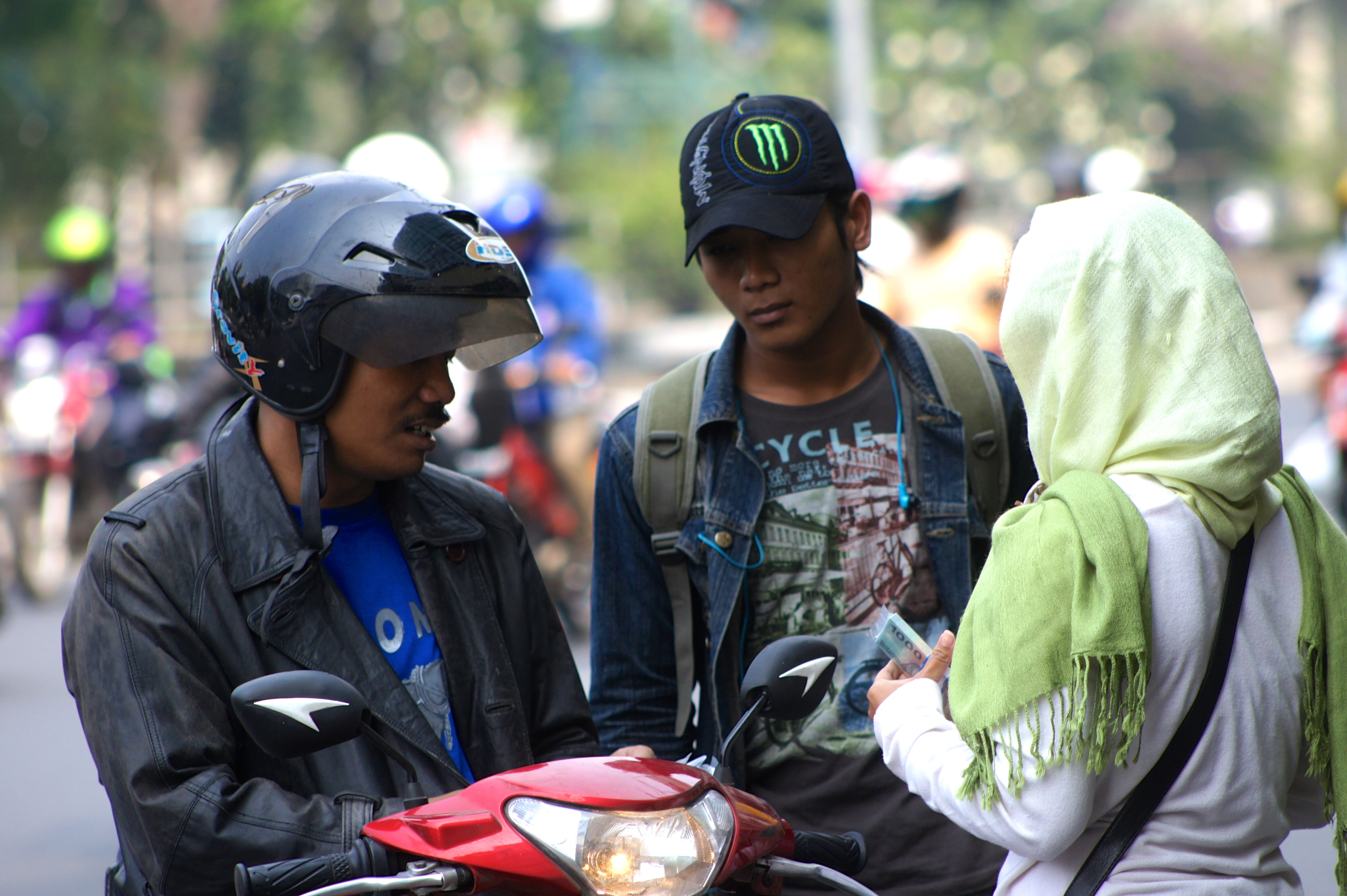
Rukmiyati, 34, and her customers do a money transaction on Jalan Gajah Mada in Central Jakarta on August 14th. Despite the fee charged, many Indonesians visit street peddlers to exchange their large bank notes for small ones for gift giving on Idul Fitri.[Elisabeth Oktofani/Khabar]
As the Chinese do on Chinese New Year, it is common among Indonesian Muslims for older relatives to give small sums of money to younger relatives after the children wish them a happy holiday on Idul Fitri
That tradition has created a business opportunity for people such as Iphan, 32, and Rukmiyati, 34, who on a recent day were selling small change – exchanging large denomination notes for small ones, for a small fee – to customers on Jalan Gajah Mada in Central Jakarta.
“I’m actually new in this business. I just started three weeks ago. In one day, I can make 300,000 rupiah ($32) in profit,” Iphan, who is originally from Medan, North Sumatra, told Khabar Southeast Asia.
“But it depends on how many customers I get per day. Basically, I can make 5 to 15 % profit from each transaction,” he added.
Iphan explains that every day he receives as much as 10 million rupiah ($1,053) from an agent, who takes a cut of his earnings.
First, he needs to go to the bank to exchange the big notes for small ones: 1,000, 5,000 and 10,000 rupiah notes (10 cents, 50 cents and $1.05).
Because of the high demand at this time of year, Bank Indonesia, in collaboration with nine other banks, opened a mobile small-change service out of a vehicle at the National Monument (Monas) in Central Jakarta, which operated from July 23rd to August 16th.
“Every day, I need to wait in line at the small-change service in the National Monument (Monas) Park, Central Jakarta. But unfortunately, we are only allowed to change up to 5 million rupiah ($527),” Iphan said.
“So that is why I also change the money with an agent,” he continued.
Even though banks make change for free, many Indonesians patronise street vendors for their small cash needs because of the convenience.
Rukmiyati, who has been working in the business for the last four years, told Khabar that she would make less profit if she changed the money with an agent.
She said she prefers to queue at the bank to get small change, even if she has to do it twice in a single day, because the agent will take an additional cut of her profit, shaving a 15% margin to 5%.
“That is why it is better to change it in the bank,” she said.
There is another reason to rely on banks, authorities say: they can vouch that the currency is real.
Questioned about the source of her capital, Rukmiyati said she did not know where the agent got the money. She believes it came from a bank.
Difi Johansyah, a spokesman for Bank Indonesia, told Khabar that informal small-change services are not banned because there are no regulations against them.
“We are aware that there are informal money changers in public places such as traditional market or side streets. Bank Indonesia will not prohibit them from doing business. However, we suggest the citizens not change the money with an informal money changer service because the authenticity is not guaranteed,” he explained.
Many Muslim religious leaders from the Indonesia Council of Ulema (MUI) consider money changing in the street “haram”. Such transactions are forbidden in Islam because of the fees charged. But MUI has not issued any fatwa banning the practice among the Muslim community.
Iphan, who worked as a laborer for 10 years in Jakarta before losing his job six months ago, told Khabar that he sells small denomination banknotes to support his family.
“If MUI said it is haram, then that is not really my problem. I have to provide food for my family. It is very difficult to find a proper job these days, and I heard about this seasonal business so I decided to join with my friend,” he said.
Many small-change vendors in Jalan Gajah Mada wear face masks, in part because they feel a little shame, Rukmiyati said.
However, “The main reason is to avoid breathing the bad pollution as big bus and trucks are passing by this road,” she said.
 Oktofani's Page