Terrorists increasingly use web for recruitment

Khabar Southeast Asia

Terrorists increasingly use web for recruitment

For terror groups, the Internet has become a useful tool to recruit would-be jihadists. The Indonesian authorities are doing their best to keep pace.

Technological advancements have enabled terrorists to wage online propaganda campaigns through “hundreds” of jihad-themed websites, experts warn.

Terrorists’ use of the Internet to spread their messages began in 2002 when Imam Samudra claimed responsibility for the Bali bombings via istimata.com, according to Noor Huda Ismail, executive director of the International Institute for Peace Building.

Ten years later, “there are hundreds of Internet sites” used to spread jihadist propaganda in Indonesia, run by groups and individuals, Noor Huda told Khabar Southeast Asia.

“There are also some individuals who manage several websites at one time,” he said. “They usually use social media and/or free blog hosting such as Facebook or Blogpot to post information or ideas about jihad.”

He said the Internet is one of the most effective ways for extremists to deliver their messages and find like-minded people.

Jakarta-based journalist Solahudin told Khabar that those websites contain information about jihad and Islam in general, and therefore tend to be attractive to their readers and followers.

One of the most popular topics on such sites, he said, is how to make a bomb from regular kitchen items.

“They can easily find out how to make bombs cheaply. They can purchase the ingredients such as match powder and also sugar without being noticed,” he said. “That was actually what happened in Umar Bin Khattab boarding school in Bima, West Nusa Tenggara. They assembled a bomb with knowledge gained from the Internet.”

The principal of the school was sentenced to 17 years in jail for preaching militant jihad and teaching his students to make bombs after a bomb exploded at the school on July 11, 2011, killing one person.

A Tangerang-based Islamic news portal, arrahmah.com, which provides information about jihad, published a letter on October 15th challenging Detachment 88 to an open fight.

According to the website, the letter was written by Abu Wardah, alias Santoso, the self-styled “Commander of Mujahideen in Eastern Indonesia,” who is on the police most wanted list.

The letter, written in Indonesian, Arabic and English, was first released by al-busyro.org, a site which also contains updates on jihad preparation in Poso and can only be accessed by members.

“In order to be a member with those kinds of websites, a person will need a recommendation from another member. Other than that, the website opens registration during certain periods of time,” Noor Huda said. “They do not want the information to be accessed freely.”

In 2006, Detachment 88 arrested three men for helping create and maintain anshar.net on the order of Noordin M. Top, a bomb-maker killed in 2009, with the purpose of spreading jihad propaganda.

Abdul Aziz, a high school computer teacher who designed the site, was sentenced to 10 years in prison that same year. Agung Prabowo was given three years in 2007 for purchasing the domain name anshar.net and a hosting account, while Agung Setyadi was sentenced to six years for sending a laptop to Imam Samudra, who was jailed in Bali at the time.

The Ministry of Communication and Information claims it has been blocking many websites since electronic transaction and information regulations were set up in 2008.

“Unlike before, when we only blocked websites on request, we now have a system which automatically blocks any website that contains negative stuff, including pornography and radicalism,” Gatot Dewa Broto, a spokesman for the ministry, told Khabar.

However, Gatot said, the ministry faces several obstacles in its efforts to block such websites, including limited bandwidth and human resources.

“If we block all the websites, it would hamper the public’s Internet access and we’d rather avoid that,” he said. “Secondly, we lack enough people who can keep monitoring the websites which contain negative material. It needs to be understood that we cannot just block any website based on like and dislike; it requires verification.”

Indonesia has 220 Internet service providers, he said; monitoring them is a big job.

“With all of these problems, we keep trying to improve,” he said.
Indonesia puts alleged terrorist hacker on trial

Khabar Southeast Asia

Indonesia puts alleged terrorist hacker on trial

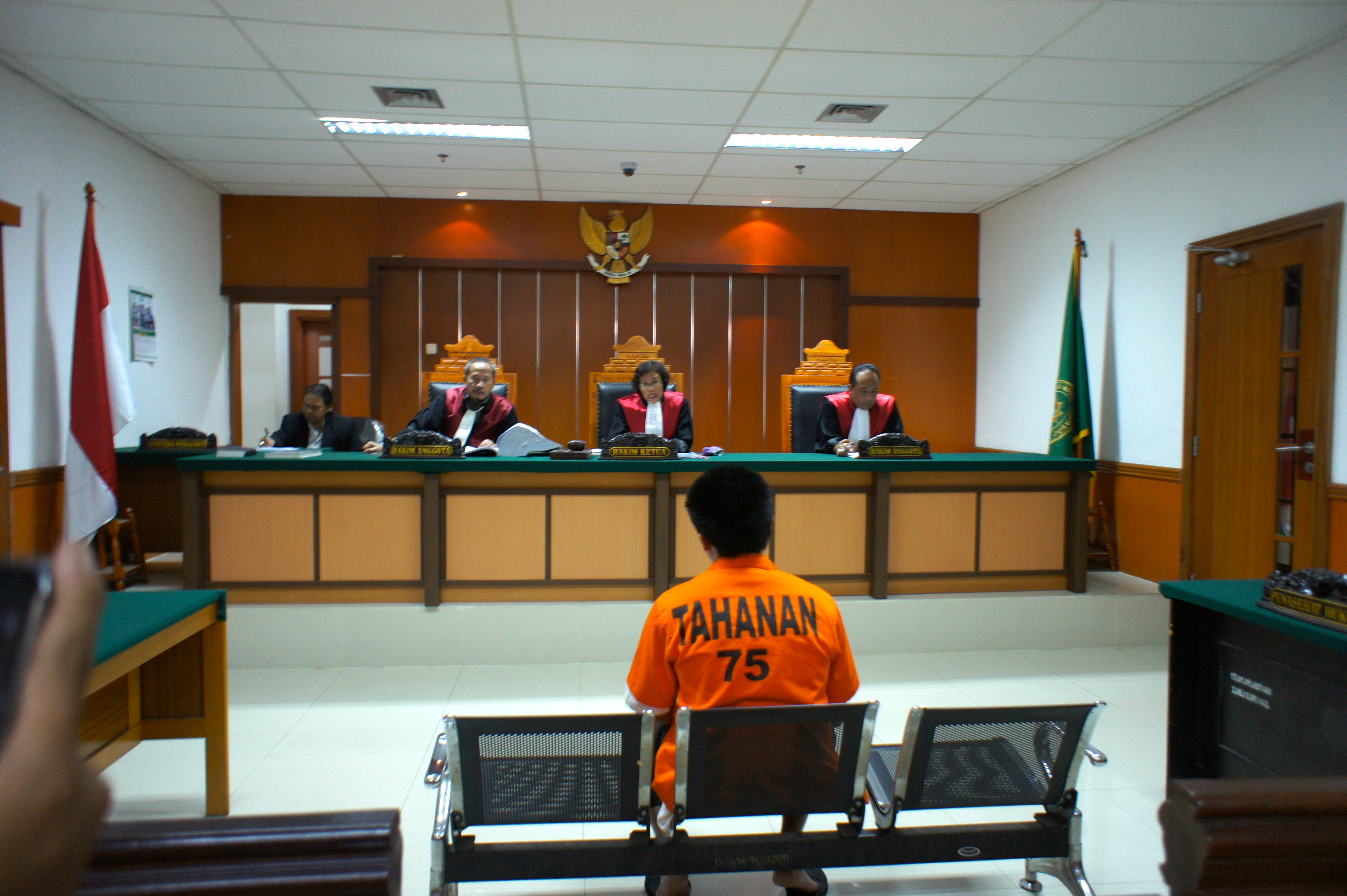
Alleged hacker Cahya Fitriyanta listens as his indictment is read out at West Jakarta District Court on October 8th. Prosecutors have accused him of premeditated murder, money laundering and electronic-system hacking. [Elisabeth Oktofani/Khabar]

The case is significant as Indonesia works to “connect the dots” on terrorism funding.

The trial of alleged hacker Cahya Fitriyanta currently under way in Jakarta represents the first time a suspect accused of stealing money online to finance terrorism has been prosecuted in Indonesia.

Prosecutors are seeking the death penalty for the 26-year-old cell phone technician, who has been charged with premeditated murder, money laundering and hacking an electronic system. His trial opened at West Jakarta District Court on October 8th.

According to the indictment obtained by Khabar Southeast Asia, Santoso, the leader of the Qoid Asykari Jamaah Ansharut Tauhid (JAT) Poso branch, ordered Cahya and Rizki Gunawan, another alleged hacker, to collect money to finance military trainings, weapons purchases and the support of terrorists’ wives.

Together they stole a total of Rp 960.3m ($100,200) by hacking an online investment website from July to November 2011.

Prosecutor Bambang Haryadi, who has handled many terrorism cases, told Khabar that Cahya’s case is the first connected with online terrorism financing to go on trial. But it will be a challenge for prosecutors to present all the necessary evidence, especially regarding fund movements and bank transactions, he said.

“Up to now, we already had hardware evidence such as the computer processor unit for money laundering and also electronic-system hacking charges,” he said. “We also need to present the funds movement and bank transactions. Therefore, we have to ask the Financial Transaction Reports and Analysis Centre (PPATK) to provide us the transaction analysis for the evidence.

“It will take some time. However, we will try our best with the evidence that we have obtained.”

Noor Huda Ismail, a terrorism expert and founder of the Institute for International Peacebuilding, told Khabar that the legal system has not been able to connect all the dots on terrorism funding.

“One of the challenges for the Indonesian courts is to prove these circumstances. Since the 2002 Bali bombing, the court has not found any evidence, such as bank transfer receipts, to prove where the funding came from,” he said.

Cahya is being prosecuted under the 2010 Anti-Money Laundering Law because Indonesia does not have a law that specifically regulates terrorism financing, he said.

“Unfortunately we do not have specific regulation for terrorism financing. But the government is now working on the anti-terrorism financing law. The draft has been submitted to the House of Representatives (DPR).”

Between July and September 2011, Cahya and Rizki hacked speedline.com, an online investment website, and stole approximately Rp 500m ($52,200). Cahya again hacked the site and stole another Rp 460,286,000 ($48,000) between September and November of last year.

According to the indictment, Cahya provided up to Rp 10m ($1,050) in financial support to the wives of terrorists in Bima, West Nusa Tenggara, through Jipo, a terrorist suspect who is at large. Cahya also gave up to Rp 150m ($15,650) for jihad preparation, also through Jipo.

Rizki gave financial support up to Rp 220m ($23,000) for jihadists in Poso and Rp 250,000 ($25) for operational funding of the church bombing in Solo in September 2011.

Cahya and Rizki attended military-style training in Poso and Malino, both in Sulawesi, for nine days in the second quarter of 2011, along with 20 other people from Java, Kalimantan, Sulawesi and West Nusa Tenggara province, the indictment said.

During the session, they got physical training, assembled homemade bombs, shot guns and practiced archery and basic military tactics.

The purpose of the training was to prepare for Jihad Fisabililah, or violent attacks on nonbelievers, including Christians in Poso and the Indonesian government, because it has not implemented Sharia Law.

Indonesia preparing amendment to terrorism laws: Ansyaad Mbai

Khabar Southeast Asia

Indonesia preparing amendment to terrorism laws: Ansyaad Mbai

In the second part of an exclusive interview, Indonesia’s counterterrorism chief describes ways about how Indonesian law and prison facilities make his job tougher.

A great weakness of the Indonesian legal system is that it does not authorise action against the “spiritual mentors” of militants, Ansyaad Mbai, head of the National Counterterrorism Agency (BNPT), told Khabar Southeast Asia in an exclusive interview last week.

To address that weakness, the government is preparing an amendment to the 2003 anti-terrorism law, Ansyaad said in a wide-ranging discussion on security issues in which he described ongoing obstacles to fighting terrorism, as well as concrete actions his agency is taking.

The legal protection of hate speech, poor prison facilities and a too-soft approach to terrorism convicts are among the obstacles outlined by the counterterrorism chief.

Rooting out radical ideology will be a long-term effort requiring broad support from civil society and moderate clergy, he said. Many former militants are co-operating with the effort, what he called one of the most effective methods of stemming radicalisation.

Free speech, or hate speech?

The recent arrests of some more than ten terror suspects in Solo suggest that the city remains a focus of illegal activity, despite concerted efforts to stomp out terrorism.

Terrorism persists in the central Javanese city because there are so many ideological figures or “spiritual mentors” who still actively preach radical messages there, Ansyaad said.

“Unfortunately, the Indonesian legal system has not yet categorised those activities as criminal actions. It’s what I consider a great weakness of our legal system” he told Khabar.

“Actually many religious leaders have urged us to take serious actions against the figures who are actively spreading hatred and enmity in the name of religion. But we do not have the authority to do so,” he explained.

“Those hate-filled speeches are still categorised as freedom of speech.” Ansyaad added that Indonesia is currently finalising a draft amendment of 2003 Anti-terrorism law that would add hate speech activity as a criminal action. “By adding the hate speech as criminal activity, we can be more proactive in countering terrorism. It is because that (hate speech) is actually the first step of the radicalism process and terrorism,” he said.

Radicalised in prison

Indonesian law also mandates a “soft approach” in handling terror detainees, he said. For example, infamous firebrand cleric and convicted terrorist Abu Bakar Bashir has never been compelled to wear a prison uniform, and is able to continue preaching from prison.

“So we have not only a soft approach, but a too-soft approach,” he said. Ansyaad admitted that Indonesia faces a challenge in curbing the spread of militant ideology in its overburdened prisons.

In March, counterterrorism forces shot dead five suspects believed to have been planning a series of attacks in Bali, which this week marks the tenth anniversary of the worst-ever terrorism attacks on Indonesian soil, the 2002 bombings in Kuta.

Three of the five suspects were former drug dealers who were radicalised by Bali bombers Imam Samudra and Amrozi in Kerobokan prison.

“It is indeed one of our biggest obstacles, minimal facilities that become overloaded. It’s a dilemma,” he said. “If we place all the terrorists in one block, then they will reunite. But if the terrorists are placed with non-terrorists, the non-terrorist can become a terrorist.”

Even if Indonesia were to isolate terrorists in a single facility, it would still be necessary to separate the high-risk prisoners from the low-risk ones, he said.

“So prisons keep trying to improve, but with limited facilities,” he said.

Reaching the ‘brother community’

The national deradicalisation programme Indonesia is currently developing has two main targets: terrorists in prison or police custody, and the broader “brother community” that provides support for terrorists.

“The first objective has been achieved in many countries. But the second objective, targeting the brother community, is a big job and require a long-term strategy,” he said. “We need the involvement of moderate religious leaders and also non-governmental organisations.”

A main goal of the effort is to neutralise radical messages about the meaning of jihad and the treatment of non-believers, for example. A key strategy will be to use former militants to denounce terrorism.

“Experience has shown, the best way to catch a thief is by using a thief. The fact that terrorists complain about this tactic shows that it is effective,” he said.

More than 50 former Indonesian militants who trained in Afghanistan have agreed to co-operate in a BNPT deradicalisation programme, visiting 14 prisons in ten big cities throughout the country “to convince others that what they were doing was wrong,” he said.

“We need more and more like them,” he said. “The more ex-terrorists who oppose terrorism, the better. And certainly that will make terrorists complain,” he said.

For the first part of the interview with Ansyaad, click here.

Bomb-makers getting more sophisticated: Ansyaad Mbai

Khabar Southeast Asia

Bomb-makers getting more sophisticated: Ansyaad Mbai

Terrorism remains a real threat in Indonesia, and the target has shifted to the “near enemy”, Indonesian police chief of the National Counterterrorism Agency (BNPT), Ansyaad Mbai told Khabar Southeast Asia in an exclusive interview last week. [Elisabeth Oktofani/Khabar]

The latest terrorism-related arrests net some long-time militants with a grim new group name and deadlier bombs

Terrorism remains a real threat in Indonesia, and militants are becoming more sophisticated at bomb-making, Ansyaad Mbai, head of the National Counterterrorism Agency (BNPT), told Khabar Southeast Asia in an exclusive interview Thursday (October 4th).

“With this latest case, the terrorism threat is still real,” Ansyaad said, referring to a string of arrests in September of suspects who claim they belong to Al-Qaeda Indonesia.

No evidence has been found of links to international terrorists. “We have found no evidence of that. But they did indeed plan to form a network called Al-Qaeda Indonesia,” he said.

Suspects picked up in a series of incidents in late September in Solo, Central Java and Depok, West Java appear to have been more creative and sophisticated than other terror groups in assembling bombs, employing, among other items, plastic food containers and rice cookers.

Police seized liquid nitroglycerin bombs packed in plastic bags, four pipe bombs, two bottle bombs, 4kg of sulphur, 5kg of gunpowder and several mobile phones.

“They have become more sophisticated. It can be seen from the latest evidence which was found: they have prepared the liquid bomb. In fact, our explosive experts considered that the bomb has higher capacity than the previous homemade bomb.” Ansyaad said.

Old group, new name

In a series of raids starting on September 22nd, police detained nine terrorist suspects: Badri Hartono, Rudi Kurnia Putra, Khumaidi, Fajar Novianto, Barkah Nawah Saputra, Triyatno, Arif Pamungkas, Joko Priyanto alias Joko Jihad, and Wendy Febriangga alias Hasan.

Other suspects are still being sought by police, he said, stressing, however, that they do not represent a new group.

Some of the detainees are former members of Jemaah Islamiyah (JI) and Jemaah Anshorut Tauhid (JAT), a hardline Islamic group once led by cleric Abu Bakar Bashir.

“So it’s not new at all. There are even some who have served prison time,” he said.

“Since the 2002 Bali bombings, Jemaah Islamiyah has been broken down into numbers of small groups or cells, but the cells are still in touch with one another. Later, when the name changed to Jemaah Anshorut Tauhid, their leader is still Abu Bakar Bashir,” he explained.

“Therefore it needs to be understood that even though they have been changing their name many times, these actually are not new groups. Each group still has the old figures and recruits new members.”

“At a certain level, these groups can reunite to carry out another action. Like now, we can see each group has its plan and carries it out in several different places… So you can’t say it’s new or, as some say, fourth generation. It’s not relevant to classify it in that way,” he said.

New targets

Their goals remain the same, but their targets have shifted over the past decade.

“Before the emphasis was the West, the ‘far enemy.’ Now it’s more the ‘near enemy’. Why? Because they have experienced — over these more than ten years — that in fact what most obstructs their movement is the ‘near enemy’, and the enemy that is nearest to them is the police,” he said.

Their goal, he added, is to establish an Islamic state based on their version of Sharia Islam.

“Careful when you write Sharia Islam…it’s ‘their version of Sharia Islam’,” he said.

Authorities have found no evidence of foreign money flowing to radicals in Indonesia. But 2012 saw evidence of multiple approaches employed to raise money at home.

“It appears that their pattern now is to focus domestically, stealing over the Internet, or using the conventional way, which is by robbing banks or gold shops or whatever they can,” he said.

In May, authorities arrested alleged hackers Rizki Gunawan in Jakarta and Cahya Fitriyanta in Bandung, who managed to break into a multi-level marketing website and obtain almost 5,937 billion rupiah ($617,150) – money used, according to police, to fund terror activities including militant training in Poso and the bombing of a church in Solo last year.

On Monday (October 8th), Cahya Fitriyanta’s trial began in West Jakarta District Court. He faces multiple charges including hacking, money laundering and supporting terrorism.

Depok bomb blast aborts sinister plans

Khabar Southeast Asia

Depok bomb blast aborts sinister plans

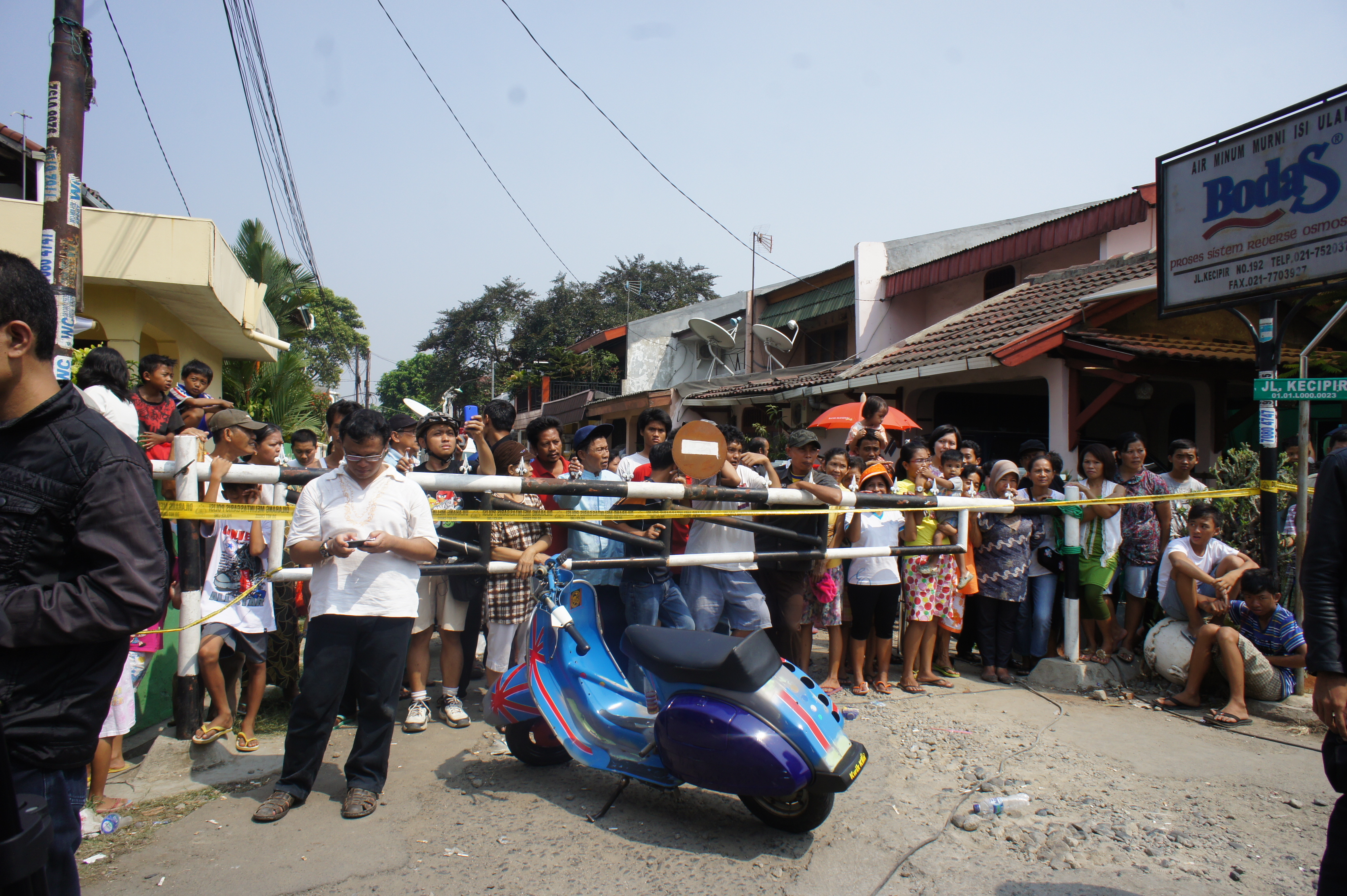
Residents of Depok, West Java watch on Sunday (September 9th) as police investigate the scene of a bomb blast the night before. The explosion injured at least six people, including a man suspected of making the bomb. [Elisabeth Oktofani/Khabar]

The men exposed by an accidental bomb blast in Depok, West Java were planning acts of terrorism, police say.

One surrendered at a police station, wearing a suicide belt and pining for his family. Another lies in a police hospital, unrecognisable, burns covering 70% of his body.

Just prior to an explosion at 9:30 pm Saturday (September 8th), the two men met at a house in Beji, Depok that advertised itself as an orphanage but turned out to be a bomb factory.

The blast at the so-called Pondok Bidara Orphanage Foundation injured at least six people, most of them neighbours who lived just behind the bomb site.

The victims are Nanut Triaman (62), Bagus Kuncoro (20), Taufik (32), Wulandari (27), Fajruddin (27), and a man originally identified only as Mr X because the severity of his injuries made immediate identification impossible.

Suspected of being a bomb maker, Mr X was brought to the Kramat Jati Police Hospital in East Jakarta for intensive treatment, according to Boy Rafli Amar, the spokesman for the Indonesian National Police.

“His right hand was damaged badly. His neck was hit by some kind of hard object, and his face has been badly burned,” he told reporters Sunday (September 9th) in Jakarta.

After the explosion, neighbours saw two men escape by motorcycle. “We’re monitoring hospitals and clinics because one of them is believed to have suffered burns,” Boy said. “We strongly believe that the suspects were involved in assembling the bomb.”

Police did not have to wait long to nab one of the fugitives. At around 5:30 on Sunday (September 9th), 32-year-old Muhammad Toriq – also spelled Toriq in some reports — turned himself in at Tambora police office in West Jakarta.

An explosives belt was strapped to his body, which he handed to police, along with a gun and ammunition, Jakarta police spokesman Col. Rikwanto said.

“He turned himself in because he missed his family,” Rikwanto said, according to The Jakarta Globe.

Planned suicide attack

Prior to his surrender, Thorik had considered blowing himself up at a police office or a Buddhist centre, Boy later told reporters in an update on the unfolding events.

According to Boy, the suspect planned to detonate a suicide bomb at one of four potential targets: Depok Mobil Brigade (Brimob) headquarters, the National Police Detachment 88 office in Jakarta, a police building in Salemba, Central Jakarta, or a Buddhist centre. The planned attack was a deluded attempt at revenge for the treatment of Rohingya Muslims in Burma.

Thorik had escaped from the police twice before he surrendered. He first escaped on September 5th after a neighbour reported smoke coming from his house in Tambora, West Jakarta.

The smoke turned out to be a cloud of explosive material that had accidently spilled. When police arrived at the house, Thorik was gone, but they took his mother Iyot, 71, his wife Sri Haryani, and his three-year-old son Mohammad Gabriel to the police station.

Thorik was at the “orphanage” in Depok when the bomb exploded but fled before police arrived.

Earlier, police thought that the critically injured man was Thoriq. But his identity has since been confirmed as Anwar, a relative of suspected militant Arif Hidayat who was arrested Monday (September 10th) in Bojonggede, Bogor, West Java, according to media reports.

A deadly “orphanage”

Based on the severity of his injuries, police think Anwar was making the bomb, perhaps even holding it, when the explosion occurred.

From the scene, police also seized three grenades, six pipes filled with explosive material, one Beretta pistol, homemade guns, small-arms ammunition, 7kg of potassium chlorate, nails, five 9-volt batteries, detonators, cables, and electronic switches.

Police also found some books related to terrorism and a goodbye letter at the scene.

A banner with the words Pondok Bidara Orphanage Foundation hung from the front of the building. Another sign indicated the place was an alternative “cupping therapy” clinic. However, local residents never saw any patients or orphans.

According to Joko, 60, a neighbourhood drinks seller, the person who rented the room had been living there since last month.

“I have never seen any activities because the gate was always locked. I tried to see the person to ask for the monthly rent, but I could not enter,” said Nurhassanah, 37, a community leader whose husband heads the neighbourhood watch (Rukun Tetangga/RT).

Boy said police had been monitoring activity at the house. It is not new for terrorists to use a business front to mask criminal activities, he said.

“Legitimate business activities have been used by terror suspects in many cases. In Wonosobo, for instance, they used their place to sell clothes,” he explained.

Boy said that people need to be aware of newcomers in their neighbourhoods because many terror suspects associate with the community and carry out normal activities.

“It is very important for the community chief to ask for and collect a copy of the identity card from new residents in their community,” he said.

New generation of terrorists shadowing Indonesia

Khabar Southeast Asia

New generation of terrorists shadowing Indonesia

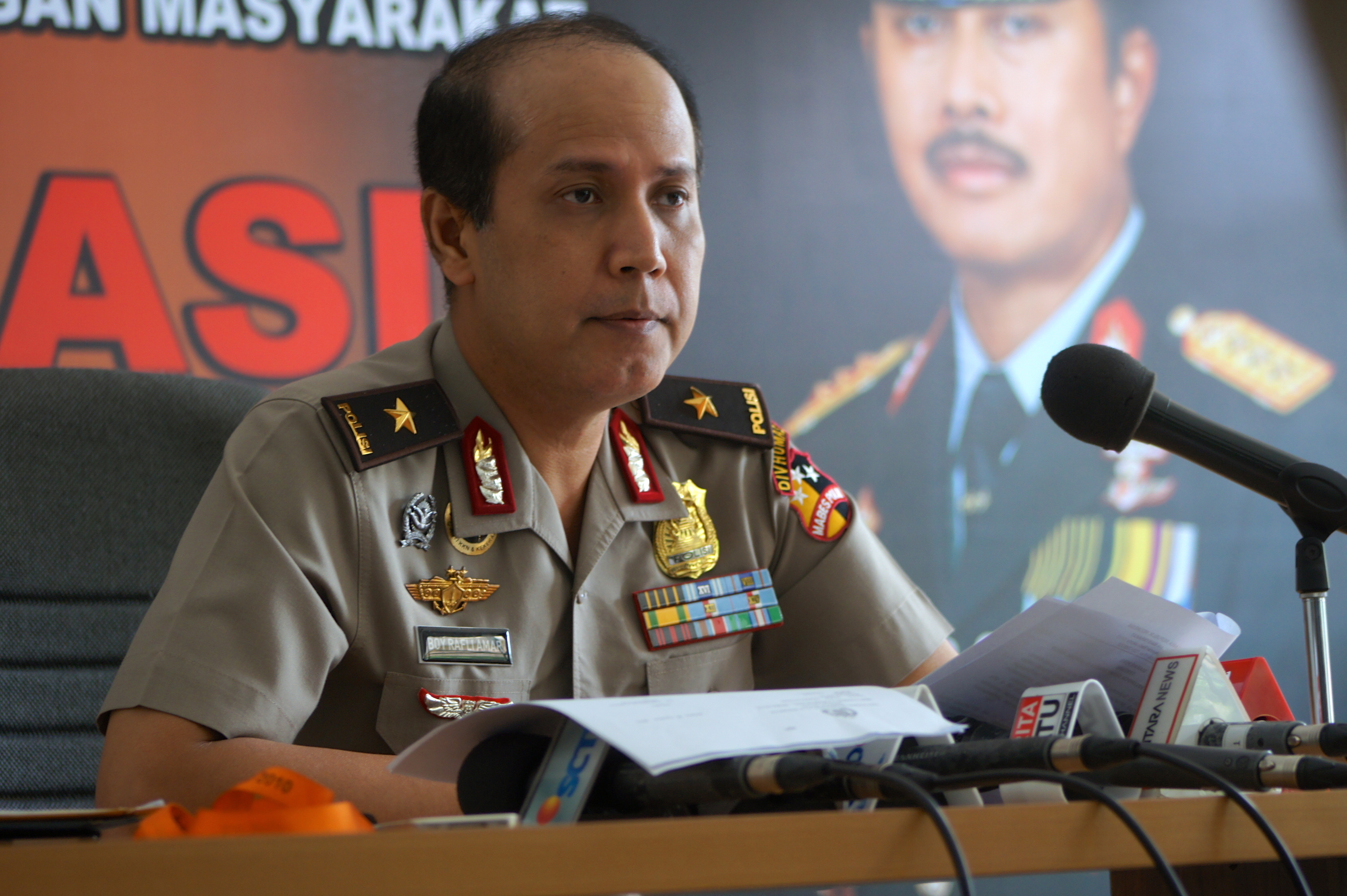
Boy Rafli Amar, National Police spokesman, told reporters on Tuesday that the youthful terror suspects in Solo had links to older extremist organisations. [Elisabeth Oktofani/Khabar].

The young men who carried out the Idul Fitri attacks in Solo belonged to a new terror network with links to established groups, police say.

A new breed of radical extremists is posing a security threat to Indonesia, officials and analysts say, citing a recent series of attacks in Solo as an example.

Two young men, Farhan Mujahidin (19) and Mukhsin Sanny Permady (20), were shot dead by counterterrorism police during an August 31st raid, after allegedly staging assaults on police posts. A third suspect, Bayu Setiono, is under arrest.

According to Brigadier General Boy Rafli Amar, spokesman for the National Police, the men appear to belong to a newly-formed extremist group – but one which is affiliated with long-standing terror networks, and with the hardline Jemaah Ansharut Tauhid (JAT) organisation.

Farhan, for instance, was the stepson of convicted terrorist Abu Umar, currently in prison for smuggling firearms from the Philippines to Indonesia, and for organising a paramilitary training camp in 2008.

In 2010, police say, Farhan resided in the Philippines, where his stepfather obtained support for launching a terrorist attack, including plans to attack the Singaporean Embassy in Jakarta.

Bayu also had a connection with the Philippines, according to police. They say he was involved in smuggling firearms and had joined the Al-Qaeda-linked Abu Sayyaf group.

Weapons seized during the August 31st raid included an Italian-made Beretta pistol stamped “PNP [Philippine National Police] property”. According to Boy, the suspects underwent physical training at Mount Merbabu in Boyolali district, and may have earlier received training in combat strategy at other camps in Aceh or Mindanao.

He said they targeted Solo, also known as Surakarta, because they were familiar with the location. But the city was just the starting point for a broader campaign of terror attacks.

“As they used to study at the Al-Mukmin Ngruki Islamic boarding school, they are familiar with the location and have contacts there where they can hide. Therefore, they could remove any trace of their presence more easily,” Boy said.

Andi Widjajanto, a security analyst from the University of Indonesia, told Khabar Southeast Asia on Wednesday (September 5) that terrorists have been targeting police and the Indonesian government ever since the execution of three Bali bombers in November 2008.

Amrozi, Ali Ghufron and Imam Samudra were found guilty and sentenced to death for their role in the 2002 Bali bombings, which killed 202 people. Speaking by phone to Khabar, acting JAT leader Mochammad Achwan denied that the terror suspects were members of his organisation.

“I have asked JAT members whether they knew the two suspects or not, but they said that they did not know them,” he said.”I am very upset that officials always link terror suspects with our organisation”.

JAT was founded by the firebrand cleric Abu Bakar Bashir, convicted in June 2011 and sentenced to 15 years in jail for helping to organise a jihadi training camp in Aceh. He is viewed as the chief ideologist and spiritual mentor of Jemaah Islamiyah (JI), implicated in the Bali bombings.

On Friday, Indonesian counterterrorism chief Ansyaad Mbai said that JAT was linked to the Solo attacks as well as a planned assault on the Indonesian Parliament in Jakarta.

“There are several small groups (whose) underground works are not related to each other, but they all came from the JI and the JAT,” he told the AFP news agency, citing information revealed by Bayu during interrogation