The Indonesian Military (TNI) and the Indonesian Police Force (POLRI) have never been the best of friends, especially after both institutions parted ways in 1998, TNI and POLRI have never been best friends. But enough is enough. President Joko “Jokowi” Widodo wants POLRI and TNI to settle their differences. But how? [continue reading]
POLRI
Endless Open War Between TNI and POLRI
NewsroomThe mini siege warfare that happened at Batam last month has yet again put the conflict between the Indonesian Military (TNI) and the Indonesian Police Force (POLRI) at the forefront of national attention. Indeed, both institutions have not been the best of friends. The Commission for Missing Persons and Victims of Violence (KontraS) noted that there were at least seven clashes between members of TNI and POLRI that took place between the period of October 2013 to September 2014. [continue reading]
Jokoways & the Challenge of Tackling Illegal Fishing in Indonesia
NewsroomPresident Joko “Jokowi” Widodo issued his strongest warning yet to those illegally fishing in Indonesian waters. The President told journalists that he would have the authorities sink foreign vessels fishing illegally in Indonesian waters. The government recorded approximately 5,400 vessels of such vessels stealing in Indonesian waters and over 300 trillion rupiah in losses as a consequence . And apparently enough is enough. [continue reading]
Security Briefing: Potential Threat in Indonesia
NewsroomThe Islamic State of Iraq and Syria, otherwise known as ISIS, has become a potential security threat in Indonesia. This is a concern for the Indonesian law enforcement officials today given that many Indonesian hard-liners have openly declared the support of ISIS. [continue reading]
Deputy Chief Badrodin Haiti
NewsroomThe chief of the national police Sutarman has appointed commissioner general Badrodin Haiti as the new deputy chief to replace Oegroseno, who retired in Feb. 2014. Badrodin was picked out of other three-star police generals including Comr. Gen. Budi Gunawan, the chief of Police Education Institution, and Comr. Gen. Anton Bachrul Alam, the General Supervision Inspector. [continue reading]
Indonesian police savvy about social media
Khabar Southeast AsiaIndonesian police savvy about social media
![About 100 people attended the event, which brought together police, civil society and social media. Their collaboration is important in the face of growing cyber-crime [2013: Oktofani]](https://oktofani.com/wp-content/uploads/2013/05/dsc06231.jpg)
About 100 people attended the event, which brought together police, civil society and social media. Their collaboration is important in the face of growing cyber-crime [2013: Oktofani]
Indonesian law enforcement personnel are using social media to interact with citizens, and are also monitoring the use of online communication tools by criminal elements.
On May 16th, police hosted a Facebookers’ Meeting for followers of the National Police Facebook page, at the National Police Headquarters in Jakarta. The three-hour event was attended by approximately 100 people from various places including Jakarta, Bandung, and Jambi, Sumatra.
Launched in 2010, the National Police Facebook page has attracted more than 86,000 followers. The page contains important information for citizens: how to renew a vehicle registration, traffic conditions, traffic violations fine list, and the news on law enforcement operations.
Police are hoping to use social media to help citizens protect themselves amid an alarming growth of crime in cyberspace, officials said.
“We have been well aware that many criminals have been taking advantage of technological advances, including the growth of social media,” National Police spokesman Boy Rafli Amar told the gathering.
“It is very concerning for us because there are many crimes occurring and starting in cyberspace,” he added.
“A young girl was kidnapped by her boyfriend that she met on Facebook. Another example of cyber-crime is an online shopping fraud,” he said.
Some people use Facebook specifically to commit crimes, he warned. “Therefore, it is very important for us to anticipate it together,” Boy said. “By establishing regular communication with civil society on social networks, we hope that we can minimise the number of criminal victims.”
Indonesian police receive at least 800,000 reports of cyber-crime annually, according to The Jakarta Globe, which cited Sutarman, chief of detectives for the National Police.
“Cyber-crimes are often related to other crimes like terrorism funding and communication between terrorism suspects. And the intensity of the cyber criminals is also alarming,” The Globe quoted him as saying.
Raising awareness
Police used the gathering to raise awareness of Law No 11 of 2008 on Electronic Information and Transactions, Law No 22 of 2009 on the Mechanism of Vehicle Registration Licence Issuance and Renewal, and a 2008 law on Transparency of Public Information.
Top officials from the Jakarta Police (Polda Metro Jaya), representing the Traffic Directorate, the Division of Professionalism and Security, and the General Crimes Directorate, also addressed the group and fielded questions.
The primary issue raised by participants was extortion, which they said was practiced by some police officers, including traffic officers.
“If there is an officer who abused their position, society should report it to us. We would take serious action against them,” Hari Harnowo, a top official from the Division of Professionalism and Security (Propam), said in response.
Finding solutions together
One participant said he appreciated the chance to interact directly with police.
“This is a very good event because it gives us a chance to have a direct two-way communications with police,” Surbaini, a 50 year-old participant from Jambi, told Khabar Southeast Asia.
“In my opinion, we do not come here to blame police for the wrong doing that the police did. But we gathered here to talk about the issue and find a solution together,” he said.
Burqa escape prompts discussion in Indonesia
Khabar Southeast AsiaBurqa escape prompts discussion in Indonesia
A convicted terrorist’s decision to escape by donning women’s garb is “embarrassing” and disrespectful to Islam, scholars say. It has also led to new screening rules at prisons where militants are incarcerated.
In November, a convicted terrorist escaped from jail by disguising himself as a woman wearing a burqa, forcing police to introduce new security checks.
Roki Aprisdianto, 29, was serving a six-year sentence for bombings in Central Java between December 2009 and January 2011. One of six men imprisoned for the blasts, he is considered the leader of the cell.
According to a police investigation, Roki disguised himself as a woman and walked out of Jakarta Metro Police Headquarters at midday on November 6th, a time when about two dozen women in burqas were visiting detainees incarcerated there.
His action has prompted security personnel to take action in order to prevent similar escapades in the future. Women in burqas who seek to visit terrorist detention centres will now be required to reveal their faces to female guards.
“All of those entering and leaving [the Jakarta Police detention centre], including people in burqas, will be checked,” National Police Inspector General Suhardi Alius announced, according to The Jakarta Globe. Previously, burqa-clad women were only required to surrender their identity cards while visiting prisoners.
Militants bring stigma to innocent women
The burqa escape has prompted heated discussion among women who choose to wear Muslim garb.
Siti Musdah Mulia, 54, an Islamic scholar from the Indonesian Conference on Religion and Peace, agreed that burqa-clad women visiting detainees need to lift their veils for identity and security reasons.
“At the State Islamic University Syarif Hidayatullah (Jakarta), where I am teaching, I don’t allow any of my female students to wear burqas in my class, because I cannot identify whether they are my students or not,” Musdah, who wears a hijab, told Khabar Southeast Asia.
“I will not let them join my class,” she said.
Setianingrum, 38, a resident of Yogyakarta who wears a burqa, disagreed with the inspection, especially if it involves policemen.
“It is not fair for us to be held responsible for this. The escape of the Indonesian terrorist must not impact us,” Setianingrum told Khabar via telephone from in Central Java.
But Baiq Marni Rosniah Kamardi, an Indonesian scholar who previously lived in Egypt and still wears a burqa, said that terrorists have once again hijacked a part of Islam for their own nefarious purposes.
“Terrorists should not use Islam to hurt people and again to escape behind the burqa. This is embarrassing,” Marni, 35, told Khabar via telephone from her home in Lombok, West Nusa Tenggara.
“I personally disagree with the Indonesian police’s decision to investigate every woman wearing a burqa. However, since this holy clothing was used by a terrorist to escape, I have no choice but to agree,” she added.
“Not only is our religion being blamed, but sadly now innocent Muslim women as well,” she said.
Changing times in Indonesia
Hijab and burqa have become more popular since the end of the Suharto regime in 1998, which restricted them from being worn in schools and government institutions. Even today, less than 5% of the population wears burqas.
In some parts of the country, however, regional regulations (Peraturan Daerah or Perda) have been established that require conservative dress.
In Aceh and in South Sulawesi, for example, Muslim women are required to cover everything but their faces, palms and feet, and Muslim men must cover themselves from the navel to the knee.
New generation of terrorists shadowing Indonesia
Khabar Southeast AsiaNew generation of terrorists shadowing Indonesia
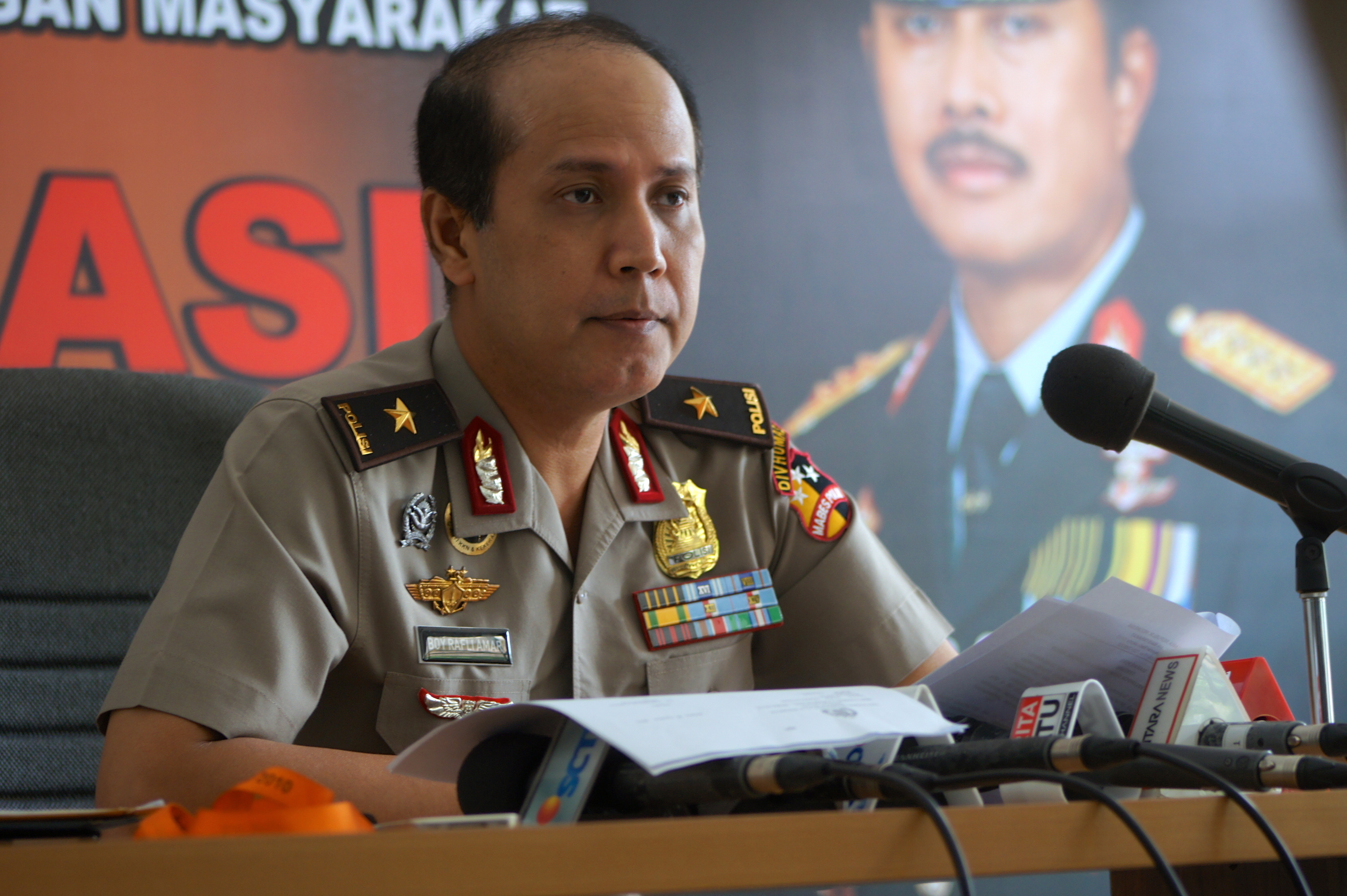
Boy Rafli Amar, National Police spokesman, told reporters on Tuesday that the youthful terror suspects in Solo had links to older extremist organisations. [Elisabeth Oktofani/Khabar].
A new breed of radical extremists is posing a security threat to Indonesia, officials and analysts say, citing a recent series of attacks in Solo as an example.
Two young men, Farhan Mujahidin (19) and Mukhsin Sanny Permady (20), were shot dead by counterterrorism police during an August 31st raid, after allegedly staging assaults on police posts. A third suspect, Bayu Setiono, is under arrest.
According to Brigadier General Boy Rafli Amar, spokesman for the National Police, the men appear to belong to a newly-formed extremist group – but one which is affiliated with long-standing terror networks, and with the hardline Jemaah Ansharut Tauhid (JAT) organisation.
Farhan, for instance, was the stepson of convicted terrorist Abu Umar, currently in prison for smuggling firearms from the Philippines to Indonesia, and for organising a paramilitary training camp in 2008.
In 2010, police say, Farhan resided in the Philippines, where his stepfather obtained support for launching a terrorist attack, including plans to attack the Singaporean Embassy in Jakarta.
Bayu also had a connection with the Philippines, according to police. They say he was involved in smuggling firearms and had joined the Al-Qaeda-linked Abu Sayyaf group.
Weapons seized during the August 31st raid included an Italian-made Beretta pistol stamped “PNP [Philippine National Police] property”. According to Boy, the suspects underwent physical training at Mount Merbabu in Boyolali district, and may have earlier received training in combat strategy at other camps in Aceh or Mindanao.
He said they targeted Solo, also known as Surakarta, because they were familiar with the location. But the city was just the starting point for a broader campaign of terror attacks.
“As they used to study at the Al-Mukmin Ngruki Islamic boarding school, they are familiar with the location and have contacts there where they can hide. Therefore, they could remove any trace of their presence more easily,” Boy said.
Andi Widjajanto, a security analyst from the University of Indonesia, told Khabar Southeast Asia on Wednesday (September 5) that terrorists have been targeting police and the Indonesian government ever since the execution of three Bali bombers in November 2008.
Amrozi, Ali Ghufron and Imam Samudra were found guilty and sentenced to death for their role in the 2002 Bali bombings, which killed 202 people. Speaking by phone to Khabar, acting JAT leader Mochammad Achwan denied that the terror suspects were members of his organisation.
“I have asked JAT members whether they knew the two suspects or not, but they said that they did not know them,” he said.”I am very upset that officials always link terror suspects with our organisation”.
JAT was founded by the firebrand cleric Abu Bakar Bashir, convicted in June 2011 and sentenced to 15 years in jail for helping to organise a jihadi training camp in Aceh. He is viewed as the chief ideologist and spiritual mentor of Jemaah Islamiyah (JI), implicated in the Bali bombings.
On Friday, Indonesian counterterrorism chief Ansyaad Mbai said that JAT was linked to the Solo attacks as well as a planned assault on the Indonesian Parliament in Jakarta.
“There are several small groups (whose) underground works are not related to each other, but they all came from the JI and the JAT,” he told the AFP news agency, citing information revealed by Bayu during interrogation
 Oktofani's Page