Victims of violence hope to change terrorist mindset

Khabar Southeast Asia

Victims of violence hope to change terrorist mindset

Sudirman Abdul Talib, 31, a victim of the 2004 Australian Embassy bombing, believes some terrorists do not understand the impact of their actions. [Elisabeth Oktofani/Khabar]

Sudirman Abdul Talib, 31, a victim of the 2004 Australian Embassy bombing, believes some terrorists do not understand the impact of their actions. [Elisabeth Oktofani/Khabar]

Those who have suffered at the hands of violent extremists believe some recruits will be moved to repent once they understand how terrorism destroys lives.

Victims of terrorism gathered on Sunday (September 8th) to commemorate a tragic episode in Jakarta’s recent history – namely, the 9th anniversary of the 2004 Australian Embassy bombing, which killed nine people and wounded at least 150 others.

“Many people might have forgotten [about the incident]. But I think it is important to make them aware that the terrorists’ victims do exist, and we are still struggling with the aftermath of the attacks,” said Mulyono Sutrisman, chairman of the Kuningan Forum, an association of people who have been affected by extremist violence.

Such atrocities must not happen again, he said at the event, which was sponsored by Alliance for Peaceful Indonesia (AIDA)

Sudirman Abdul Talib, 31, is a former security guard at the embassy. He lost his left eye in the attack and suffers from a permanent disability affecting both of his hands.

“As victims, we want to be involved in the government’s deradicalisation programme, in eliminating terrorism and preventing the growth of violent extremism in Indonesia,” Sudirman told Khabar Southeast Asia.

He believes that if all victims are united against terrorism and promote peace, it will make a difference in the future.

“We just want to be involved in making Indonesia more peaceful,” he added.

Sudirman, who now works as an administrative staff member for the security guard department, says he does not want to become a prisoner of the trauma he experienced. He believes his story can be used to change the minds of those who have been misled by violent and extremist groups.

“I have met a few former convicted terrorists. I told them about the impact of the terrorism. They were shocked and cried. They regretted their actions and apologised,” Sudirman said. “It is clear to see that sharing and explaining the impact of terrorism on the victims is an effective method to convince them [terrorists] to stop their actions.”

A crucial role in combating extremist notions

The director of AIDA, Hasibullah Satrawi, said that Indonesia has the potential to win the battle against terrorism – not only because of law enforcement efforts, but also because victims of terrorism have been willing to join in efforts to combat it.

“The victims play a strategic role in bringing Indonesia to a more peaceful place,” he said. Therefore, it is very important to empower the victims – whether mentally, physically, or financially.”

Al Chaidar, a terrorism analyst, agreed that those affected by violence have great potential to combat recruitment by extremist groups. He agreed that the government should involve victims of terrorist activity in deradicalisation programmes.

“By meeting and seeing the victims, the terrorists would consider the actions that they are going to take because they have seen the impact of their attacks,” he added.

Sudirman, the wounded security guard, says he is troubled that his hometown of Bima, in West Nusa Tenggara, is being appropriated by terrorists as a base for planning their attacks. In 2011, police raided the local Umar bin Khattab Muslib Boarding School, where they found bomb-making materials as well as weapons and jihadist videos.

“Bima is a very religious place,” Sudirman said. Muslims pray five times a day and have strong faith. As far as I know, they are not radical people. They need moderate religious leaders to tell them that Islam is actually a religion of peace,” he said.

Those vulnerable to the message of radical terrorists need to be aware of the consequences of violence, he reiterated. “They need to meet people just like us to show them the impact of terrorist acts. It is also hurting Muslims as well,” Sudirman said.

Indonesian police savvy about social media

Khabar Southeast Asia

Indonesian police savvy about social media

About 100 people attended the event, which brought together police, civil society and social media. Their collaboration is important in the face of growing cyber-crime [2013: Oktofani]

About 100 people attended the event, which brought together police, civil society and social media. Their collaboration is important in the face of growing cyber-crime [2013: Oktofani]

Police are using Facebook to increase public awareness about the law and cyber-crime, and to foster a closer relationship with citizens.

Indonesian law enforcement personnel are using social media to interact with citizens, and are also monitoring the use of online communication tools by criminal elements.

On May 16th, police hosted a Facebookers’ Meeting for followers of the National Police Facebook page, at the National Police Headquarters in Jakarta. The three-hour event was attended by approximately 100 people from various places including Jakarta, Bandung, and Jambi, Sumatra.

Launched in 2010, the National Police Facebook page has attracted more than 86,000 followers. The page contains important information for citizens: how to renew a vehicle registration, traffic conditions, traffic violations fine list, and the news on law enforcement operations.

Police are hoping to use social media to help citizens protect themselves amid an alarming growth of crime in cyberspace, officials said.

“We have been well aware that many criminals have been taking advantage of technological advances, including the growth of social media,” National Police spokesman Boy Rafli Amar told the gathering.

“It is very concerning for us because there are many crimes occurring and starting in cyberspace,” he added.

“A young girl was kidnapped by her boyfriend that she met on Facebook. Another example of cyber-crime is an online shopping fraud,” he said.

Some people use Facebook specifically to commit crimes, he warned. “Therefore, it is very important for us to anticipate it together,” Boy said. “By establishing regular communication with civil society on social networks, we hope that we can minimise the number of criminal victims.”

Indonesian police receive at least 800,000 reports of cyber-crime annually, according to The Jakarta Globe, which cited Sutarman, chief of detectives for the National Police.

“Cyber-crimes are often related to other crimes like terrorism funding and communication between terrorism suspects. And the intensity of the cyber criminals is also alarming,” The Globe quoted him as saying.

Raising awareness

Police used the gathering to raise awareness of Law No 11 of 2008 on Electronic Information and Transactions, Law No 22 of 2009 on the Mechanism of Vehicle Registration Licence Issuance and Renewal, and a 2008 law on Transparency of Public Information.

Top officials from the Jakarta Police (Polda Metro Jaya), representing the Traffic Directorate, the Division of Professionalism and Security, and the General Crimes Directorate, also addressed the group and fielded questions.

The primary issue raised by participants was extortion, which they said was practiced by some police officers, including traffic officers.

“If there is an officer who abused their position, society should report it to us. We would take serious action against them,” Hari Harnowo, a top official from the Division of Professionalism and Security (Propam), said in response.

Finding solutions together

One participant said he appreciated the chance to interact directly with police.

“This is a very good event because it gives us a chance to have a direct two-way communications with police,” Surbaini, a 50 year-old participant from Jambi, told Khabar Southeast Asia.

“In my opinion, we do not come here to blame police for the wrong doing that the police did. But we gathered here to talk about the issue and find a solution together,” he said.

Muslim, Christian leaders gather to seek common ground

Khabar Southeast Asia

Muslim, Christian leaders gather to seek common ground

Religious leaders from 16 Asian countries came to Jakarta for the February 26 – March 1st Conference of Muslim-Christian Religious Leaders of Asia, which emphasised that the two religions share a core teaching: love. [Photos: Elisabeth Oktofani/Khabar]

Religious leaders from 16 Asian countries came to Jakarta for the February 26 – March 1st Conference of Muslim-Christian Religious Leaders of Asia, which emphasised that the two religions share a core teaching: love. [Photos: Elisabeth Oktofani/Khabar]

International interfaith conference discusses need for dialogue, collaboration in tackling modern problems in the region.

Muslim and Christian leaders from 16 Asian countries pledged to work side by side to tackle present-day problems in the region at a recent conference here, grounding their common vision in religious teachings both share.

“Asia is currently facing serious problems of poverty and environmental degradation,” M. Nashihin Hasan, executive director of the International Conference of Islamic Scholars (ICIS), told Khabar Southeast Asia.

“Here, we are trying to find a solution based on religious values, and not secularism,” he added.

ICIS organised the four-day Conference of Muslim-Christian Religious Leaders of Asia, together with Indonesian Bishops Conference (KWI) and The Indonesian Communion of Churches (PGI).

Both the Qur’an and the Bible teach love of God and love of one’s neighbour. That shared teaching “provides a common ground for Muslims and Christians to work together for peace and harmony in this violence-torn world today”, a conference statement said.

Rejecting extremism

Held February 26th-March 1st at Jakarta’s Hotel Acacia, the gathering was attended by 120 Indonesians and 55 religious leaders from 16 countries, including Pakistan, Afghanistan, Timor-Leste, India and Malaysia.

Many participants stressed the need for dialogue among believers of different religions as a means to foster a culture of harmony and peace in Asia.

Religious leaders need to come together on a regular basis on the local level, and to have a clear process of identifying common problems, Monsignor Felix Machado, archbishop of Vasai, India, told the forum on its opening day.

“This collaboration must be founded on the rejection of fanaticism, extremism and mutual antagonisms which lead to violence,” he said. “Education is also an important tool to promote mutual understanding, co-operation and respect.”

The growing gap between rich and poor was another common theme.

“I often heard various problems which could be identified as social and economic injustice in Asia as the result of modern prosperity only enjoyed by a few people, while many are exploited and marginalised,” Bishop Felix said.

The importance of dialogue

The chairman of Muhammadiyah, Indonesia’s second-largest Muslim organisation, told Khabar he appreciated the event and hoped it would be fruitful.

Both Islam and Christianity value humanity and both “have a significant role in developing and anticipating the dynamic of Asia as the future of the world,” Din Syamsuddin told Khabar outside Istiqlal Mosque, during a visit there by conference participants.

Dialogue among moderate religious leaders is important to push the government to take serious action on eradicating religious conflict, he said. He voiced hope that in the future, the conference would also invite religious leaders from fundamentalist groups, so their voices can be heard.

Afghan participant Fazalghani Kakar said he wants to apply what he learned in his home community.

“Although we don’t have many religions in Afghanistan …. This conference is very important for us because we are all aware that Afghanistan has been in war these past three decades,” he said.

“We also need dialogue to get a mutual understanding both technically and also professionally to create tolerance among us,” Fazalghani said.

A path of moderation

In their concluding statement participants pledged to renew efforts to promote peace and justice, prevent violence and facilitate dialogue in situations of conflict.

“We believe that if human dignity is respected, human values are promoted and the path [to] dialogue remains open, conflict can be avoided in every circumstance,” it said. “…A path of moderation and a pedagogy of persuasion are more in keeping with the Asian genius than the use of force or mutual denunciation.”

Conference participants understood such goals cannot be instantly achieved.

“We do not want to be in a rush,” Nashihin, of ICIS, said. “Perhaps, we would hold another meeting within three years to see the result of the implementation of our agreement.”

Disenchanted with politics-as-usual, Indonesians pine for change

Khabar Southeast Asia

Disenchanted with politics-as-usual, Indonesians pine for change

The face of politics is changing, thanks to a stronger role for the media – and a new crop of candidates who know how to harness it.

With one year to go before the 2014 presidential election, Indonesians appear to be in the mood for change. Polls show a relative newcomer – Jakarta governor Joko Widodo (nicknamed Jokowi) – ahead of other potential candidates, including several well-established figures.

The results reflect an ongoing trend in Indonesian politics, analysts say. The traditional party machinery is losing its potency as a new generation of media-savvy politicians is better able to harness public opinion.

Citizens, meanwhile, are increasingly distrustful of political elites and determined to elect politicians who will remain close to their interests.

In its latest opinion survey, Pusat Data Bersatu (PDB) polled 1,200 respondents from 30 provinces. Jokowi garnered 21.2% support, the largest percentage for all the potential candidates. Behind him were several political veterans — former vice president Jusuf Kalla, former president Megawati Sukarnoputri, Great Indonesian Movement (Gerindra) Party figure Prabowo Subianto, and Golkar Party Chairman Abu Rizal Bakrie, among others.

Didik J. Rachbini, a political expert at PDB, said the results showed a clear trend.

“Citizens want a new figure for the 2014 presidential election, and it appears that Jokowi is that figure,” Didik told Khabar Southeast Asia.

However, he added, the rising political star will first need to demonstrate a strong performance in his current job, including by taking charge of the flooding situation in Jakarta.

Media appeal becoming crucial

Burhanuddin Muhtadi, a political analyst with the Indonesian Survey Institute (Lembaga Survey Indonesia/LSI), agreed that the electorate wants someone new.

“Citizens are looking for a figure who is firm, has no distance from the citizens, [and is] unpretentious,” he told reporters.

Jokowi’s popularity has swelled since he took over the city governorship, a role which brings frequent media appearances, Burhanuddin said.

Moreover, he added, the governor has received positive coverage of his education and health care initiatives, the Kartu Jakarta Pintar (Jakarta Education Card/KJP) and Kartu Jakarta Sehat (Jakarta Health Card/KJS).

The KJP provides students with as much as Rp 240,000 ($25) per month for education-related expenses such as books, uniforms, and transportation. Bank DKI refills the card every month with provincial government funds. Similarly, the KJS provides free health care access, especially for those in need.

Although previous governors ran similar initiatives, Jokowi has proven particularly effective at making citizens aware of them, Burhanuddin said.

“He knows how to maintain public optimism,” he said.

Jokowi is not the first politician in this mold, the analyst said. Indonesia’s current president, Susilo Bambang Yudhoyono, demonstrated a similar appeal during his campaign eight years ago, relying more on a strong media presence than on the traditional workings of party machinery.

“Back in 2004, President Susilo became a media darling with his personality and intellect. He is also very friendly with the media,” he added. In general, he added, “political parties are no longer able to claim that they are the only funnels to represent the public’s preference”.

Disenchantment grows with politics-as-usual

Muhammad Yusuf, an 18-year-old Pemalang resident, told Khabar he wants a new president who remains close to the people. “I think we need a smart figure and humble, just like Governor Jokowi,” Muhammad said.

Hilary Desuari, a 25 year-old Yogyakarta resident, told Khabar, “I find it difficult to trust the political elite.” Jokowi, she said, may be a viable candidate “because he does real work and solves many problems.”

Willy Bordus Tatag Hastungkoro, a 24 year-old Jakarta resident who originally hails from Central Java, said Indonesia needs a president who has a vision for the country, and not just for a political party.

“I think that we need a figure with a good mindset to protect and develop the public’s interests mandated by Pancasila, our guiding principles,” he said.

Prisoners’ products a source of pride, income

Khabar Southeast Asia

Prisoners’ products a source of pride, income

Ade, 37, demonstrates his skill making footballs at the Napi Craft 2012 exhibit in Jakarta. Income from sale of prisoners' products will be given to them upon their release, according to officials from the Directorate General of Corrections. [Photo by Clara Prima/ Khabar]

Ade, 37, demonstrates his skill making footballs at the Napi Craft 2012 exhibit in Jakarta. Income from sale of prisoners’ products will be given to them upon their release, according to officials from the Directorate General of Corrections. [Photo by Clara Prima/ Khabar]

Ade, a 37-year-old prisoner at Cirebon Class One Prison, recently had the opportunity to demonstrate his skill making footballs at the Napi Craft 2012 exhibition in Jakarta.

The event held December 17-21st at the East Building, Mega Kuningan, South Jakarta, was intended to show that inmates – napi – can be creative, innovative and productive.

Ade, who is serving a six-year sentence, said he enjoys making footballs because it allows him to develop his abilities and keep busy.

The father of a six-year-old boy is also hoping to use his skill to work in a factory or establish his own business when he is released from prison two years from now.

“I can make four to five footballs in a day. If the material is soft, it only takes me an hour to make one football,” Ade told Khabar Southeast Asia.

Some 149,873 inmates are incarcerated across Indonesia, according to the Ministry of Justice and Human Rights, which sponsored the exhibit.

“That number has great potential and can be used to produce certain types of products. So it also can support government programmes in economically creative ways,” said founder of Napi Craft 2012 Evi Amir Syamsuddin during its December 17th opening. She is wife of Minister of Justice and Human Rights Amir Syamsuddin.

“Other than that, the exhibition is also expected to improve the inmates’ quality of life as well as their welfare – especially for those who join the Prisoners’ Workshop,” or Bengkel Kerja Naripidana,” she said.

Ismail Nasrul, a public relations representative from the Directorate General of Corrections, told Khabar his department is putting greater emphasis on marketing prisoner products to help motivate inmates to join the skills training workshops.

Though many inmates think the training is a waste of time, he said, because they are unsure how to market what they make, false eyelashes made in West Java’s Garut Penitentiary have already found customers in Taiwan, Switzerland and China.

“Through this exhibition, we wanted to show to them that their products can be appreciated and recognised by society,” he said. “It needs to be understood that getting recognition will motivate them to improve the quality of their product.”

In total, more than 1,500 products were displayed at Napi Craft 2012, including artwork, false eyelashes and synthetic rattan chairs. On the third day, six paintings ranging in price from Rp. 5m ($518) to Rp. 17m ($1,761) were sold.

“The income from the sale will be given to the inmates upon their release. They will have their own money to start a new life because not all of them will be simply accepted by their own family,” Ismail said.

Arum Wahyuni, 26, an exhibition visitor, said she was impressed with several of the products. “I would say that many of the handmade crafts are properly made. It is also amazing that those fake eyelashes, which were made by prisoners, are exported to other countries,” she said.

“I just hope that when they are released from prison, they use their skills to start a new, creative and innovative life, especially knowing that they have the ability to be a better person,” Arum added.

Small change is good business ahead of Lebaran

Khabar Southeast Asia

Small change is good business ahead of Lebaran

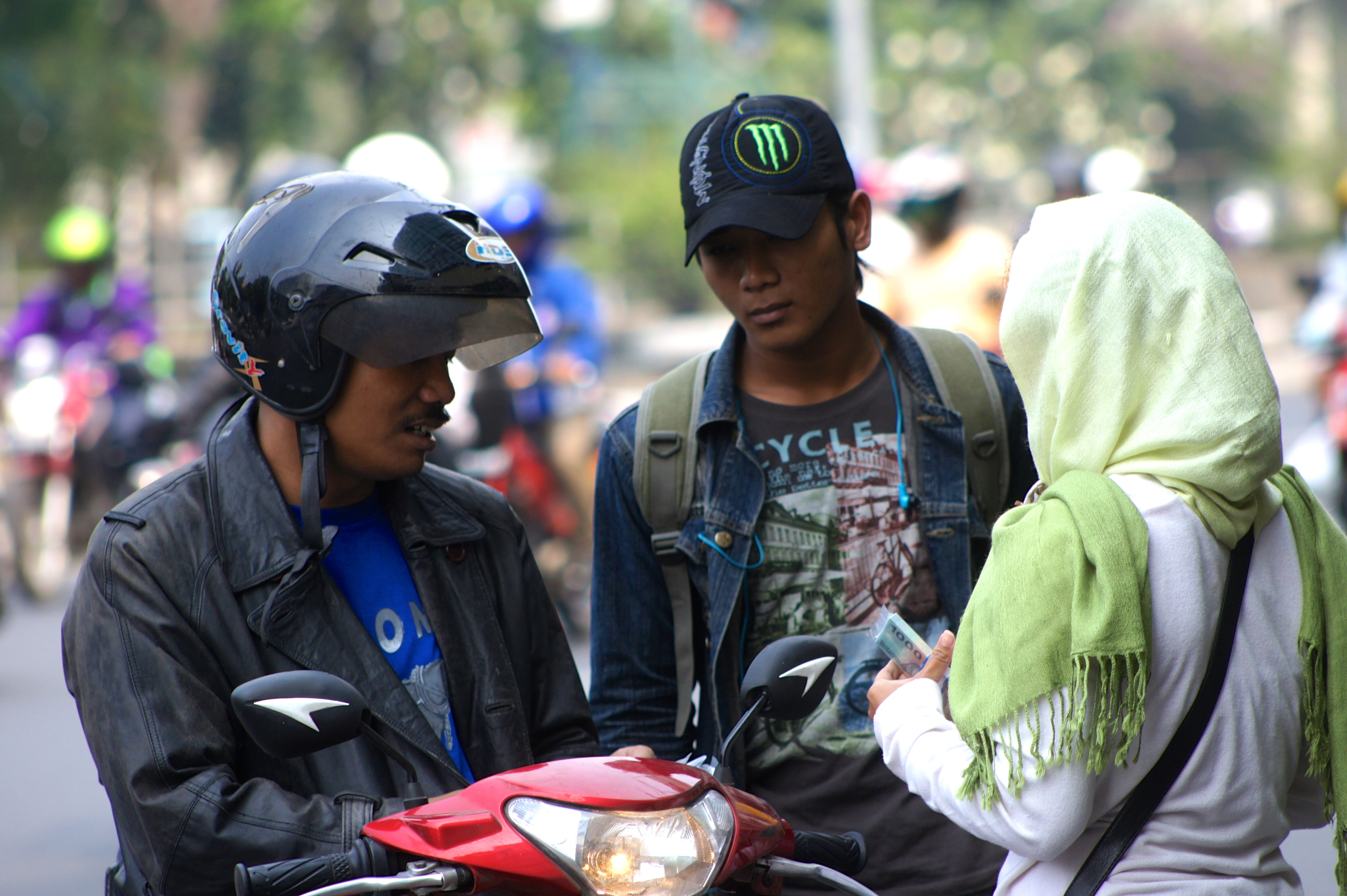
Rukmiyati, 34, and her customers do a money transaction on Jalan Gajah Mada in Central Jakarta on August 14th. Despite the fee charged, many Indonesians visit street peddlers to exchange their large bank notes for small ones for gift giving on Idul Fitri.[Elisabeth Oktofani/Khabar]

Small gifts of money make Idul Fitri sweet for youngsters. Many Jakarta residents get their small change for a small fee on the street, though some frown on such businesses.

As the Chinese do on Chinese New Year, it is common among Indonesian Muslims for older relatives to give small sums of money to younger relatives after the children wish them a happy holiday on Idul Fitri

That tradition has created a business opportunity for people such as Iphan, 32, and Rukmiyati, 34, who on a recent day were selling small change – exchanging large denomination notes for small ones, for a small fee – to customers on Jalan Gajah Mada in Central Jakarta.

“I’m actually new in this business. I just started three weeks ago. In one day, I can make 300,000 rupiah ($32) in profit,” Iphan, who is originally from Medan, North Sumatra, told Khabar Southeast Asia.

“But it depends on how many customers I get per day. Basically, I can make 5 to 15 % profit from each transaction,” he added.

Iphan explains that every day he receives as much as 10 million rupiah ($1,053) from an agent, who takes a cut of his earnings.

First, he needs to go to the bank to exchange the big notes for small ones: 1,000, 5,000 and 10,000 rupiah notes (10 cents, 50 cents and $1.05).

Because of the high demand at this time of year, Bank Indonesia, in collaboration with nine other banks, opened a mobile small-change service out of a vehicle at the National Monument (Monas) in Central Jakarta, which operated from July 23rd to August 16th.

“Every day, I need to wait in line at the small-change service in the National Monument (Monas) Park, Central Jakarta. But unfortunately, we are only allowed to change up to 5 million rupiah ($527),” Iphan said.

“So that is why I also change the money with an agent,” he continued.

Even though banks make change for free, many Indonesians patronise street vendors for their small cash needs because of the convenience.

Rukmiyati, who has been working in the business for the last four years, told Khabar that she would make less profit if she changed the money with an agent.

She said she prefers to queue at the bank to get small change, even if she has to do it twice in a single day, because the agent will take an additional cut of her profit, shaving a 15% margin to 5%.

“That is why it is better to change it in the bank,” she said.

There is another reason to rely on banks, authorities say: they can vouch that the currency is real.

Questioned about the source of her capital, Rukmiyati said she did not know where the agent got the money. She believes it came from a bank.

Difi Johansyah, a spokesman for Bank Indonesia, told Khabar that informal small-change services are not banned because there are no regulations against them.

“We are aware that there are informal money changers in public places such as traditional market or side streets. Bank Indonesia will not prohibit them from doing business. However, we suggest the citizens not change the money with an informal money changer service because the authenticity is not guaranteed,” he explained.

Many Muslim religious leaders from the Indonesia Council of Ulema (MUI) consider money changing in the street “haram”. Such transactions are forbidden in Islam because of the fees charged. But MUI has not issued any fatwa banning the practice among the Muslim community.

Iphan, who worked as a laborer for 10 years in Jakarta before losing his job six months ago, told Khabar that he sells small denomination banknotes to support his family.

“If MUI said it is haram, then that is not really my problem. I have to provide food for my family. It is very difficult to find a proper job these days, and I heard about this seasonal business so I decided to join with my friend,” he said.

Many small-change vendors in Jalan Gajah Mada wear face masks, in part because they feel a little shame, Rukmiyati said.

However, “The main reason is to avoid breathing the bad pollution as big bus and trucks are passing by this road,” she said.

Islamist vigilantes lead teens into trouble

Khabar Southeast Asia

Islamist vigilantes lead teens into trouble

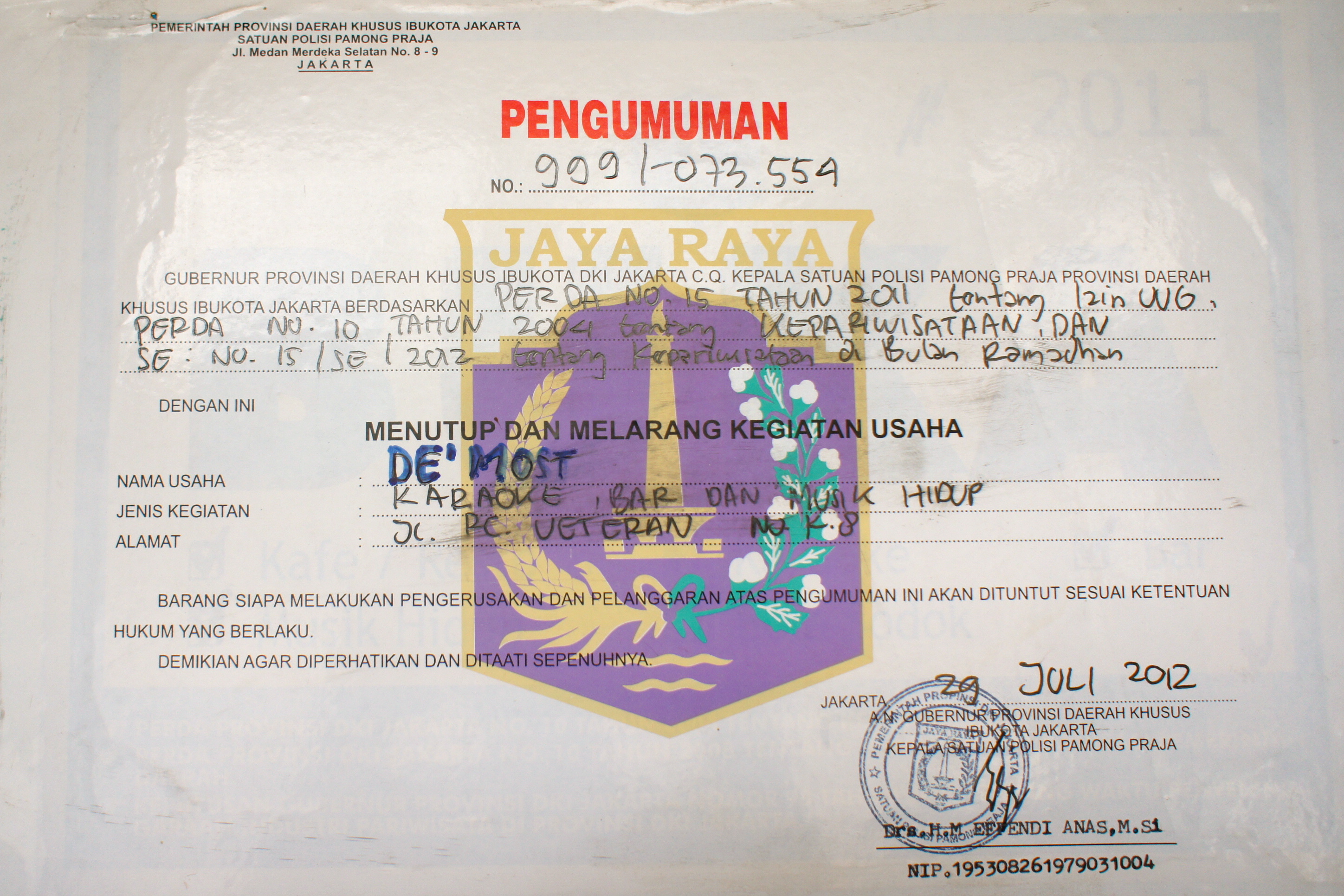
A July 29th police notice posted on the door of Café de’Most bans it from operating based on local laws governing entertainment venues during Ramadan. [Elisabeth Oktofani/Khabar]

A hardline group that raided a bar in late July recruited local teens for the illegal attack. Two of them now face prison time.

Jakarta residents are applauding police for arresting members of a hardline group that raided a bar for serving alcohol during Ramadan, and enlisted teenagers for the illegal vigilante attack.

About 150 members of the Prophet’s Defender Council (Majelis Pembela Rasulullah, or MPR) swarmed into Cafe’ de’Most in South Jakarta late on July 28th and ransacked it, shattering windows, breaking bottles, and assaulting employees.

Police apprehended the group as they left the club on motorbikes, and seized a machete, a sickle, four samurai swords, a golf club and four wooden poles, as well as musical instruments stolen from the bar.

“We arrested 62 people. But we released 39 juveniles without charges because they were not directly involved in attacking the bar,” South Jakarta police chief, Senior Commander Imam Sugianto, told Khabar Southeast Asia.

Among the 23 not released were two juveniles who were carrying a sickle and a machete, Imam said.

“They could face up to six years in prison under the Emergency Law No 12, 1951 for carrying weapons, and two and half years for destroying private property,” he said. Also arrested was MPR’s 29-year-old leader, Habib Bahar bin Smith, who organised the attack and was able to influence minors to take part in it, according to Imam.

Bahar and another adult identified only as S.Y. have been charged with the same offenses as the teenagers but face up to 12 years in jail terms because they are adults.

The remaining suspects were charged with aggravated assault on several bar employees and could face up to five and a half years in prison.

Mia Trisnawati, a waitress at a bar in South Jakarta, was happy to hear it.

“I have always been afraid to work during the fasting month because a number of hardline groups have threatened bars and night clubs,” Mia told Khabar.

“But I think that the police have done something different to protect their citizens by arresting the hardline group that acted as if they were the police with their raid,” Mia said

Vigilante organisations, notably the Islamic Defenders’ Front (FPI), say they are acting to protect Islam, but critics say their tactics are violent, illegal and also redundant, as authorities have already moved to limit the activities and operational hours of nightclubs and other entertainment venues during Ramadan.

In fact, police shut down Café de’ Most on July 29th because it was selling alcohol during Ramadan in violation of local regulations.

The involvement of minors in the raid is a cause for special concern. Arist Merdeka Sirait, Chairman of the National Commission for Child Protection, said parents and officials must declare a campaign against violence in society and make efforts to deter teenager involvement.

“Basically, teenagers tend to copy their idol’s behaviour. Therefore, it is very important for us, parents, teachers, government and religious leaders, to show how to live in peace and omit violence from daily life,” he told Khabar.


Jazz stars bring their talents to Jakarta mosque

Khabar Southeast Asia

Jazz stars bring their talents to Jakarta mosque

Producers of the Ramadan Jazz Festival say music can be a form of preaching, reaching out to young people, and showing them that mosques can be cool.

For two nights in late July, the Cut Meutia Mosque compound in Jakarta rang with swinging sounds as Indonesian jazz musicians and groups entertained thousands at the second annual Ramadan Jazz Festival.

“We want to send a message to Muslim youth that the mosque is actually a cool place for Muslim youth to hang out,” said Agus Setiawan of Jakarta-based jazz promoters Warta Jazz, which produced the festival together with the Cut Meutia Mosque Islamic Youth Association (RICMA).

“The mosque is actually not only a worship place. It is also a place to socialise,” Agus added.

Jazz is very popular among young Muslims in Jakarta, he said.

“The Q’uran verse says, ‘Preach with your own people’s language.’ Hence, we use jazz music as a medium to preach and approach young people, so there would be more Indonesian youth coming to the mosque more often,” he said.

Gilang Widodo is a 22-year-old who came to pray and lingered for jazz.

“I am not a big fan of jazz music. But I found this jazz festival to be unique because we could enjoy jazz music in a mosque after Taraweeh prayers, which is very unusual,” he said, referring to a special prayer said during Ramadan. “I decided to stay here to watch it.”

A focus on tolerance

This year’s festival featured 16 prominent Indonesian jazz musicians. They included Dwiki Dharmawan, Idang Rasjidi, Payung Teduh, Tompi, Endah N. Rhesa, Ari Pramudito, Barry Likumahuwa and also Jilly Likumahuwa.

Coming from different backgrounds, they brought diversity and high-calibre talent to an event where the emphasis was on religious as well as musical harmony.

“Through the Ramadan Jazz Festival, we want to share the spirit of togetherness without being concerned about our differences,” said Agus, the Warta Jazz representative.

“We want to show that Islam is a tolerant religion. For example, we not only invited Muslim jazz musicians, but also Christian jazz musicians such as Barry Likumahuwa and also Jilly Likumahuwa,” he explained.

The first Ramadan Jazz Festival, held in 2011, attracted 2,500 young audience members from the greater Jakarta area. This year, attendance at the July 27th-28th event topped 4,000.

Audience members also helped support local libraries. Instead of purchasing a ticket, those attending the event were asked to donate a children’s book.

Andhika Mauludi, a RICMA spokesman who chaired the event, told Khabar the books will be donated to ten libraries in East Nusa Tenggara Province.

“Every book was exchanged for an entrance ticket. For those who did not bring books, we sold a donation ticket for a nominal 20,000 rupiah ($2). The money will be used to buy more books,” he said.

“Last week, we were able to collect 1,600 books, which was more than our target of 1,000. We also raised one million rupiah ($106) in donations,” he said.

The books will be examined prior to delivery to ensure that none contains portrayals of violence, racism, or other sensitive issues, he said. RICMA plans to sort them that after Idul Fitri (Eid Mubarak). Then, they will be donated through the non-profit Sabantara Community at the University of Indonesia, which has a book donation programme.

Islam for a new generation

Andhika told Khabar that RICMA has been using non-conventional approaches to engage young Indonesian Muslims since the early 1990s.

“The jazz festival is actually not our first modern approach to preaching. Previously, we have held events such as Bike to Mosque and the Jakarta Islamic Fashion Guide,” he went on.

He believes that these are some of the best ways to reach Indonesian youth.

“We hope that by using a modern approach, we could attract as many young Muslims as possible to come to the mosque more often and be active and involved in mosque activities,” Andhika explained.