Muslim, Christian leaders gather to seek common ground

Khabar Southeast Asia

Muslim, Christian leaders gather to seek common ground

Religious leaders from 16 Asian countries came to Jakarta for the February 26 – March 1st Conference of Muslim-Christian Religious Leaders of Asia, which emphasised that the two religions share a core teaching: love. [Photos: Elisabeth Oktofani/Khabar]

Religious leaders from 16 Asian countries came to Jakarta for the February 26 – March 1st Conference of Muslim-Christian Religious Leaders of Asia, which emphasised that the two religions share a core teaching: love. [Photos: Elisabeth Oktofani/Khabar]

International interfaith conference discusses need for dialogue, collaboration in tackling modern problems in the region.

Muslim and Christian leaders from 16 Asian countries pledged to work side by side to tackle present-day problems in the region at a recent conference here, grounding their common vision in religious teachings both share.

“Asia is currently facing serious problems of poverty and environmental degradation,” M. Nashihin Hasan, executive director of the International Conference of Islamic Scholars (ICIS), told Khabar Southeast Asia.

“Here, we are trying to find a solution based on religious values, and not secularism,” he added.

ICIS organised the four-day Conference of Muslim-Christian Religious Leaders of Asia, together with Indonesian Bishops Conference (KWI) and The Indonesian Communion of Churches (PGI).

Both the Qur’an and the Bible teach love of God and love of one’s neighbour. That shared teaching “provides a common ground for Muslims and Christians to work together for peace and harmony in this violence-torn world today”, a conference statement said.

Rejecting extremism

Held February 26th-March 1st at Jakarta’s Hotel Acacia, the gathering was attended by 120 Indonesians and 55 religious leaders from 16 countries, including Pakistan, Afghanistan, Timor-Leste, India and Malaysia.

Many participants stressed the need for dialogue among believers of different religions as a means to foster a culture of harmony and peace in Asia.

Religious leaders need to come together on a regular basis on the local level, and to have a clear process of identifying common problems, Monsignor Felix Machado, archbishop of Vasai, India, told the forum on its opening day.

“This collaboration must be founded on the rejection of fanaticism, extremism and mutual antagonisms which lead to violence,” he said. “Education is also an important tool to promote mutual understanding, co-operation and respect.”

The growing gap between rich and poor was another common theme.

“I often heard various problems which could be identified as social and economic injustice in Asia as the result of modern prosperity only enjoyed by a few people, while many are exploited and marginalised,” Bishop Felix said.

The importance of dialogue

The chairman of Muhammadiyah, Indonesia’s second-largest Muslim organisation, told Khabar he appreciated the event and hoped it would be fruitful.

Both Islam and Christianity value humanity and both “have a significant role in developing and anticipating the dynamic of Asia as the future of the world,” Din Syamsuddin told Khabar outside Istiqlal Mosque, during a visit there by conference participants.

Dialogue among moderate religious leaders is important to push the government to take serious action on eradicating religious conflict, he said. He voiced hope that in the future, the conference would also invite religious leaders from fundamentalist groups, so their voices can be heard.

Afghan participant Fazalghani Kakar said he wants to apply what he learned in his home community.

“Although we don’t have many religions in Afghanistan …. This conference is very important for us because we are all aware that Afghanistan has been in war these past three decades,” he said.

“We also need dialogue to get a mutual understanding both technically and also professionally to create tolerance among us,” Fazalghani said.

A path of moderation

In their concluding statement participants pledged to renew efforts to promote peace and justice, prevent violence and facilitate dialogue in situations of conflict.

“We believe that if human dignity is respected, human values are promoted and the path [to] dialogue remains open, conflict can be avoided in every circumstance,” it said. “…A path of moderation and a pedagogy of persuasion are more in keeping with the Asian genius than the use of force or mutual denunciation.”

Conference participants understood such goals cannot be instantly achieved.

“We do not want to be in a rush,” Nashihin, of ICIS, said. “Perhaps, we would hold another meeting within three years to see the result of the implementation of our agreement.”

Indonesia hopes to become world leader in “Sharia tourism”

Khabar Southeast Asia

Indonesia hopes to become world leader in “Sharia tourism”

Riyanto Sofyan, president-commissioner of the Sofyan Hotel chain, says revenue has increased ahead of the industry as a whole ever since the hotels converted to a Sharia-based system. [Elisabeth Oktofani/Khabar]

Riyanto Sofyan, president-commissioner of the Sofyan Hotel chain, says revenue has increased ahead of the industry as a whole ever since the hotels converted to a Sharia-based system. [Elisabeth Oktofani/Khabar]

With Muslim vacationers seeking a holiday experience that accords with their values, the archipelago could become a top destination for this niche market.

Hoping to tap a burgeoning market among devout Muslims, Indonesia’s government has teamed up with religious leaders to develop “Sharia tourism”, which seeks to provide participants with a holiday experience that is aligned with Islamic values and beliefs.

A key milestone was reached in December when the Ministry of Tourism and Creative Economy (MTCE) signed a Memorandum of Understanding with the Indonesian Ulema Council (Majelis Ulama Indonesia/MUI), on a programme to foster this form of tourism. The government hopes to launch the initiative by June or July.

“Basically Sharia tourism is a concept [involving] leisure accompanied by religious values. It provides facilities and services closest to the values of Islam,” Firmansyah Rahmin, director general of destination development for the MTCE, told Khabar Southeast Asia.

This emerging form of tourism is not the same thing as a religious pilgrimage, a practice that has existed for centuries. Rather, it entails providing a travel environment aligned with Muslim observances.

“It needs to be understood that Sharia tourism is different from a religious trip,” Rahmin said.

Qur’an in each room, no liquor in restaurant

The Sofyan Hotel chain, headed by Riyanto Sofyan, is one of the pioneers behind the concept.

“We provide a Qur’an, Muslim prayer rug and directions for praying in every room. We provide toilets with sprinklers. We also don’t sell any alcohol or pork in our restaurant,” explained Riyanto, who is also chairman of the Indonesian Sharia Hotel and Restaurant Association (AHSIN).

Since converting to a Sharia-based model in 1994, he added, the chain’s revenues have increased by 15% to 20% each year.

“Our revenue is above the growth of the industry, which is only 10% a year,” he told Khabar.

In 1998, Sofyan Hotel closed down its nightclub and discotheque. In 2000, they stopped selling alcohol. And finally in 2002, it started to screen guests to ensure they are not using the hotel for activities prohibited by Islam. For example, unmarried couples are not permitted to stay.

“Guest selection is conducted to determine whether a couple who is going to check in is a married couple, family or an unmarried couple. If they are an unmarried couple and going to stay a short time, we will politely reject them,” Riyanto said.

According to Riyanto, Sofyan Hotel rejects approximately 1,000 to 2,000 guests every year.

Although it adheres to the Sharia code, he said, it welcomes business from members of other faiths who are willing to comply with the guidelines.

“A Sharia hotel is not exclusive for Muslims only. It’s open to anyone, whatever their race, religion or ethnicity as long as their activities do not violate any regulation,” he said.

Increased prospects as industry booms

Businesses such as Sofyan Hotel are benefitting from what appears to be a growing international trend, according to industry data.

According to Crescentrating, a halal-friendly travel and tourism consultant, the world’s Muslim travellers contributed as much as $930 billion to the tourism industry in 2009 (the latest).

According to country’s Directorate General of Marketing, meanwhile, approximately 1.3 million foreign Muslims visited Indonesia in 2010. Riyanto said 18% of those were interested in Sharia tourism.

“Interestingly most Muslim travellers were not only coming from the Middle East but also Europe, Australia, Japan, and China. The potential Sharia market in the tourism industry remains virtually untapped,” he said.

An MUI representative contacted by Khabar said the Islamic organisation is excited about the trend, but cautioned that Indonesia’s religious diversity must be taken into account.

“MUI is very supportive of the development of the tourism business,” said the representative, Slamet Effendy Yusuf.

But Sharia tourism, he added, is not appropriate for all parts of Indonesia because of cultural differences.

“Definitely Sharia tourism cannot be implemented in Bali or Manado (where Muslims are in the minority). However, it can be implemented in places such as East Java or Lombok. Therefore, we should be wise in implementing it,” Slamet said.

According to Zoraida Ibrahim, the director of the tourism industry at the MTCE, following the Sharia code is a “lifestyle” that is proving more and more popular.

She stressed, however, that there is no obligation in Indonesia for all tourism-related businesses to follow Sharia-based practices, despite the growing trend.

In Indonesia, continuing debate over “female circumcision”

Khabar Southeast Asia

In Indonesia, continuing debate over “female circumcision”

G.K.R Hemas, the queen of Yogyakarta, has urged the government to revoke the 2010 Ministry of Health Regulation that legitimises the practice of female genital mutilation and authorizes medical professionals to perform it. [Elisabeth Oktofani/Khabar]

G.K.R Hemas, the queen of Yogyakarta, has urged the government to revoke the 2010 Ministry of Health Regulation that legitimises the practice of female genital mutilation and authorizes medical professionals to perform it. [Elisabeth Oktofani/Khabar]

The OIC says Islam does not support the practice and the UN has condemned it. What stance will Indonesia take?

Despite growing international condemnation of female genital mutilation, the Indonesia Ulema Council (MUI) is urging the government to resist any international or domestic pressure to ban the practice it calls female circumcision.

“On the issue of female circumcision, we do not consider it compulsory, but we forbid any action to ban it,” MUI Chairman Ma’ruf Amin told a January 21st press conference on the subject at MUI’s Central Jakarta office, according to multiple media reports.

He said that in recent times more medical practitioners have refused to perform female circumcisions, and he urged the government to act decisively against such individuals, based on its 2010 Health Ministry regulation on the practice, which effectively legitimises female circumcision and authorise medical professionals to perform it, the Jawa Pos National Network reported.

“Because we support that regulation, we ask the government not to heed any effort by any party that wants circumcision banned in Indonesia,” he said, according to Detik News.

“Circumcision is a part of Islamic teaching that is highly recommended for Muslims, whether male or female,” he said, adding that the law on the matter calls for specific procedures which, he claimed, do not damage the clitoris.

“The procedure for female circumcision according to Islamic teaching is removal of only the membrane, or in medical terms preputium [the clitoral hood] that covers the clitoris,” he said.

“It needs to be understood that Islamic teaching prohibits the female circumcision practice which is done by cutting or injuring the clitoris, as it is dangerous.”

Mixed messages

The government has issued mixed messages on female circumcision. In 2006, the Ministry of Health banned it as potentially harmful. But in 2010, it issued guidelines on how the procedure should be done, raising the ire of some women’s rights activists.

Gusti Kanjeng Ratu Hemas, the queen of Yogyakarta, believes the government must revoke the 2010 regulation effectively legitimising female circumcision and authorizing medical professionals to perform it.

“I am very certain that the 2010 regulation on female circumcision was issued because there was a big pressure from religious organisations to the Ministry of Health. Even recently, the MUI has demanded the government lift the ban on female circumcision,” she told Khabar Southeast Asia.

“I think that all the parties, which are involved, should have a wider point of view on female circumcision, particularly from the health point of view,” she said.

It is not known how many Indonesian girls undergo female circumcision, which is believed to reduce sexual desire and prevent promiscuity, and encompasses a wide range of practices in Indonesia, from cutting a small part of the clitoris to scratching it to pressing spices on the genitals.

Suratningtyas, a 46-year-old midwife at a private hospital in Depok, West Java, told Khabar that some parents do ask the hospital for female circumcision.

“I cannot reject their request because we are allowed to do it. But we make sure to do it properly so it will not harm the baby girl,” she said.

Condemned by the OIC

At odds with developments in Indonesia, there is growing international consensus against the practice of female genital mutilation.

On December 20th, 2012, the United Nations General Assembly adopted its first-ever resolution on the female genital mutilation, urging states to “take all measures — including legislation — to protect women and girls from this form of violence”.

Earlier the same month, speaking in Jakarta at the opening of a conference on women in development, Organisation of Islamic Co-operation (OIC) Secretary General Ekmeleddin Ihsanoglu called on OIC member states to prohibit the practice.

“This practice is a ritual that has survived over centuries and must be stopped, as Islam does not support it,” he said, according to reports in OnIslam.net and Tempo. “Female genital mutilation is a violation of human rights of girls and women.”

A weak theological basis

The theological basis for female circumcision is a weak hadith, according to Maria Ulfah Anshor, secretary general of Alimat (the Movement for Indonesia Family Justice) and former chairwoman of the woman’s wing of Nahdlatul Ulama, Indonesia’s biggest Muslim organisation.

“The hadith said that circumcision is sunnah for men [highly recommended] and makrumah for women [voluntary but meritorious]. Hence it cannot be used as a theological basis to conduct female circumcision, because it is optional,” she told Khabar.

The government does not need to regulate it, nor should it ban medical professionals from giving the service to a Muslim family that requests it, she said. But she said it is unfortunate that female circumcision is often conducted on infants, meaning that girls have no say in whether they want to undergo an optional practice.

“It is against human rights,” she said.

A Javanese tradition

Javanese tradition includes a ceremonial form of circumcision conducted without removing or harming the female body in any way, G.K.R Hemas told Khabar in an exclusive interview.

“Female circumcision in Javanese tradition is very different with what happened in other places. It is done by holding on to a piece of fresh turmeric on female genitals,” she said. Later the turmeric and other offerings are thrown to the rivers, she added.

The ceremony is conducted twice, at the age of five and when a girl begins to menstruate. These days, such ceremonies are rarely carried out in Javanese society, except for royal family members at the Yogyakarta sultanate.

“Once again, there is no woman’s body part which is being removed or harmed from those two traditions,” she added.

Proposed ban on straddling motorcycles criticised

Khabar Southeast Asia

Proposed ban on straddling motorcycles criticised

A Muslim scholar is among those expressing doubt that the prohibition will make women safer.

A planned regulation banning female passengers from straddling motorcycles in Lhokseumawe, Aceh has sparked criticism from Indonesians, including a leading Muslim scholar who says it does not reflect the spirit of Sharia law.

Suaidi Yahya, the mayor of Aceh’s second largest city, said earlier this month he would issue the regulation because “it’s improper for women to sit astride. We implement Islamic law here.”

“Women sitting on motorbikes must not sit astride because it will provoke the male driver. It’s also to protect women from an undesirable condition,” Suaidi told AFP on January 2nd.

He said women could face forward in an emergency situation, or if they are driving, as long as they are dressed “in a Muslim way”.

His administration has started distributing handouts throughout the municipality to inform residents of the new policy before the plan is legally implemented in a few months, he said.

Unsafe for riders?

The plan has sparked widespread criticism from Indonesians who say it is unsafe.

Cut Fitriani, 34, an Acehnese woman who moved from Aceh to Jakarta in the last two years, told Khabar that the Lhoksumawe administration has demonstrated ignorance of safe driving principals.

“I don’t see that the regulation is very Islamic. Instead, it puts women in a dangerous situation. I believe that drivers will have difficulty keeping their balance,” she said.

Jusri Pulubuhu, a founder of Jakarta Defensive Driving Consulting (JDDC), told Khabar his group strongly suggests that motorcycle passengers sit facing forward.

“When you are driving a motorcycle, you have to know how to keep it stable and balanced,” Jusri said.

“When a motorcycle passenger is sidesaddle, it would be difficult for the passenger to find a safe position because her two legs would not be within the handlebar area,” he added.

“One of the safety requirements of driving a motorcycle is that any object or passenger must stay within the handlebar area.”

Protecting citizens

Siti Musdah Mulia, chairwoman of the Indonesian Conference on Religion and Peace (ICRP), argued that the regulation has nothing to do with Sharia Islam and it puts female passenger in danger.

Further, she argued that the bylaw is incompatible with the spirit of Sharia.

“A regulation must give a protection to the citizen, instead of putting the citizen in danger. Even during the prophet period, the prophet’s wife was sitting forward-facing while they were riding a camel,” she said.

“Therefore, I do not think that there is a theological reason for this regulation,” she added,

By implementing Sharia Islam, the local government must improve the welfare of its citizens. That is what being an Islamic society means, Siti told Khabar.

Central government review

Home Affairs Minister Gamawan Fauzi said the central government will review the planned bylaw, and could annul it.

“[It will be reviewed] whether the bylaw is too much or [whether] it is to maintain the tradition,” he told reporters January 7th in Bogor, outside Jakarta.

“If it is to maintain the tradition, it is alright. [But] it should be studied first [to find out] what is the purpose of the regulation,” he said, adding, it would take up to one month to evaluate the bylaw, and that his office had not yet received a copy of it.

Burqa escape prompts discussion in Indonesia

Khabar Southeast Asia

Burqa escape prompts discussion in Indonesia

A convicted terrorist’s decision to escape by donning women’s garb is “embarrassing” and disrespectful to Islam, scholars say. It has also led to new screening rules at prisons where militants are incarcerated.

In November, a convicted terrorist escaped from jail by disguising himself as a woman wearing a burqa, forcing police to introduce new security checks.

Roki Aprisdianto, 29, was serving a six-year sentence for bombings in Central Java between December 2009 and January 2011. One of six men imprisoned for the blasts, he is considered the leader of the cell.

According to a police investigation, Roki disguised himself as a woman and walked out of Jakarta Metro Police Headquarters at midday on November 6th, a time when about two dozen women in burqas were visiting detainees incarcerated there.

His action has prompted security personnel to take action in order to prevent similar escapades in the future. Women in burqas who seek to visit terrorist detention centres will now be required to reveal their faces to female guards.

“All of those entering and leaving [the Jakarta Police detention centre], including people in burqas, will be checked,” National Police Inspector General Suhardi Alius announced, according to The Jakarta Globe. Previously, burqa-clad women were only required to surrender their identity cards while visiting prisoners.

Militants bring stigma to innocent women

The burqa escape has prompted heated discussion among women who choose to wear Muslim garb.

Siti Musdah Mulia, 54, an Islamic scholar from the Indonesian Conference on Religion and Peace, agreed that burqa-clad women visiting detainees need to lift their veils for identity and security reasons.

“At the State Islamic University Syarif Hidayatullah (Jakarta), where I am teaching, I don’t allow any of my female students to wear burqas in my class, because I cannot identify whether they are my students or not,” Musdah, who wears a hijab, told Khabar Southeast Asia.

“I will not let them join my class,” she said.

Setianingrum, 38, a resident of Yogyakarta who wears a burqa, disagreed with the inspection, especially if it involves policemen.

“It is not fair for us to be held responsible for this. The escape of the Indonesian terrorist must not impact us,” Setianingrum told Khabar via telephone from in Central Java.

But Baiq Marni Rosniah Kamardi, an Indonesian scholar who previously lived in Egypt and still wears a burqa, said that terrorists have once again hijacked a part of Islam for their own nefarious purposes.

“Terrorists should not use Islam to hurt people and again to escape behind the burqa. This is embarrassing,” Marni, 35, told Khabar via telephone from her home in Lombok, West Nusa Tenggara.

“I personally disagree with the Indonesian police’s decision to investigate every woman wearing a burqa. However, since this holy clothing was used by a terrorist to escape, I have no choice but to agree,” she added.

“Not only is our religion being blamed, but sadly now innocent Muslim women as well,” she said.

Changing times in Indonesia

Hijab and burqa have become more popular since the end of the Suharto regime in 1998, which restricted them from being worn in schools and government institutions. Even today, less than 5% of the population wears burqas.

In some parts of the country, however, regional regulations (Peraturan Daerah or Perda) have been established that require conservative dress.

In Aceh and in South Sulawesi, for example, Muslim women are required to cover everything but their faces, palms and feet, and Muslim men must cover themselves from the navel to the knee.

Militant training camp discovered in Poso

Khabar Southeast Asia

Militant training camp discovered in Poso

Officials say the hills and forests of Central Sulawesi – once the scene of horrific sectarian conflict – have become a haven for terrorists

A major security operation under way in Poso, Central Sulawesi has uncovered a suspected terrorist training site on Gunung Biru (Blue Mountain), not far from the place where the dead bodies of two missing policemen were found in early October, multiple media have reported.

Police found weapons, hiding places dug in the ground and the word “jihad” written on a tree at the site, a clearing about two hectares in size in the midst of a thick forest.

Live mines, apparently placed to target security forces, were successfully deactivated, Central Sulawesi Police Chief Dewa Parsana told the Antara News Agency. A 300-strong joint force of police and soldiers is combing the area, hunting for militants and any other explosives that could harm local residents working in a nearby cocoa plantation.

The clearing is about 2km from where two missing policemen were found on October 16th, buried together in a hole, their throats slit. They had been sent to the area to investigate an alleged paramilitary training camp linked to extremist Islamist group Jamaah Ansharut Tauhid (JAT).

Terrorism hotbed

The following day, security forces mounted an aggressive operation in the area which is still unfolding. Major events are summarised here. [LINK TO TIMELINE]

Officials say that militants who once gathered in the hills of Aceh have decamped to Central Sulawesi, a place already scarred by a history of Christian-Muslim violence.

“Since 2010, terrorist groups wanted to make Aceh a militant training base because of the geographical reason. But we have successfully defeated their plan,” National Counterterrorism Agency (BNPT) head Ansyaad Mbai told Khabar Southeast Asia.

“Therefore they looked for a new place, which ended up in Poso. They chose Poso because of its geography and history, since Poso was a conflict area back in 1998 and 2000.”

From the late 1990s to the mid-2000s, Poso was home to sectarian conflict between Muslims and Christians in which 1,000 people were reportedly killed.

Since then, Poso has become a terrorism hotbed, hosting several terrorism cells. The groups are trying to reignite sectarian conflict in the region, Mbai said.

“Their goal is to establish an Islamic state based on their version of Sharia Islam.” Ansyaad said. “If the scenario goes as expected, they would call for a jihad,” he said.

“However, the local communities are aware of what is happening. They are not easily provoked because they have been suffering from previous experiences,” he said. Experts: terrorists trying to use Poso as base

At a recent forum in Jakarta, terrorism expert Solahuddin said that militants are trying to establish a new jihad movement in Poso by uniting smaller cells from all over Indonesia, including those based in Medan and Java.

“They were all united through the military training. They got funded from cyber robbery,” said Solahuddin, a journalist who wrote “From NII to JI: Salafi Jihadism in Indonesia”.

Fugitive terrorist Santoso, thought to be the current leader of the Poso movement, was enflamed after police recently arrested members of the Al-Qaeda Indonesia network, including a man arrested in Palu, Sulawesi.

“That led to the kidnapping of police officers and the bombing of a police post, and they now challenge police officers to an open war,” Solahuddin said.

Caught in the crossfire

The security operation has been costly for local residents. Twenty-two people swept up in a sunrise raid in Kayamanya village and released that evening are taking complaints of heavy-handed police techniques to the National Commission on Human Rights (Komnas Ham), according to reports.

Residents have also protested the deaths of two local people – militant suspects, according to police – shot dead in the course of the raids.

Ansyaad said one of the biggest problems in combating terrorism in Poso is religious sensitivity and misinterpretation of what is happening.

“Often time, the counterterrorism operation tends to be misinterpreted as repressive to religious activities because the terrorist groups always claim their activities as religious activities,” he said. “The terrorist tends to claim that what they are doing is a religious struggle, which is very easily used to provoke society.”

At the same time, local officials and citizens support counterterrorism efforts in Poso because they are tired of the terrorists’ activities.

“Even the local government is worried that terrorist groups’ activities can trigger the sectarian conflict in Poso. And local communities also have been sick and tired with the terrorist groups’ activities. But they are too afraid to report it to the police,” he said. “However, residents have shown their support to the law enforcement officers to combat the growth of terrorism in Poso.”

Security incidents in Poso, Sulawesi: October 8th – November 8th

October 8:

Two policemen sent to investigate reports of a terror training camp last seen alive in Tamenjeka village, Poso Pesisir district, Central Sulawesi.

October 16:

The two are found buried together in a hole with their throats slit, near where they were last seen.

October 17th:

Security forces begin a massive operation to capture the perpetrators, combing the Tamanjeka mountain range, where they believe terrorists are hiding.

October 22:

A church in Madale, Poso is torched. About four hours later, a pair of bombs explode at a traffic police post in Poso City, the regency’s capital.

October 23:

Police detonate a home-made bomb found in Tonipa, Poso.

October 28:

Police find a bomb capable of triggering a “massive” explosion in the yard of a house in Tamanjeka.

October 31:

Anti-terrorism forces arrest five suspected terrorists in Kalora village, Poso Pesisir Utara district. One man, identified as wanted terror suspect Jipo, is killed in the operation.

November 3rd:

Detachment 88 tracks down two more suspected terrorists, identified as MY and K, in Kayamanya village. K is shot dead after he flings explosives at police. MY is arrested. The same day, soldiers discover an apparent militant training camp not far from Tamanjeka.

November 8th:

Police detonate a bomb found behind a home in Landangan, Poso. They say it is similar to explosives found at the militant training site.

Arrests in Java yield new crop of terror suspects

Khabar Southeast Asia

Arrests in Java yield new crop of terror suspects

A police officer assists with an investigation at a house in Palmerah, West Jakarta where Detachment 88 arrested three suspected terrorists on Saturday (October 27th). A total of 11 alleged militants were arrested in four provinces. [Clara Prima/Khabar]

As new terror plots come to light, religious leaders lament how radicalism is undermining Indonesian pluralism and harmony.

Eleven terror suspects arrested by anti-terrorism squad Detachment 88 in Java over the weekend are all new to law enforcement, police said Monday (October 29th).

“We are currently investigating their profile. It appears that their faces are 100% new. They have never been listed in the old networks,” national police spokesman Brigadier General Boy Rafli Amar told reporters in Jakarta.

“Even though their faces are 100% new, we strongly suspect that they have a strong relationship with old networks,” Boy said.

From Friday to Saturday, counterterrorism operations across Java yielded 11 suspects as well as home-made bombs, explosive material, ammunition and bomb-making manuals in four different locations.

At 8 pm Friday (October 26th), Detachment 88 forces arrested two suspected terrorists – Agus Anton and Warso – in Madiun, East Java.

On Saturday, the anti-terror squad picked up three terror suspects in Solo, Central Java – Abu Hanifah, Harun and Budianto. Abu Hanifah is the leader of the Sunni Movement for Indonesian Society (Harakah Sunni untuk Masyarakat Indonesia or HASMI).

The same day, anti-terror forces arrested three suspects in Bogor, West Java –Emir, Zainudin and Usman – and three more in Palmerah, West Jakarta: Azhar, Herman and Sunarto.

Group had ambitious plans for violence

All the detained men allegedly belonged to a network that was targeting US diplomatic missions and a Jakarta building that houses the offices of mining giant Freeport-McMoRan, according to police.

“This group targeted the US consulate in Surabaya, the US embassy in Jakarta, Plaza 89 in Jakarta, which is located in front of the Australian embassy and the office of Freeport, and also Mobile Police Brigade in Central Java,” national police spokesman Suhardi Alius told reporters in a press conference Saturday.

Boy added that based on current analysis of seized documents; the group wanted to attack foreigners because of the “Innocence of Muslims” film. “Other than that, the group also wants to attack the law enforcement officers,” he added.

Information leading to arrests was obtained from investigations of previous cases, tips from regular people and the use of technology to monitor activities, he said.

Religious leader: economy, misunderstandings of Islam sow militancy

Hearing of the arrests, Mustofa Bisri, a religious leader from Central Java, said the emergence of a new terror outfit was likely rooted in economic factors and mistaken religious convictions.

He urged the government to address economic disparities that can set the stage for young people to be led astray. Meanwhile, he said, religious leaders must set people straight about the true meaning of jihad.

“The government must be sensitive to immediately find solutions to radicalisation and terrorist movements in this country,” said the leader, affectionately known to his followers as Gus Mus. He spoke after attending a ceremony in remembrance of the late president Abdurrahman Wahid in Jombang East Java, on Sunday (October 28th).

Police raids alone will not extinguish terrorism, he cautioned: the root causes of radicalism must be addressed. Those efforts must be redoubled, because the movement keeps popping up and spawning new terrorists who are young people, he said.

“It’s very unfortunate that such movements continue to emerge and haunt the security of this nation,” Gus Mus said. “This country, which has embraced the ideology of pluralism, must maintain peace. Indonesia is a big country with the potential to show harmony to the world.”

“There will be no beauty in this country if violence and arrogant actions are called up to address every kind of problem,” echoed Salahuddin Wahid, the former president’s brother. HASMI group denies connection

Meanwhile, a Bogor based Islamic mass organisation named HASMI visited the National Police headquarters in Jakarta to deny any links with the suspected terrorists.

According to a press release published on their official website, the organisation has nothing to do with the HASMI terrorist group, but focuses on formal education and peaceful preaching.

Police spokesman Boy indicated it may be a case of the same name being used by two different groups – one a legitimate organisation, and the other a network of extremist militants.

“We strongly assume that HASMI (terrorist group) is different with Bogor based HASMI. We do not want to get stuck on the name of an organisation, but on what they are doing, what their plans are,” Boy said.

Small change is good business ahead of Lebaran

Khabar Southeast Asia

Small change is good business ahead of Lebaran

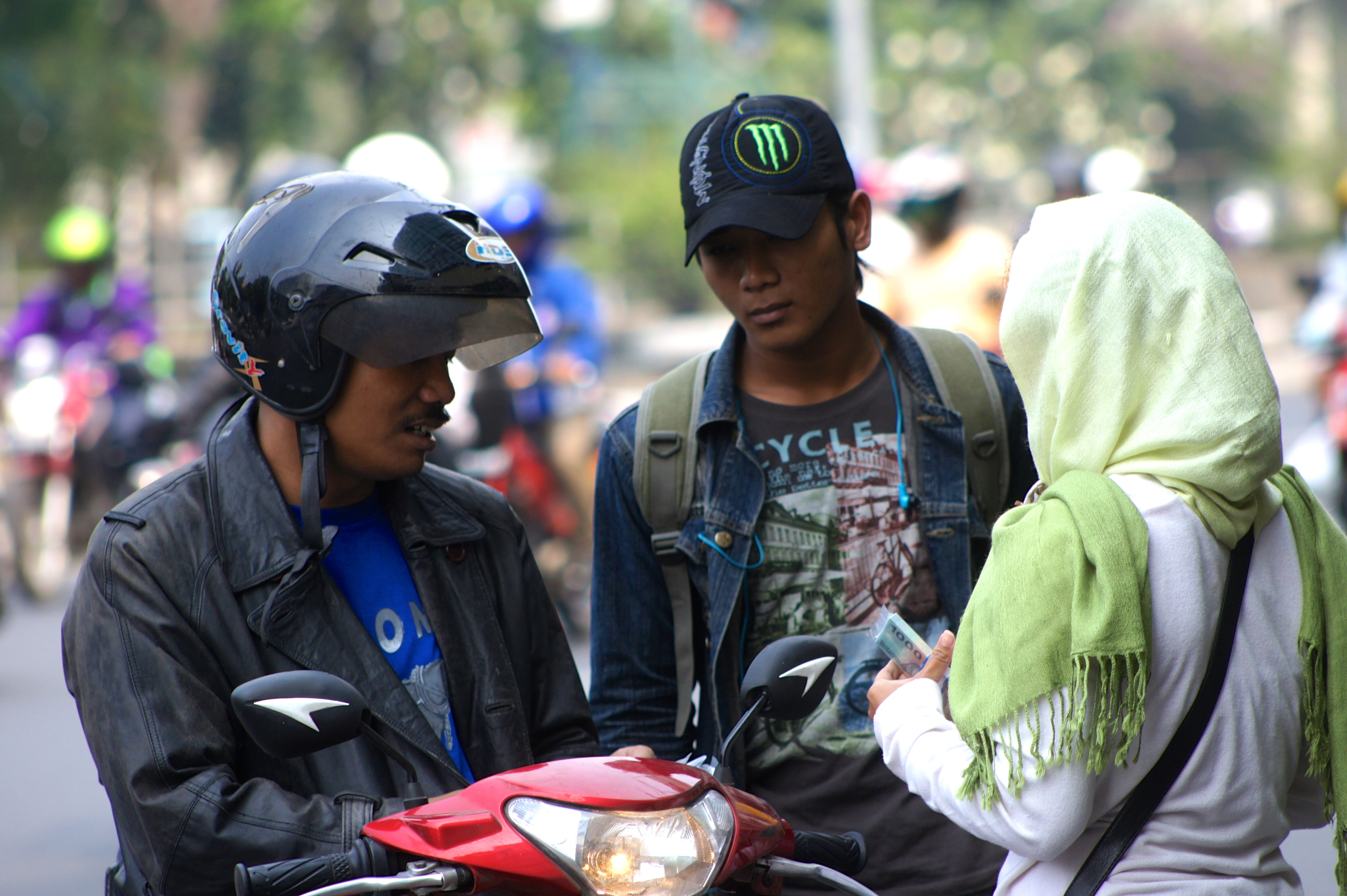
Rukmiyati, 34, and her customers do a money transaction on Jalan Gajah Mada in Central Jakarta on August 14th. Despite the fee charged, many Indonesians visit street peddlers to exchange their large bank notes for small ones for gift giving on Idul Fitri.[Elisabeth Oktofani/Khabar]

Small gifts of money make Idul Fitri sweet for youngsters. Many Jakarta residents get their small change for a small fee on the street, though some frown on such businesses.

As the Chinese do on Chinese New Year, it is common among Indonesian Muslims for older relatives to give small sums of money to younger relatives after the children wish them a happy holiday on Idul Fitri

That tradition has created a business opportunity for people such as Iphan, 32, and Rukmiyati, 34, who on a recent day were selling small change – exchanging large denomination notes for small ones, for a small fee – to customers on Jalan Gajah Mada in Central Jakarta.

“I’m actually new in this business. I just started three weeks ago. In one day, I can make 300,000 rupiah ($32) in profit,” Iphan, who is originally from Medan, North Sumatra, told Khabar Southeast Asia.

“But it depends on how many customers I get per day. Basically, I can make 5 to 15 % profit from each transaction,” he added.

Iphan explains that every day he receives as much as 10 million rupiah ($1,053) from an agent, who takes a cut of his earnings.

First, he needs to go to the bank to exchange the big notes for small ones: 1,000, 5,000 and 10,000 rupiah notes (10 cents, 50 cents and $1.05).

Because of the high demand at this time of year, Bank Indonesia, in collaboration with nine other banks, opened a mobile small-change service out of a vehicle at the National Monument (Monas) in Central Jakarta, which operated from July 23rd to August 16th.

“Every day, I need to wait in line at the small-change service in the National Monument (Monas) Park, Central Jakarta. But unfortunately, we are only allowed to change up to 5 million rupiah ($527),” Iphan said.

“So that is why I also change the money with an agent,” he continued.

Even though banks make change for free, many Indonesians patronise street vendors for their small cash needs because of the convenience.

Rukmiyati, who has been working in the business for the last four years, told Khabar that she would make less profit if she changed the money with an agent.

She said she prefers to queue at the bank to get small change, even if she has to do it twice in a single day, because the agent will take an additional cut of her profit, shaving a 15% margin to 5%.

“That is why it is better to change it in the bank,” she said.

There is another reason to rely on banks, authorities say: they can vouch that the currency is real.

Questioned about the source of her capital, Rukmiyati said she did not know where the agent got the money. She believes it came from a bank.

Difi Johansyah, a spokesman for Bank Indonesia, told Khabar that informal small-change services are not banned because there are no regulations against them.

“We are aware that there are informal money changers in public places such as traditional market or side streets. Bank Indonesia will not prohibit them from doing business. However, we suggest the citizens not change the money with an informal money changer service because the authenticity is not guaranteed,” he explained.

Many Muslim religious leaders from the Indonesia Council of Ulema (MUI) consider money changing in the street “haram”. Such transactions are forbidden in Islam because of the fees charged. But MUI has not issued any fatwa banning the practice among the Muslim community.

Iphan, who worked as a laborer for 10 years in Jakarta before losing his job six months ago, told Khabar that he sells small denomination banknotes to support his family.

“If MUI said it is haram, then that is not really my problem. I have to provide food for my family. It is very difficult to find a proper job these days, and I heard about this seasonal business so I decided to join with my friend,” he said.

Many small-change vendors in Jalan Gajah Mada wear face masks, in part because they feel a little shame, Rukmiyati said.

However, “The main reason is to avoid breathing the bad pollution as big bus and trucks are passing by this road,” she said.

Islamist vigilantes lead teens into trouble

Khabar Southeast Asia

Islamist vigilantes lead teens into trouble

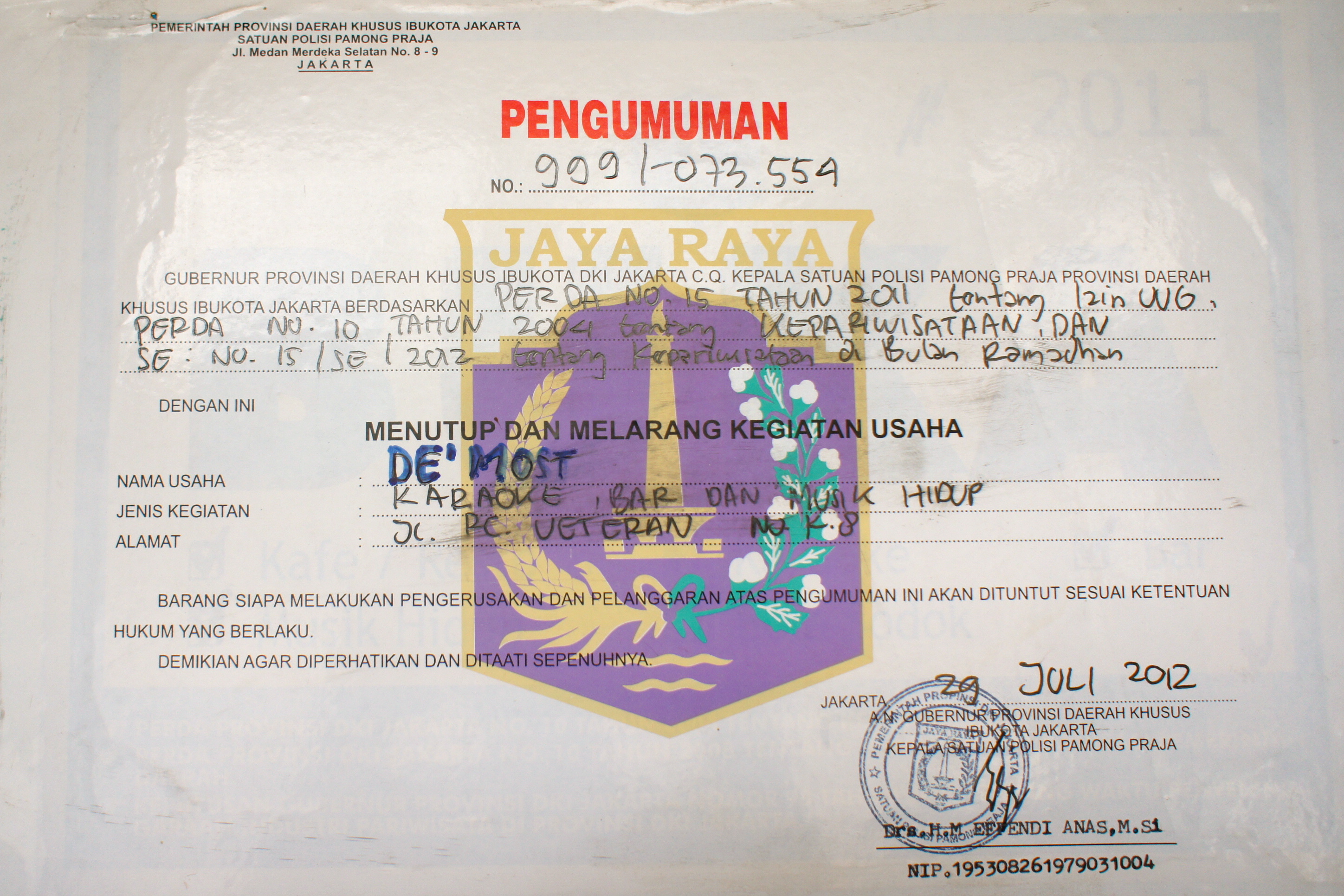
A July 29th police notice posted on the door of Café de’Most bans it from operating based on local laws governing entertainment venues during Ramadan. [Elisabeth Oktofani/Khabar]

A hardline group that raided a bar in late July recruited local teens for the illegal attack. Two of them now face prison time.

Jakarta residents are applauding police for arresting members of a hardline group that raided a bar for serving alcohol during Ramadan, and enlisted teenagers for the illegal vigilante attack.

About 150 members of the Prophet’s Defender Council (Majelis Pembela Rasulullah, or MPR) swarmed into Cafe’ de’Most in South Jakarta late on July 28th and ransacked it, shattering windows, breaking bottles, and assaulting employees.

Police apprehended the group as they left the club on motorbikes, and seized a machete, a sickle, four samurai swords, a golf club and four wooden poles, as well as musical instruments stolen from the bar.

“We arrested 62 people. But we released 39 juveniles without charges because they were not directly involved in attacking the bar,” South Jakarta police chief, Senior Commander Imam Sugianto, told Khabar Southeast Asia.

Among the 23 not released were two juveniles who were carrying a sickle and a machete, Imam said.

“They could face up to six years in prison under the Emergency Law No 12, 1951 for carrying weapons, and two and half years for destroying private property,” he said. Also arrested was MPR’s 29-year-old leader, Habib Bahar bin Smith, who organised the attack and was able to influence minors to take part in it, according to Imam.

Bahar and another adult identified only as S.Y. have been charged with the same offenses as the teenagers but face up to 12 years in jail terms because they are adults.

The remaining suspects were charged with aggravated assault on several bar employees and could face up to five and a half years in prison.

Mia Trisnawati, a waitress at a bar in South Jakarta, was happy to hear it.

“I have always been afraid to work during the fasting month because a number of hardline groups have threatened bars and night clubs,” Mia told Khabar.

“But I think that the police have done something different to protect their citizens by arresting the hardline group that acted as if they were the police with their raid,” Mia said

Vigilante organisations, notably the Islamic Defenders’ Front (FPI), say they are acting to protect Islam, but critics say their tactics are violent, illegal and also redundant, as authorities have already moved to limit the activities and operational hours of nightclubs and other entertainment venues during Ramadan.

In fact, police shut down Café de’ Most on July 29th because it was selling alcohol during Ramadan in violation of local regulations.

The involvement of minors in the raid is a cause for special concern. Arist Merdeka Sirait, Chairman of the National Commission for Child Protection, said parents and officials must declare a campaign against violence in society and make efforts to deter teenager involvement.

“Basically, teenagers tend to copy their idol’s behaviour. Therefore, it is very important for us, parents, teachers, government and religious leaders, to show how to live in peace and omit violence from daily life,” he told Khabar.