Indonesia hopes to become world leader in “Sharia tourism”

Khabar Southeast Asia

Indonesia hopes to become world leader in “Sharia tourism”

Riyanto Sofyan, president-commissioner of the Sofyan Hotel chain, says revenue has increased ahead of the industry as a whole ever since the hotels converted to a Sharia-based system. [Elisabeth Oktofani/Khabar]

Riyanto Sofyan, president-commissioner of the Sofyan Hotel chain, says revenue has increased ahead of the industry as a whole ever since the hotels converted to a Sharia-based system. [Elisabeth Oktofani/Khabar]

With Muslim vacationers seeking a holiday experience that accords with their values, the archipelago could become a top destination for this niche market.

Hoping to tap a burgeoning market among devout Muslims, Indonesia’s government has teamed up with religious leaders to develop “Sharia tourism”, which seeks to provide participants with a holiday experience that is aligned with Islamic values and beliefs.

A key milestone was reached in December when the Ministry of Tourism and Creative Economy (MTCE) signed a Memorandum of Understanding with the Indonesian Ulema Council (Majelis Ulama Indonesia/MUI), on a programme to foster this form of tourism. The government hopes to launch the initiative by June or July.

“Basically Sharia tourism is a concept [involving] leisure accompanied by religious values. It provides facilities and services closest to the values of Islam,” Firmansyah Rahmin, director general of destination development for the MTCE, told Khabar Southeast Asia.

This emerging form of tourism is not the same thing as a religious pilgrimage, a practice that has existed for centuries. Rather, it entails providing a travel environment aligned with Muslim observances.

“It needs to be understood that Sharia tourism is different from a religious trip,” Rahmin said.

Qur’an in each room, no liquor in restaurant

The Sofyan Hotel chain, headed by Riyanto Sofyan, is one of the pioneers behind the concept.

“We provide a Qur’an, Muslim prayer rug and directions for praying in every room. We provide toilets with sprinklers. We also don’t sell any alcohol or pork in our restaurant,” explained Riyanto, who is also chairman of the Indonesian Sharia Hotel and Restaurant Association (AHSIN).

Since converting to a Sharia-based model in 1994, he added, the chain’s revenues have increased by 15% to 20% each year.

“Our revenue is above the growth of the industry, which is only 10% a year,” he told Khabar.

In 1998, Sofyan Hotel closed down its nightclub and discotheque. In 2000, they stopped selling alcohol. And finally in 2002, it started to screen guests to ensure they are not using the hotel for activities prohibited by Islam. For example, unmarried couples are not permitted to stay.

“Guest selection is conducted to determine whether a couple who is going to check in is a married couple, family or an unmarried couple. If they are an unmarried couple and going to stay a short time, we will politely reject them,” Riyanto said.

According to Riyanto, Sofyan Hotel rejects approximately 1,000 to 2,000 guests every year.

Although it adheres to the Sharia code, he said, it welcomes business from members of other faiths who are willing to comply with the guidelines.

“A Sharia hotel is not exclusive for Muslims only. It’s open to anyone, whatever their race, religion or ethnicity as long as their activities do not violate any regulation,” he said.

Increased prospects as industry booms

Businesses such as Sofyan Hotel are benefitting from what appears to be a growing international trend, according to industry data.

According to Crescentrating, a halal-friendly travel and tourism consultant, the world’s Muslim travellers contributed as much as $930 billion to the tourism industry in 2009 (the latest).

According to country’s Directorate General of Marketing, meanwhile, approximately 1.3 million foreign Muslims visited Indonesia in 2010. Riyanto said 18% of those were interested in Sharia tourism.

“Interestingly most Muslim travellers were not only coming from the Middle East but also Europe, Australia, Japan, and China. The potential Sharia market in the tourism industry remains virtually untapped,” he said.

An MUI representative contacted by Khabar said the Islamic organisation is excited about the trend, but cautioned that Indonesia’s religious diversity must be taken into account.

“MUI is very supportive of the development of the tourism business,” said the representative, Slamet Effendy Yusuf.

But Sharia tourism, he added, is not appropriate for all parts of Indonesia because of cultural differences.

“Definitely Sharia tourism cannot be implemented in Bali or Manado (where Muslims are in the minority). However, it can be implemented in places such as East Java or Lombok. Therefore, we should be wise in implementing it,” Slamet said.

According to Zoraida Ibrahim, the director of the tourism industry at the MTCE, following the Sharia code is a “lifestyle” that is proving more and more popular.

She stressed, however, that there is no obligation in Indonesia for all tourism-related businesses to follow Sharia-based practices, despite the growing trend.

In Indonesia, continuing debate over “female circumcision”

Khabar Southeast Asia

In Indonesia, continuing debate over “female circumcision”

G.K.R Hemas, the queen of Yogyakarta, has urged the government to revoke the 2010 Ministry of Health Regulation that legitimises the practice of female genital mutilation and authorizes medical professionals to perform it. [Elisabeth Oktofani/Khabar]

G.K.R Hemas, the queen of Yogyakarta, has urged the government to revoke the 2010 Ministry of Health Regulation that legitimises the practice of female genital mutilation and authorizes medical professionals to perform it. [Elisabeth Oktofani/Khabar]

The OIC says Islam does not support the practice and the UN has condemned it. What stance will Indonesia take?

Despite growing international condemnation of female genital mutilation, the Indonesia Ulema Council (MUI) is urging the government to resist any international or domestic pressure to ban the practice it calls female circumcision.

“On the issue of female circumcision, we do not consider it compulsory, but we forbid any action to ban it,” MUI Chairman Ma’ruf Amin told a January 21st press conference on the subject at MUI’s Central Jakarta office, according to multiple media reports.

He said that in recent times more medical practitioners have refused to perform female circumcisions, and he urged the government to act decisively against such individuals, based on its 2010 Health Ministry regulation on the practice, which effectively legitimises female circumcision and authorise medical professionals to perform it, the Jawa Pos National Network reported.

“Because we support that regulation, we ask the government not to heed any effort by any party that wants circumcision banned in Indonesia,” he said, according to Detik News.

“Circumcision is a part of Islamic teaching that is highly recommended for Muslims, whether male or female,” he said, adding that the law on the matter calls for specific procedures which, he claimed, do not damage the clitoris.

“The procedure for female circumcision according to Islamic teaching is removal of only the membrane, or in medical terms preputium [the clitoral hood] that covers the clitoris,” he said.

“It needs to be understood that Islamic teaching prohibits the female circumcision practice which is done by cutting or injuring the clitoris, as it is dangerous.”

Mixed messages

The government has issued mixed messages on female circumcision. In 2006, the Ministry of Health banned it as potentially harmful. But in 2010, it issued guidelines on how the procedure should be done, raising the ire of some women’s rights activists.

Gusti Kanjeng Ratu Hemas, the queen of Yogyakarta, believes the government must revoke the 2010 regulation effectively legitimising female circumcision and authorizing medical professionals to perform it.

“I am very certain that the 2010 regulation on female circumcision was issued because there was a big pressure from religious organisations to the Ministry of Health. Even recently, the MUI has demanded the government lift the ban on female circumcision,” she told Khabar Southeast Asia.

“I think that all the parties, which are involved, should have a wider point of view on female circumcision, particularly from the health point of view,” she said.

It is not known how many Indonesian girls undergo female circumcision, which is believed to reduce sexual desire and prevent promiscuity, and encompasses a wide range of practices in Indonesia, from cutting a small part of the clitoris to scratching it to pressing spices on the genitals.

Suratningtyas, a 46-year-old midwife at a private hospital in Depok, West Java, told Khabar that some parents do ask the hospital for female circumcision.

“I cannot reject their request because we are allowed to do it. But we make sure to do it properly so it will not harm the baby girl,” she said.

Condemned by the OIC

At odds with developments in Indonesia, there is growing international consensus against the practice of female genital mutilation.

On December 20th, 2012, the United Nations General Assembly adopted its first-ever resolution on the female genital mutilation, urging states to “take all measures — including legislation — to protect women and girls from this form of violence”.

Earlier the same month, speaking in Jakarta at the opening of a conference on women in development, Organisation of Islamic Co-operation (OIC) Secretary General Ekmeleddin Ihsanoglu called on OIC member states to prohibit the practice.

“This practice is a ritual that has survived over centuries and must be stopped, as Islam does not support it,” he said, according to reports in OnIslam.net and Tempo. “Female genital mutilation is a violation of human rights of girls and women.”

A weak theological basis

The theological basis for female circumcision is a weak hadith, according to Maria Ulfah Anshor, secretary general of Alimat (the Movement for Indonesia Family Justice) and former chairwoman of the woman’s wing of Nahdlatul Ulama, Indonesia’s biggest Muslim organisation.

“The hadith said that circumcision is sunnah for men [highly recommended] and makrumah for women [voluntary but meritorious]. Hence it cannot be used as a theological basis to conduct female circumcision, because it is optional,” she told Khabar.

The government does not need to regulate it, nor should it ban medical professionals from giving the service to a Muslim family that requests it, she said. But she said it is unfortunate that female circumcision is often conducted on infants, meaning that girls have no say in whether they want to undergo an optional practice.

“It is against human rights,” she said.

A Javanese tradition

Javanese tradition includes a ceremonial form of circumcision conducted without removing or harming the female body in any way, G.K.R Hemas told Khabar in an exclusive interview.

“Female circumcision in Javanese tradition is very different with what happened in other places. It is done by holding on to a piece of fresh turmeric on female genitals,” she said. Later the turmeric and other offerings are thrown to the rivers, she added.

The ceremony is conducted twice, at the age of five and when a girl begins to menstruate. These days, such ceremonies are rarely carried out in Javanese society, except for royal family members at the Yogyakarta sultanate.

“Once again, there is no woman’s body part which is being removed or harmed from those two traditions,” she added.

Disenchanted with politics-as-usual, Indonesians pine for change

Khabar Southeast Asia

Disenchanted with politics-as-usual, Indonesians pine for change

The face of politics is changing, thanks to a stronger role for the media – and a new crop of candidates who know how to harness it.

With one year to go before the 2014 presidential election, Indonesians appear to be in the mood for change. Polls show a relative newcomer – Jakarta governor Joko Widodo (nicknamed Jokowi) – ahead of other potential candidates, including several well-established figures.

The results reflect an ongoing trend in Indonesian politics, analysts say. The traditional party machinery is losing its potency as a new generation of media-savvy politicians is better able to harness public opinion.

Citizens, meanwhile, are increasingly distrustful of political elites and determined to elect politicians who will remain close to their interests.

In its latest opinion survey, Pusat Data Bersatu (PDB) polled 1,200 respondents from 30 provinces. Jokowi garnered 21.2% support, the largest percentage for all the potential candidates. Behind him were several political veterans — former vice president Jusuf Kalla, former president Megawati Sukarnoputri, Great Indonesian Movement (Gerindra) Party figure Prabowo Subianto, and Golkar Party Chairman Abu Rizal Bakrie, among others.

Didik J. Rachbini, a political expert at PDB, said the results showed a clear trend.

“Citizens want a new figure for the 2014 presidential election, and it appears that Jokowi is that figure,” Didik told Khabar Southeast Asia.

However, he added, the rising political star will first need to demonstrate a strong performance in his current job, including by taking charge of the flooding situation in Jakarta.

Media appeal becoming crucial

Burhanuddin Muhtadi, a political analyst with the Indonesian Survey Institute (Lembaga Survey Indonesia/LSI), agreed that the electorate wants someone new.

“Citizens are looking for a figure who is firm, has no distance from the citizens, [and is] unpretentious,” he told reporters.

Jokowi’s popularity has swelled since he took over the city governorship, a role which brings frequent media appearances, Burhanuddin said.

Moreover, he added, the governor has received positive coverage of his education and health care initiatives, the Kartu Jakarta Pintar (Jakarta Education Card/KJP) and Kartu Jakarta Sehat (Jakarta Health Card/KJS).

The KJP provides students with as much as Rp 240,000 ($25) per month for education-related expenses such as books, uniforms, and transportation. Bank DKI refills the card every month with provincial government funds. Similarly, the KJS provides free health care access, especially for those in need.

Although previous governors ran similar initiatives, Jokowi has proven particularly effective at making citizens aware of them, Burhanuddin said.

“He knows how to maintain public optimism,” he said.

Jokowi is not the first politician in this mold, the analyst said. Indonesia’s current president, Susilo Bambang Yudhoyono, demonstrated a similar appeal during his campaign eight years ago, relying more on a strong media presence than on the traditional workings of party machinery.

“Back in 2004, President Susilo became a media darling with his personality and intellect. He is also very friendly with the media,” he added. In general, he added, “political parties are no longer able to claim that they are the only funnels to represent the public’s preference”.

Disenchantment grows with politics-as-usual

Muhammad Yusuf, an 18-year-old Pemalang resident, told Khabar he wants a new president who remains close to the people. “I think we need a smart figure and humble, just like Governor Jokowi,” Muhammad said.

Hilary Desuari, a 25 year-old Yogyakarta resident, told Khabar, “I find it difficult to trust the political elite.” Jokowi, she said, may be a viable candidate “because he does real work and solves many problems.”

Willy Bordus Tatag Hastungkoro, a 24 year-old Jakarta resident who originally hails from Central Java, said Indonesia needs a president who has a vision for the country, and not just for a political party.

“I think that we need a figure with a good mindset to protect and develop the public’s interests mandated by Pancasila, our guiding principles,” he said.

Indonesians lament celebrity drug use

Khabar Southeast Asia

Indonesians lament celebrity drug use

Following a high-profile-drug bust, parents and children’s advocates demand entertainers set a better example for the nation’s youth.

In the wake of the latest celebrity drug arrest, Indonesians are concerned such individuals are undermining the country’s effort to become drug-free.

“We are worrying with the increasing number of drug users in our society,” said Agus Hendrawan, an officer at the National Narcotics Agency (BNN), when asked about the late January arrest of popular television presenter and actor Raffi Ahmad.

“Many youths admit that their interest to use drugs is influenced by the environment, including public figure such as celebrities,” he told Khabar Southeast Asia.

Even though law enforcement on drug use is improving, the government is still facing big challenges, he said. According to a BNN survey conducted at the end of 2011, there are 3.8 million to 4.2 million illicit drug users in Indonesia, many of them young professionals.

Drug bust grabs headlines

Authorities arrested 17 people in a raid early January 27th on Raffi’s South Jakarta home and seized 14 ecstasy pills and two marijuana joints. Reports of the drug bust went viral, as several well-known people were involved.

Nine people were found innocent and released in following days, including actor Irwansyah, 27, and his actress wife, Zaskia Sungkar, 22, as well as the National Mandate Party’s (PAN) Wanda Hamidah, a 34-year-old member of the Jakarta Legislative Council.

One person was charged for not reporting drug use, while six others were sent to rehabilitation and face up to four years in prison if convicted under Indonesia’s 2009 anti-narcotics law.

Five of those arrested tested positive for drugs in initial urine tests on January 27th. But Sumirat Dwiyanto, a BNN spokesman, told reporters that two people who originally tested negative were later found to have cathinone in their system.

Cathinone, a drug related to the stimulant khat, found in Arab and East African countries, is relatively new in Indonesia.

Raffi, 25, faces multiple charges and up to 12 years in prison if convicted. Once the presenter on television’s most popular music program, Dahsyat, he is now jailed in a BNN detention facility in East Jakarta, awaiting further investigation and a court trial.

Banned from television?

Many celebrities in Indonesia — and abroad — have faced legal problems over drug use. Senior Indonesian rocker Ahmad Albar was convicted of drug use and sent to jail for several years after his arrest in 2007.

Fahria Ade, an Indonesian actress who was arrested for possession of shabu (crystal meth) in 2010, told reporters it is very common to use drugs at filming locations.

“I used to be asked to use drugs by the film director so I would not be tired and could act maximally,” Ade said, according to entertainment news site Kapanlagi.com.

Celebrity drug use has a potentially negative impact on children, according to the Indonesian Commission on Child Protection (KPAI).

“Celebrities are idolized by children. We’re calling on celebrities to adopt a healthy lifestyle without narcotics. We’re even encouraging them to become ambassadors in the fight against drugs,” M. Ihsan, the head of KPAI’s child protection task force, told reporters following the arrests.

Nocky Chandra, a 25 year-old university student from Yogyakarta, agrees.

“Celebrities, who actually can be a role model for young people, should really watch their behaviour and lifestyle, because everybody is watching them,” Nocky said.

Ayu Sekarsari, 36, the mother of a 9-year-old boy, thinks celebrities convicted of drug use should be banned from television.

“My son often watches ‘Dahsyat’,” she said. “He often found that Raffi is a cool young man.”

“As a parent, I always tell my son the danger of drugs. I just don’t want my son to think that it is also cool to consume drugs… they are relatively easily influenced by their idols,” she added.

“Banning celebrities who are convicted of drug use is one way to prevent children from using drugs. Unless they have been going to rehabilitation and are willing to fight against narcotics openly through mass media,” Ayu told Khabar

Proposed ban on straddling motorcycles criticised

Khabar Southeast Asia

Proposed ban on straddling motorcycles criticised

A Muslim scholar is among those expressing doubt that the prohibition will make women safer.

A planned regulation banning female passengers from straddling motorcycles in Lhokseumawe, Aceh has sparked criticism from Indonesians, including a leading Muslim scholar who says it does not reflect the spirit of Sharia law.

Suaidi Yahya, the mayor of Aceh’s second largest city, said earlier this month he would issue the regulation because “it’s improper for women to sit astride. We implement Islamic law here.”

“Women sitting on motorbikes must not sit astride because it will provoke the male driver. It’s also to protect women from an undesirable condition,” Suaidi told AFP on January 2nd.

He said women could face forward in an emergency situation, or if they are driving, as long as they are dressed “in a Muslim way”.

His administration has started distributing handouts throughout the municipality to inform residents of the new policy before the plan is legally implemented in a few months, he said.

Unsafe for riders?

The plan has sparked widespread criticism from Indonesians who say it is unsafe.

Cut Fitriani, 34, an Acehnese woman who moved from Aceh to Jakarta in the last two years, told Khabar that the Lhoksumawe administration has demonstrated ignorance of safe driving principals.

“I don’t see that the regulation is very Islamic. Instead, it puts women in a dangerous situation. I believe that drivers will have difficulty keeping their balance,” she said.

Jusri Pulubuhu, a founder of Jakarta Defensive Driving Consulting (JDDC), told Khabar his group strongly suggests that motorcycle passengers sit facing forward.

“When you are driving a motorcycle, you have to know how to keep it stable and balanced,” Jusri said.

“When a motorcycle passenger is sidesaddle, it would be difficult for the passenger to find a safe position because her two legs would not be within the handlebar area,” he added.

“One of the safety requirements of driving a motorcycle is that any object or passenger must stay within the handlebar area.”

Protecting citizens

Siti Musdah Mulia, chairwoman of the Indonesian Conference on Religion and Peace (ICRP), argued that the regulation has nothing to do with Sharia Islam and it puts female passenger in danger.

Further, she argued that the bylaw is incompatible with the spirit of Sharia.

“A regulation must give a protection to the citizen, instead of putting the citizen in danger. Even during the prophet period, the prophet’s wife was sitting forward-facing while they were riding a camel,” she said.

“Therefore, I do not think that there is a theological reason for this regulation,” she added,

By implementing Sharia Islam, the local government must improve the welfare of its citizens. That is what being an Islamic society means, Siti told Khabar.

Central government review

Home Affairs Minister Gamawan Fauzi said the central government will review the planned bylaw, and could annul it.

“[It will be reviewed] whether the bylaw is too much or [whether] it is to maintain the tradition,” he told reporters January 7th in Bogor, outside Jakarta.

“If it is to maintain the tradition, it is alright. [But] it should be studied first [to find out] what is the purpose of the regulation,” he said, adding, it would take up to one month to evaluate the bylaw, and that his office had not yet received a copy of it.

Prisoners’ products a source of pride, income

Khabar Southeast Asia

Prisoners’ products a source of pride, income

Ade, 37, demonstrates his skill making footballs at the Napi Craft 2012 exhibit in Jakarta. Income from sale of prisoners' products will be given to them upon their release, according to officials from the Directorate General of Corrections. [Photo by Clara Prima/ Khabar]

Ade, 37, demonstrates his skill making footballs at the Napi Craft 2012 exhibit in Jakarta. Income from sale of prisoners’ products will be given to them upon their release, according to officials from the Directorate General of Corrections. [Photo by Clara Prima/ Khabar]

Ade, a 37-year-old prisoner at Cirebon Class One Prison, recently had the opportunity to demonstrate his skill making footballs at the Napi Craft 2012 exhibition in Jakarta.

The event held December 17-21st at the East Building, Mega Kuningan, South Jakarta, was intended to show that inmates – napi – can be creative, innovative and productive.

Ade, who is serving a six-year sentence, said he enjoys making footballs because it allows him to develop his abilities and keep busy.

The father of a six-year-old boy is also hoping to use his skill to work in a factory or establish his own business when he is released from prison two years from now.

“I can make four to five footballs in a day. If the material is soft, it only takes me an hour to make one football,” Ade told Khabar Southeast Asia.

Some 149,873 inmates are incarcerated across Indonesia, according to the Ministry of Justice and Human Rights, which sponsored the exhibit.

“That number has great potential and can be used to produce certain types of products. So it also can support government programmes in economically creative ways,” said founder of Napi Craft 2012 Evi Amir Syamsuddin during its December 17th opening. She is wife of Minister of Justice and Human Rights Amir Syamsuddin.

“Other than that, the exhibition is also expected to improve the inmates’ quality of life as well as their welfare – especially for those who join the Prisoners’ Workshop,” or Bengkel Kerja Naripidana,” she said.

Ismail Nasrul, a public relations representative from the Directorate General of Corrections, told Khabar his department is putting greater emphasis on marketing prisoner products to help motivate inmates to join the skills training workshops.

Though many inmates think the training is a waste of time, he said, because they are unsure how to market what they make, false eyelashes made in West Java’s Garut Penitentiary have already found customers in Taiwan, Switzerland and China.

“Through this exhibition, we wanted to show to them that their products can be appreciated and recognised by society,” he said. “It needs to be understood that getting recognition will motivate them to improve the quality of their product.”

In total, more than 1,500 products were displayed at Napi Craft 2012, including artwork, false eyelashes and synthetic rattan chairs. On the third day, six paintings ranging in price from Rp. 5m ($518) to Rp. 17m ($1,761) were sold.

“The income from the sale will be given to the inmates upon their release. They will have their own money to start a new life because not all of them will be simply accepted by their own family,” Ismail said.

Arum Wahyuni, 26, an exhibition visitor, said she was impressed with several of the products. “I would say that many of the handmade crafts are properly made. It is also amazing that those fake eyelashes, which were made by prisoners, are exported to other countries,” she said.

“I just hope that when they are released from prison, they use their skills to start a new, creative and innovative life, especially knowing that they have the ability to be a better person,” Arum added.

Indonesia prepares terror financing law

Khabar Southeast Asia

Indonesia prepares terror financing law

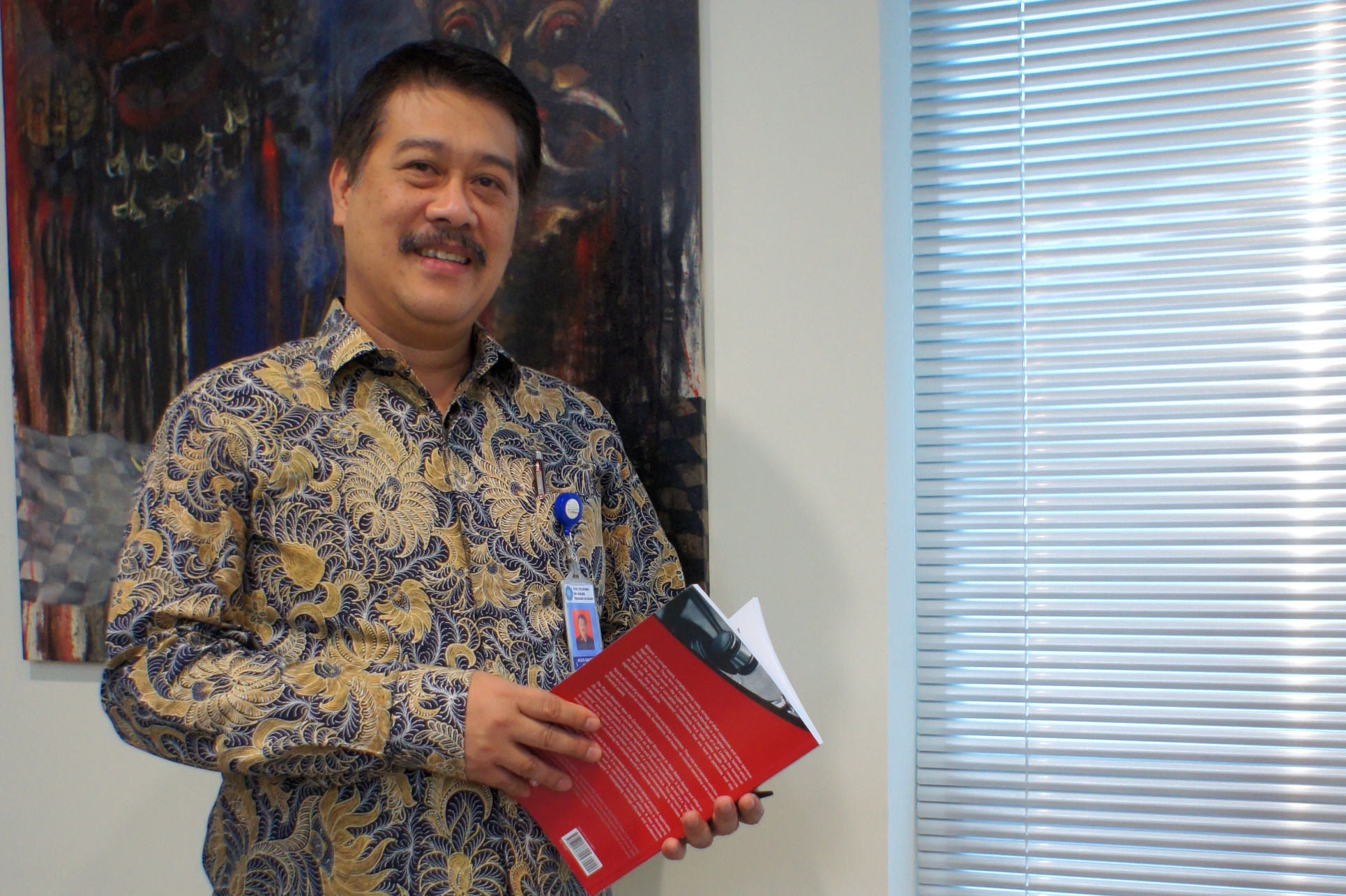
Agus Santoso, deputy chairman of the money-laundering watchdog PPATK, hopes Indonesia will have a new law targeting terrorist financing by February. The law would enable authorities to freeze bank accounts used to finance terrorism.

Agus Santoso, deputy chairman of the money-laundering watchdog PPATK, hopes Indonesia will have a new law targeting terrorist financing by February. The law would enable authorities to freeze bank accounts used to finance terrorism. [2012: Oktofani]

New legislation will enable authorities to seize assets and freeze bank accounts.

Indonesia hopes to have a potent new weapon against terrorism this year: a law enabling authorities to freeze bank accounts or seize assets of terrorists and those who finance them.

The law will create the legal mechanisms needed to target terror financing, according to Agus Santoso, deputy chairman of the Financial Transaction Reports and Analysis Centre (PPATK), an independent institution charged with fighting money laundering and other financial crimes.

“We have been working on this regulation for the past three years. We really hope that it will pass by February 2013,” he said, adding that the law is urgently needed.

From January to July 2012, financial service providers reported 191 suspicious financial transactions to PPATK. Analysis of the transactions found that 48 were linked to terrorism financing.

The proposed law is not the result of pressure from other nations, Agus said. “We know for a fact that Indonesia has been threatened with terrorism for many years. Therefore, our need for this law is real,” he said.

Terrorism risk undermines economy

Although the country insists it does not need outside pressure in order to act, experts acknowledge there is a concern about meeting global standards.

“Indonesia is one of two G-20 countries that does not have regulations regarding the funding of terror-related activities,” Santoso said.

On December 12th, Indonesian Finance Minister Agus Martowardojo said the timing is becoming urgent. Without the new statute, international institutions such as the Financial Action Task Force (FATF) could label Indonesia a non-cooperative jurisdiction, he told reporters.

“It needs to be passed soon because FATF will review Indonesia in 2013. We need that law to be able to say that Indonesia has a law to prevent funding for terrorists,”
he said. “If we are downgraded to a non-cooperative jurisdiction, we will be put on the same level as countries unworthy of international financial transactions.”

Being labeled “unworthy” could hurt the country’s economy, the finance minister added.

Militants find innovative ways to obtain funds

Recent incidents underscore the need for updated legislation as extremist cells find sophisticated new ways of drumming up money.

In May 2012, the anti-terror squad Detachment 88 captured 11 individuals suspected of hacking into multilevel marketing websites and stealing some 8 billion rupiah ($835,000). The money allegedly was used to finance terrorist activities such as terrorist trainings in Poso, Central Sulawesi and to produce explosive devices used in churches.

Rizki Gunawan and Cahya Fitriyanta, two of 11 alleged terrorist hackers, are currently on trial in West Jakarta District Court, charged under the 2003 Anti-Terrorism Law and the 2010 Anti-Money Laundering Law.

According to Agus, however, the existing laws do not precisely fit the alleged crimes, demonstrating the need for a new legislation.

In particular, he said, the 2010 Anti-Money Laundering Law “does not specifically regulate the terrorism financing system,” he said, adding that a Counter Terrorism Financing Law would close the gap.

The new law will be strictly implemented and applied to anyone who finances terrorism activity, he stressed.

“The person does not have to be a terrorist. Any individual or organisation that supports terrorist activity will be subject to this law,” he said.

Concerns over implementation

Ordinary citizens told Khabar that the government should also work to make the Indonesian public better aware of the dangers.

Taufan Restu Putra, a 32 year-old Jakarta resident, said he appreciates government efforts to protect Indonesian citizens and the Indonesian financial system with this new law, but he expressed some concern about how it would be implemented.

“What if somehow a terrorist asked me for financial support, but he didn’t tell me the truth that the money will be used to finance terrorist activity? Will I also be charged because I am considered to have supported terrorist activity?” he commented.

“I think the government needs to publicize the regulation properly as soon as it is passed – especially in the remote villages and also the mosques. So that anyone who has a good intention to give to a charity will not be manipulated by terrorists to gain financial support,” he said.

Indonesia nets alleged HASMI militants

Khabar Southeast Asia

Indonesia nets alleged HASMI militants

The terror network has deep Islamist roots – and a training camp in East Java, authorities and experts say.

Anti-terrorism forces in Indonesia have arrested three men in Central Java who allegedly stored explosives for Abu Hanifah, leader of the Sunni Movement for Indonesian Society (HASMI).

The men, identified as Winduro bin Nur Hadi, 28, Feri Susanto, 23, and Bambang Kurmanto, 45, were arrested December 6th and 7th in Sroyo village of Karanganyar Regency.

“They were arrested because they are suspected of storing chemicals and explosive powders for suspect Abu Hanifah,” Agus Rianto, National police spokesman, told reporters in Jakarta on December 7th.

Police reportedly found black powder suspected of being a bomb-making ingredient, three Molotov cocktails, and flashlights in Feri’s house.

The arrests follow counterterrorism operations across Java in late October that netted 11 HASMI members, including Abu Hanifah, as well as homemade bombs, explosive material, ammunition, and bomb-making manuals.

The network was planning attacks on US diplomatic missions in Surabaya and Jakarta, a Jakarta building that houses the offices of mining giant Freeport-McMoRan, and police facilities in Central Java, according to police.

Terrorist training camp in Java

HASMI emerged from Tim Hisbah, the network responsible for recent suicide bombings in Cirebon and Solo, and has roots in the 1950s-era Islamist group Darul Islam, Al Chaidar, a terrorism expert from Malikussaleh University in Aceh, told Khabar Southeast Asia.

“Abu Hanifah restored the Tim Hisbah movement after the death of Sigit Qurdowi, the chief of Tim Hisbah,” Chaidar said.

“He recruited new members who are not Jemaah Islamiyah members,” he said. “Unlike many terrorist groups which link to Jemaah Islamiyah, Hanifah’s network links to Darul Islam, which came to the fore in the 1950s as rebels sought to set up an Islamic state.”

Its main target, according to Chaidar, is the Indonesian government, which is hindering its efforts to establish an Islamic state.

Following the arrests in October, police learned that Abu Hanifah’s network had been conducting paramilitary training in Gunung Wilis, Madiun – unlike other militant groups that set up training camps in conflict-prone areas outside of Java, like Aceh and Poso.

“It is not something new that terrorist network established a paramilitary training camp in Java, because Darul Islam has been doing it for many years, such as in Serang, Banten and also Parangtritis, Yogyakarta,” Noor Huda Ismail, executive director of the International Institute for Peace Building, told Khabar.

Winduro bin Nur Hadi, one of the men arrested on December 6th, is suspected of having trained at Gunung Wilis with Abu Hanifah, National Police spokesman Boy Rafli Amar told reporters during a trip to Lombok, according to Liputan6.

“Hanifah’s network has about 70 members. Up to now, police have arrested about 33 of them,” Chaidar said.

Militants in their midst

Residents of the village where the arrests took place expressed shock.

A witness, Yudi, said Winduro was a friendly person who worked as a garbage collector. “There is nothing wrong with his presence among people. He looks normal and works hard,” Yudi said.

Local resident Samardi Sastro expressed disbelief that local youths from a small village like Sroyo could radicalise.

“It is possible that young children can be radicalised once they leave our village. But as I witness here, there is no radical teaching or suspicious acts around the neighbourhood,” he said.

A former researcher from Gadjah Mada University, Yonaye Odriana, said radicalisation can happen anywhere.

“Youths can be radicalised in many ways, through teaching, learning, and/or by the Internet,” Yonaye told Khabar by phone from her home in Yogyakarta.

“This case is additional evidence that a small area can be a good place to grow radicalism,” she said of the arrests in Karanganyar. “Therefore, a neighbourhood watch must increase its role to monitor the community closely.”

“Meanwhile, a good teaching of peace, tolerance, and harmony based on the Qur’an will help Indonesian youth embrace those values,” she said.

Yenny Herawati in Karanganyar, Central Java contributed to this report

Burqa escape prompts discussion in Indonesia

Khabar Southeast Asia

Burqa escape prompts discussion in Indonesia

A convicted terrorist’s decision to escape by donning women’s garb is “embarrassing” and disrespectful to Islam, scholars say. It has also led to new screening rules at prisons where militants are incarcerated.

In November, a convicted terrorist escaped from jail by disguising himself as a woman wearing a burqa, forcing police to introduce new security checks.

Roki Aprisdianto, 29, was serving a six-year sentence for bombings in Central Java between December 2009 and January 2011. One of six men imprisoned for the blasts, he is considered the leader of the cell.

According to a police investigation, Roki disguised himself as a woman and walked out of Jakarta Metro Police Headquarters at midday on November 6th, a time when about two dozen women in burqas were visiting detainees incarcerated there.

His action has prompted security personnel to take action in order to prevent similar escapades in the future. Women in burqas who seek to visit terrorist detention centres will now be required to reveal their faces to female guards.

“All of those entering and leaving [the Jakarta Police detention centre], including people in burqas, will be checked,” National Police Inspector General Suhardi Alius announced, according to The Jakarta Globe. Previously, burqa-clad women were only required to surrender their identity cards while visiting prisoners.

Militants bring stigma to innocent women

The burqa escape has prompted heated discussion among women who choose to wear Muslim garb.

Siti Musdah Mulia, 54, an Islamic scholar from the Indonesian Conference on Religion and Peace, agreed that burqa-clad women visiting detainees need to lift their veils for identity and security reasons.

“At the State Islamic University Syarif Hidayatullah (Jakarta), where I am teaching, I don’t allow any of my female students to wear burqas in my class, because I cannot identify whether they are my students or not,” Musdah, who wears a hijab, told Khabar Southeast Asia.

“I will not let them join my class,” she said.

Setianingrum, 38, a resident of Yogyakarta who wears a burqa, disagreed with the inspection, especially if it involves policemen.

“It is not fair for us to be held responsible for this. The escape of the Indonesian terrorist must not impact us,” Setianingrum told Khabar via telephone from in Central Java.

But Baiq Marni Rosniah Kamardi, an Indonesian scholar who previously lived in Egypt and still wears a burqa, said that terrorists have once again hijacked a part of Islam for their own nefarious purposes.

“Terrorists should not use Islam to hurt people and again to escape behind the burqa. This is embarrassing,” Marni, 35, told Khabar via telephone from her home in Lombok, West Nusa Tenggara.

“I personally disagree with the Indonesian police’s decision to investigate every woman wearing a burqa. However, since this holy clothing was used by a terrorist to escape, I have no choice but to agree,” she added.

“Not only is our religion being blamed, but sadly now innocent Muslim women as well,” she said.

Changing times in Indonesia

Hijab and burqa have become more popular since the end of the Suharto regime in 1998, which restricted them from being worn in schools and government institutions. Even today, less than 5% of the population wears burqas.

In some parts of the country, however, regional regulations (Peraturan Daerah or Perda) have been established that require conservative dress.

In Aceh and in South Sulawesi, for example, Muslim women are required to cover everything but their faces, palms and feet, and Muslim men must cover themselves from the navel to the knee.

Cooking Up a Clean New Life

Khabar Southeast Asia

Cooking up a clean new life

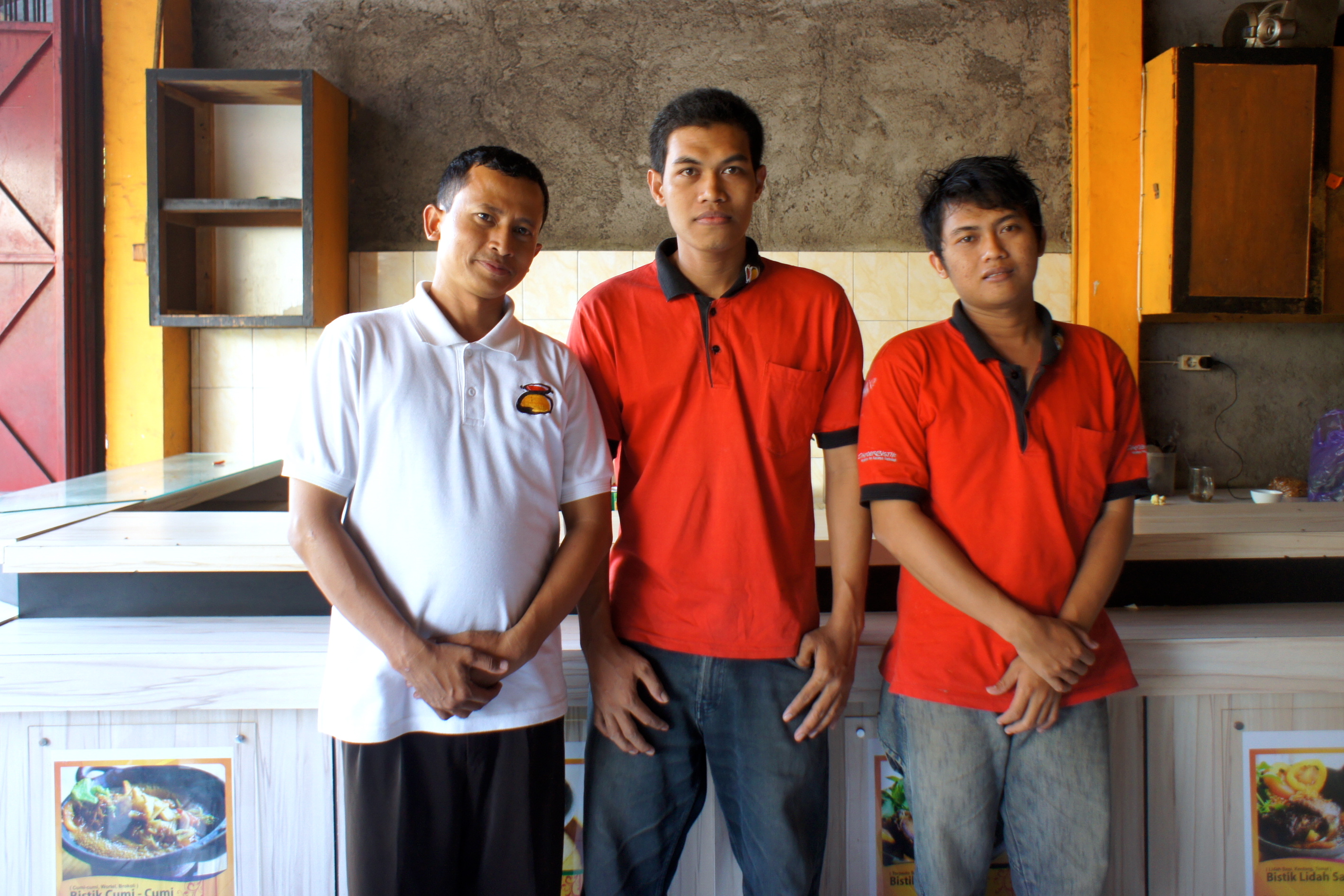
Machmudi Hariono (in white), aka Yusuf Adamira, and two Dapoer Bistik employees, pictured at the restaurant in Semarang, Central Java. The enterprise is run by The Institute for International Peacebuilding to provide former terrorists with a place to work. [Elisabeth Oktofani/Khabar]

Restaurant business provides a new life, an income and a sense of purpose to former terrorist 

For three years, Machmudi Hariono, also known as Yusuf Adirima, 36, has been managing a backstreet restaurant in Semarang, Central Java.

It was no easy feat for this convicted terrorist to put violent activity behind him, land a job and focus on building a clean life.

A former member of the Jemaah Islamiyah (JI) who fought in the Philippines Yusuf, was sentenced to ten years in prison by Semarang District Court in 2004 for possessing and keeping explosive materials, detonators, firearms and ammunitions in a rented house in Semarang.

He spent five and half years in three different prisons, then was paroled for good behaviour.

“When I was in jail, I was thinking, what am I going to do when I am released?” Yusuf told Khabar Southeast Asia at Dapoer Bistik (Steak Kitchen) restaurant, on Jalan Kusumawardhani, Semarang.

“If I want to work as a civil servant, it is not possible because I have been black listed…It would not be easy for me to find a job. It became a problem for me.”

Fortunately, he met Noor Huda Ismail, who gave him not only motivation to start a new life, but also a work opportunity.

Skills first, ideology later

The counter-terrorism expert has devoted much thought to how to wean violent extremists back into civil society. His Institute for International Peacebuilding (Yayasan Prasasti Perdamaian) has a rehabilitation programme that provides skills training and runs businesses – including Dapoer Bistik – where former terrorists can work.

“One of the possibilities that we can do is what I call a social enterprise. Any initiative of peace should be very practical and applicable,” Noor Huda said at a recent panel discussion in Jakarta on terrorism and de-radicalisation in Indonesia.

Civil society efforts are crucial to peace-building and terror prevention, because an approach restricted to law enforcement can feed the problem, he said.

According to data collected by the institute, police have arrested more than 700 terrorists in Indonesia since 2002, weakening militant networks. Meanwhile, 58 terror suspects were killed outright and at least 28 individuals were wrongfully arrested.

“It produced a cycle of vendetta and a narrative that will last for a very long time,” Noor Huda said.

The graduate of Pesantren Al-Mukmin in Ngruki, Solo explained that to disengage militants from violence, one must reach out to them, provide skills training, and then approach their ideology.

“We don’t go to their ideology first because no one like being told [what to believe]. We have to win their trust by visiting them, talking to them and understanding them. But understanding them does not mean supporting them,” he said.

“Once we win their trust, we can provide them skill training such as in cooking and also managing a café. Later, we can approach their ideology. That is what I did with Yusuf,” Noor Huda explained.

From Jihad to Culinary Business

After interviewing Yusuf in prison, Noor Huda visited him regularly, and finally recruited him to the restaurant business. Yusuf found himself falling in love with it.

“At that time, I worked in a duck restaurant. Somehow, I found that I like to cook, serve people and also send delivery food,” Yusuf said. “From there, I realised that I have an interest in cooking and the culinary business, because food is among our daily needs,” he said.

Dapoer Bistik serves Indonesian-style beef steak, chicken, crabs and squid with an affordable price for local people. Located in a culinary centre of Semarang, the restaurant earns Rp 1m-2m ($104-$208) per day.

Yusuf is responsible for managing the restaurant’s finances and hopes to strengthen the brand so they can develop a franchise business.

“Dapoer Bistik has just got a nomination to join a comparative study in Bandung in November, where we would meet prospective buyers who are interested to invest in Dapoer Bistik,” he told Khabar.

Outreach work

When he’s not focusing on the business, Yusuf visits friends: other convicted former terrorists who are in jail in Jakarta, Semarang, Nusa Kambangan or Depok.

While maintaining the ties of friendship, he also talks to them about business alternatives to consider once they are released.

“I do this because I care about them. I don’t want them to have no job when they are released and end up engaged with terrorism activity again,” he explained.

“I would not force them to do the same business as me. If they are interested with other stuff, then they can also do it. At least, they have a source of income,” he added.

Noor Huda has also encouraged Yusuf to recruit drop-out students to work at Dapoer Bistik, to give the daily work a greater sense of social mission.

“Merely being employed is not everything for former terrorists. Therefore, I asked Yusuf to start searching for drop-out students to work at Dapoer Bistik,” he said.

“It provided him a feeling that he was a useful member in the community because he was helping to solve one of Indonesia’s acute social problems, which is unemployment.”

Expanding to Solo

Bistik Iga Bakar, an Indonesian-style rib steak, served at Dapoer Bistik.

Yusuf has successfully brought several convicted terrorists into the business.

They include Hari Setia, who spent four years in jail for providing a shelter for Noordin M Top; Wawan, who helped fund the second Bali bombing by robbing a cell phone shop in Semarang; Ardi, who provided Noordin M Top transportation; and Jack Harun, who was Noordin’s former right-hand man and also a veteran of the Ambon conflict.

“One of Hari’s greatest contributions to Dapoer Bistik is his initiative to register Dapoer Bistik’s products at the health department in Semarang,” Noor Huda said.

“Wawan used to work for Dapoer Bistik for two months cleaning up dishes. He’s now running his own business, providing glass for construction purposes.” he explained.

An unexpected request came from Jack Harun in 2011: to open a Dapoer Bistik in Solo.

“With directions from Yusuf, Jack has chosen an excellent place. It’s in a culinary area and near a mosque where Bashir delivered his sermons and a place where many Islamic activists get together,” he said, referring to jailed Indonesian cleric Abu Bakar Bashir, seen as a spiritual mentor to militants.

Noor Huda explained that running Dapoer Bistik in Solo is much more challenging than Semarang, because it is located in the heart of a radical environment.

“The role of environment plays an important role in disengaging individuals from violent activities. Dapoer Bistik in Solo is still a work in progress. It is far too early to judge the effectiveness of the programme,” he said.

But one positive indicator is that Jack has managed to recruit a former member of Tim Hisbah to Dapoer Bistik in Solo, he said.

Hisbah, an anti-vice group with a history of raiding nightclubs, has recently launched attacks on police, and is believed responsible for suicide attacks in Solo and Cirebon.

“Not such a dangerous person”

Last month, Yusuf reached another landmark in his rehabilitation: he completed his probation on October 10th.

Prior to that date, he was required to report to the East Java Police once a month, making a five-hour trip by motorcycle to Surabaya to sign a piece of paper.

“During my probation period, I was often asked by police to give them information about the terror suspects. I understand that they must still suspect me sometimes,” he said.

“Not just police. My family often checks on me. But I understand and I cannot blame them,” he added.

Yusuf told Khabar he has brought his parents and family to Dapoer Bistik to show them who he is today.

“The most important thing is that I can assure them is that their son is not such a dangerous person anymore. That I have not engaged in any terrorism activity anymore. That is the most important thing,” he explained proudly.