Indonesians decry attack, call for acceptance of Shia minority

Khabar Southeast Asia

Indonesians decry attack, call for acceptance of Shia minority
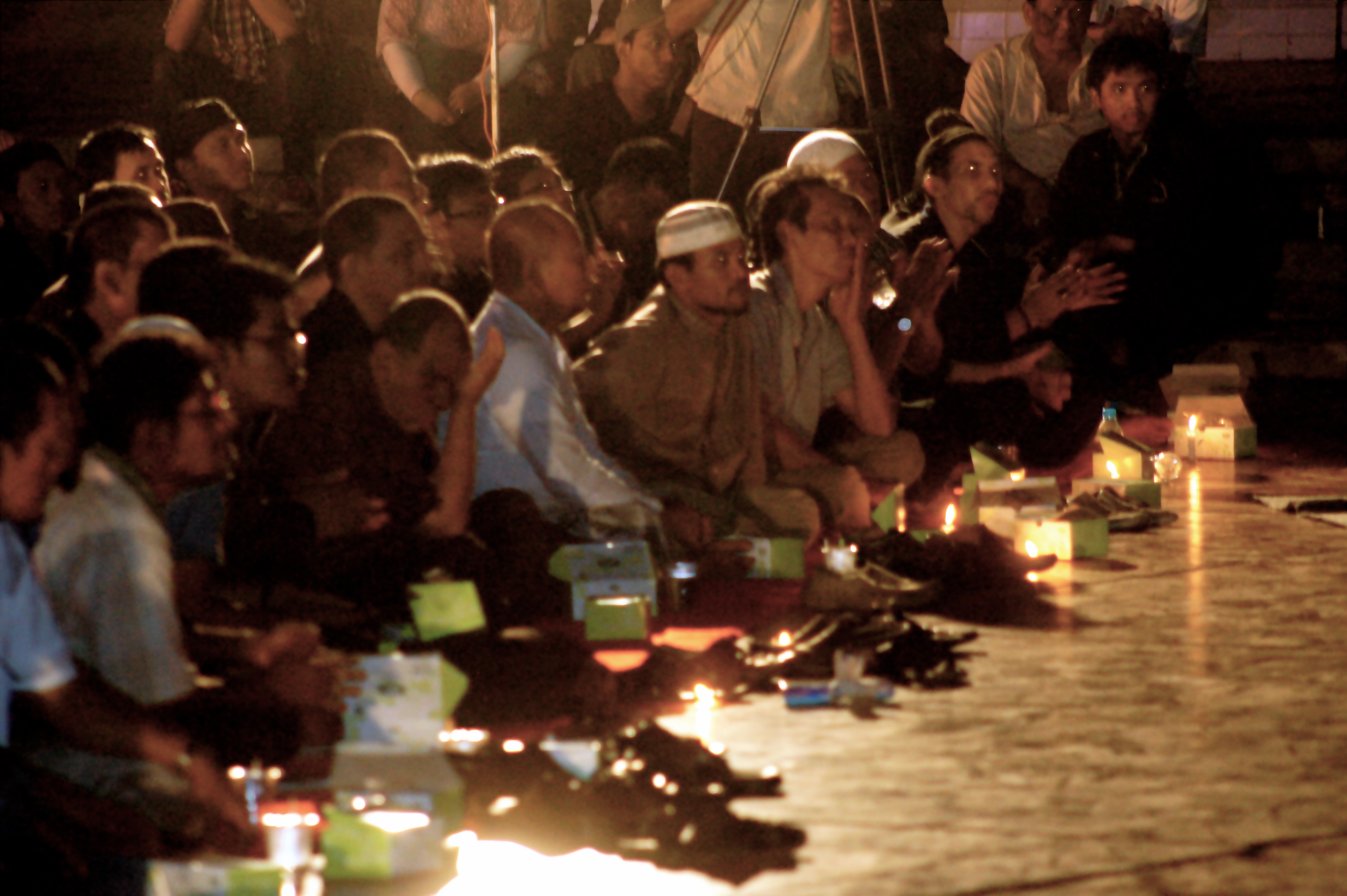
People attend a candlelight vigil at Proclamation Monument in central Jakarta on Tuesday night (August 28th) to pray and show support for Shia Muslims in Sampang, Madura after local Sunni Muslims attacked the community, killing two men and burning dozens of homes. Hundreds attended the Malam Seribu Lilin (Night of a Thousand Candles). [Elisabeth Oktofani/Khabar].

Top figures urge the government to eliminate the misperception that Shia is not a legitimate branch of Islam.

Indonesians are condemning the latest attack on a Shia Muslim community in Sampang, Madura, and urging the government to state publicly that Shia is not a perversion of Islam.

Local Sunni Muslims attacked Karang Gayam village on the island Sunday (August 26th), killing two men and torching dozens of homes, causing hundreds to flee. The same Shia community was attacked in December 2011.

Commenting on the events, Minister of Religious Affairs Suryadharma Ali said that violence in the name of religion cannot be justified, and urged dialogue to resolve issues in the community.

“Religion teaches peace and does not teach violence. The different opinions of religion have always been there, including about Shia and Sunni. However, it does not mean that we can use it as a reason to conduct any violence against others,” he told Khabar Southeast Asia.

“Therefore, if there is a different opinion about some issue, it should be solved with constructive dialogue.”

Marzuki Alie, Speaker of the House of Representatives (DPR), called on the government and the Indonesian Ulema Council (MUI) to actively educate society about the Shia sect of Islam.

“It is clear to see that there is a misunderstanding in society [in claiming] that Shia is a perverted religion. The lack of understanding has caused misperceptions and triggered anarchy in the community,” he said.

“Therefore, it is very important that the Ministry of Religious Affairs and MUI explain to society the position of Shia in Islam, to eliminate threats to civil order,” Marzuki added.

OIC, Nahdlatul Ulama view Shia as legitimate

A top figure in the human rights community urged the government to disseminate “to all levels of government institutions throughout the nation” the stance of the Organisation of Islamic Co-operation (OIC), which considers Shia a legitimate form of Islam.

“There is no reason to say that Shia is a perverted religion because the OIC considers Shia and Sunni to be the same,” said Choirul Anam, executive director of Human Rights Working Group (HRWG), a coalition of non-governmental organisations working in the field of human rights.

Nahdlatul Ulama (NU), a traditionalist Sunni group that is the largest Muslim organisation in Indonesia, also does not dispute the legitimacy of Shia as a branch of Islam – even though some of its members, particularly in East Java, appear to hold sectarian views not sanctioned by the organisation.

Sunni and Shia Muslims have the same God (Allah), the same prophet (Muhammad), and the same holy book (the Qur’an), NU deputy secretary general Imdadun Rahmat told Khabar.

“Even though Shias differ on who was to take over the leadership of the Muslim community after the Prophet died, we still consider Shia to be a part of Islam and we do not dismiss Shia,” he said.

Nusron Wahid, chairman of the youth movement of NU (Gerakan Pemuda Ansor/GP Ansor), told Khabar that GP Anshor condemns the attack in Sampang and is willing to raise funds to help the Shia community rebuild their houses.

“For the sake of human rights, we will help them to rebuild their houses. We are not going to see whether they are Shia or Sunni when we are helping them,” he went on.

“I would say that it is not our right to judge them whether they are right or wrong. Only Allah can judge their beliefs as Shia followers,” he added.

Assault suspects face grave charges

Police have arrested and investigated eight suspects allegedly involved in Sunday’s assault. The suspects are facing five charges including murder, assault, group assault, vandalism and participation in a crime.

“The mastermind of the attack, whose first initial is R, has also been arrested. There are still three more suspects at large. God willing, we will arrest them soon,” National Police Chief General Timor Pradopo told reporters on Monday.

Police also seized hundreds of sharp-edged weapons including sickles, machetes, and swords from the location of the attack.

Meanwhile, during a speech commemorating the 67th anniversary of Indonesia’s independence on August 17th, President Susilo Bambang Yudhoyono again stressed the importance of pluralism and tolerance in a nation as diverse as Indonesia.

“Our state should be the window of tolerance and harmony. It should not be the window of community conflict or horizontal violence,” he said
Small change is good business ahead of Lebaran

Khabar Southeast Asia

Small change is good business ahead of Lebaran

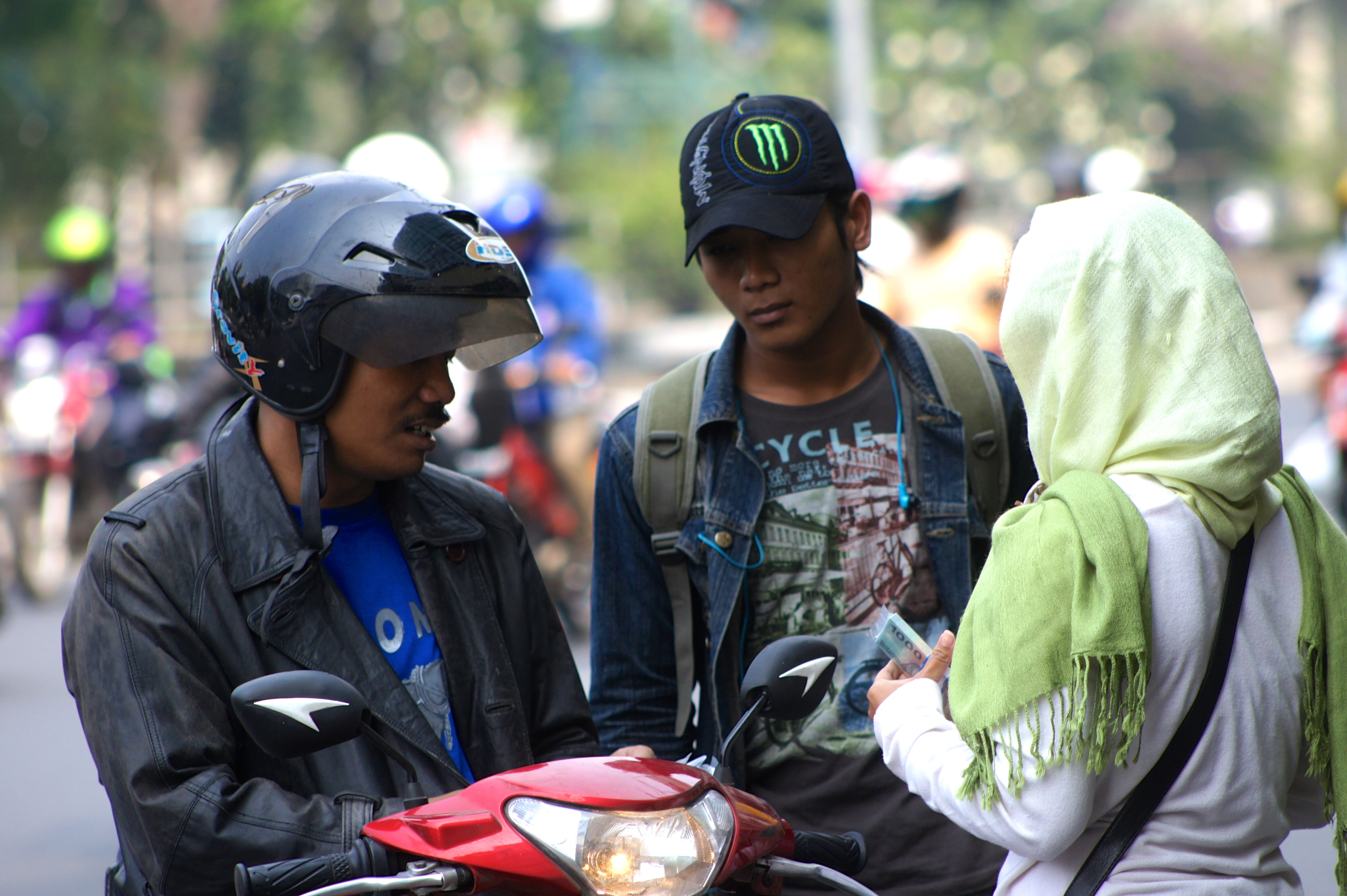
Rukmiyati, 34, and her customers do a money transaction on Jalan Gajah Mada in Central Jakarta on August 14th. Despite the fee charged, many Indonesians visit street peddlers to exchange their large bank notes for small ones for gift giving on Idul Fitri.[Elisabeth Oktofani/Khabar]

Small gifts of money make Idul Fitri sweet for youngsters. Many Jakarta residents get their small change for a small fee on the street, though some frown on such businesses.

As the Chinese do on Chinese New Year, it is common among Indonesian Muslims for older relatives to give small sums of money to younger relatives after the children wish them a happy holiday on Idul Fitri

That tradition has created a business opportunity for people such as Iphan, 32, and Rukmiyati, 34, who on a recent day were selling small change – exchanging large denomination notes for small ones, for a small fee – to customers on Jalan Gajah Mada in Central Jakarta.

“I’m actually new in this business. I just started three weeks ago. In one day, I can make 300,000 rupiah ($32) in profit,” Iphan, who is originally from Medan, North Sumatra, told Khabar Southeast Asia.

“But it depends on how many customers I get per day. Basically, I can make 5 to 15 % profit from each transaction,” he added.

Iphan explains that every day he receives as much as 10 million rupiah ($1,053) from an agent, who takes a cut of his earnings.

First, he needs to go to the bank to exchange the big notes for small ones: 1,000, 5,000 and 10,000 rupiah notes (10 cents, 50 cents and $1.05).

Because of the high demand at this time of year, Bank Indonesia, in collaboration with nine other banks, opened a mobile small-change service out of a vehicle at the National Monument (Monas) in Central Jakarta, which operated from July 23rd to August 16th.

“Every day, I need to wait in line at the small-change service in the National Monument (Monas) Park, Central Jakarta. But unfortunately, we are only allowed to change up to 5 million rupiah ($527),” Iphan said.

“So that is why I also change the money with an agent,” he continued.

Even though banks make change for free, many Indonesians patronise street vendors for their small cash needs because of the convenience.

Rukmiyati, who has been working in the business for the last four years, told Khabar that she would make less profit if she changed the money with an agent.

She said she prefers to queue at the bank to get small change, even if she has to do it twice in a single day, because the agent will take an additional cut of her profit, shaving a 15% margin to 5%.

“That is why it is better to change it in the bank,” she said.

There is another reason to rely on banks, authorities say: they can vouch that the currency is real.

Questioned about the source of her capital, Rukmiyati said she did not know where the agent got the money. She believes it came from a bank.

Difi Johansyah, a spokesman for Bank Indonesia, told Khabar that informal small-change services are not banned because there are no regulations against them.

“We are aware that there are informal money changers in public places such as traditional market or side streets. Bank Indonesia will not prohibit them from doing business. However, we suggest the citizens not change the money with an informal money changer service because the authenticity is not guaranteed,” he explained.

Many Muslim religious leaders from the Indonesia Council of Ulema (MUI) consider money changing in the street “haram”. Such transactions are forbidden in Islam because of the fees charged. But MUI has not issued any fatwa banning the practice among the Muslim community.

Iphan, who worked as a laborer for 10 years in Jakarta before losing his job six months ago, told Khabar that he sells small denomination banknotes to support his family.

“If MUI said it is haram, then that is not really my problem. I have to provide food for my family. It is very difficult to find a proper job these days, and I heard about this seasonal business so I decided to join with my friend,” he said.

Many small-change vendors in Jalan Gajah Mada wear face masks, in part because they feel a little shame, Rukmiyati said.

However, “The main reason is to avoid breathing the bad pollution as big bus and trucks are passing by this road,” she said.

Islamist vigilantes lead teens into trouble

Khabar Southeast Asia

Islamist vigilantes lead teens into trouble

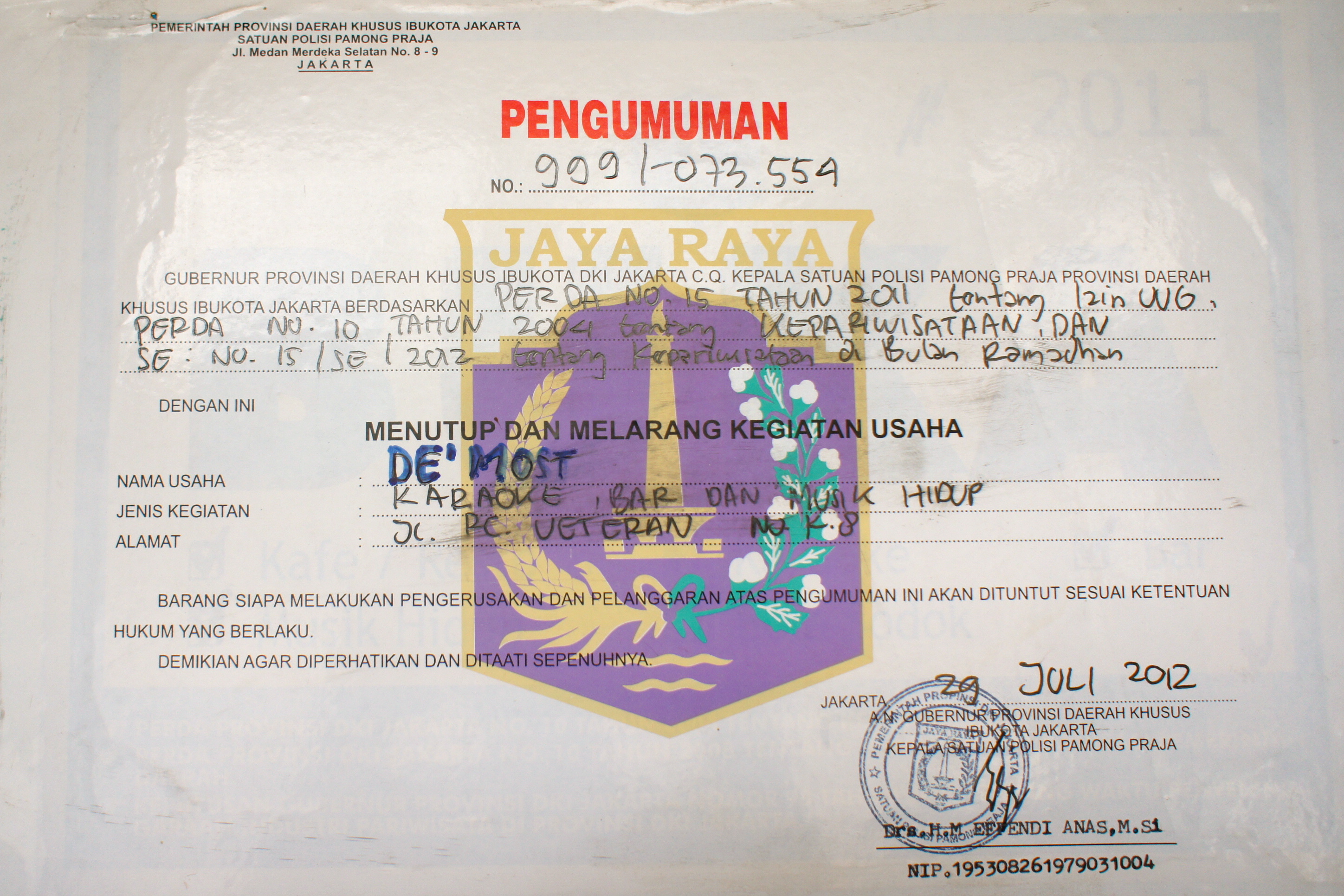
A July 29th police notice posted on the door of Café de’Most bans it from operating based on local laws governing entertainment venues during Ramadan. [Elisabeth Oktofani/Khabar]

A hardline group that raided a bar in late July recruited local teens for the illegal attack. Two of them now face prison time.

Jakarta residents are applauding police for arresting members of a hardline group that raided a bar for serving alcohol during Ramadan, and enlisted teenagers for the illegal vigilante attack.

About 150 members of the Prophet’s Defender Council (Majelis Pembela Rasulullah, or MPR) swarmed into Cafe’ de’Most in South Jakarta late on July 28th and ransacked it, shattering windows, breaking bottles, and assaulting employees.

Police apprehended the group as they left the club on motorbikes, and seized a machete, a sickle, four samurai swords, a golf club and four wooden poles, as well as musical instruments stolen from the bar.

“We arrested 62 people. But we released 39 juveniles without charges because they were not directly involved in attacking the bar,” South Jakarta police chief, Senior Commander Imam Sugianto, told Khabar Southeast Asia.

Among the 23 not released were two juveniles who were carrying a sickle and a machete, Imam said.

“They could face up to six years in prison under the Emergency Law No 12, 1951 for carrying weapons, and two and half years for destroying private property,” he said. Also arrested was MPR’s 29-year-old leader, Habib Bahar bin Smith, who organised the attack and was able to influence minors to take part in it, according to Imam.

Bahar and another adult identified only as S.Y. have been charged with the same offenses as the teenagers but face up to 12 years in jail terms because they are adults.

The remaining suspects were charged with aggravated assault on several bar employees and could face up to five and a half years in prison.

Mia Trisnawati, a waitress at a bar in South Jakarta, was happy to hear it.

“I have always been afraid to work during the fasting month because a number of hardline groups have threatened bars and night clubs,” Mia told Khabar.

“But I think that the police have done something different to protect their citizens by arresting the hardline group that acted as if they were the police with their raid,” Mia said

Vigilante organisations, notably the Islamic Defenders’ Front (FPI), say they are acting to protect Islam, but critics say their tactics are violent, illegal and also redundant, as authorities have already moved to limit the activities and operational hours of nightclubs and other entertainment venues during Ramadan.

In fact, police shut down Café de’ Most on July 29th because it was selling alcohol during Ramadan in violation of local regulations.

The involvement of minors in the raid is a cause for special concern. Arist Merdeka Sirait, Chairman of the National Commission for Child Protection, said parents and officials must declare a campaign against violence in society and make efforts to deter teenager involvement.

“Basically, teenagers tend to copy their idol’s behaviour. Therefore, it is very important for us, parents, teachers, government and religious leaders, to show how to live in peace and omit violence from daily life,” he told Khabar.


Jazz stars bring their talents to Jakarta mosque

Khabar Southeast Asia

Jazz stars bring their talents to Jakarta mosque

Producers of the Ramadan Jazz Festival say music can be a form of preaching, reaching out to young people, and showing them that mosques can be cool.

For two nights in late July, the Cut Meutia Mosque compound in Jakarta rang with swinging sounds as Indonesian jazz musicians and groups entertained thousands at the second annual Ramadan Jazz Festival.

“We want to send a message to Muslim youth that the mosque is actually a cool place for Muslim youth to hang out,” said Agus Setiawan of Jakarta-based jazz promoters Warta Jazz, which produced the festival together with the Cut Meutia Mosque Islamic Youth Association (RICMA).

“The mosque is actually not only a worship place. It is also a place to socialise,” Agus added.

Jazz is very popular among young Muslims in Jakarta, he said.

“The Q’uran verse says, ‘Preach with your own people’s language.’ Hence, we use jazz music as a medium to preach and approach young people, so there would be more Indonesian youth coming to the mosque more often,” he said.

Gilang Widodo is a 22-year-old who came to pray and lingered for jazz.

“I am not a big fan of jazz music. But I found this jazz festival to be unique because we could enjoy jazz music in a mosque after Taraweeh prayers, which is very unusual,” he said, referring to a special prayer said during Ramadan. “I decided to stay here to watch it.”

A focus on tolerance

This year’s festival featured 16 prominent Indonesian jazz musicians. They included Dwiki Dharmawan, Idang Rasjidi, Payung Teduh, Tompi, Endah N. Rhesa, Ari Pramudito, Barry Likumahuwa and also Jilly Likumahuwa.

Coming from different backgrounds, they brought diversity and high-calibre talent to an event where the emphasis was on religious as well as musical harmony.

“Through the Ramadan Jazz Festival, we want to share the spirit of togetherness without being concerned about our differences,” said Agus, the Warta Jazz representative.

“We want to show that Islam is a tolerant religion. For example, we not only invited Muslim jazz musicians, but also Christian jazz musicians such as Barry Likumahuwa and also Jilly Likumahuwa,” he explained.

The first Ramadan Jazz Festival, held in 2011, attracted 2,500 young audience members from the greater Jakarta area. This year, attendance at the July 27th-28th event topped 4,000.

Audience members also helped support local libraries. Instead of purchasing a ticket, those attending the event were asked to donate a children’s book.

Andhika Mauludi, a RICMA spokesman who chaired the event, told Khabar the books will be donated to ten libraries in East Nusa Tenggara Province.

“Every book was exchanged for an entrance ticket. For those who did not bring books, we sold a donation ticket for a nominal 20,000 rupiah ($2). The money will be used to buy more books,” he said.

“Last week, we were able to collect 1,600 books, which was more than our target of 1,000. We also raised one million rupiah ($106) in donations,” he said.

The books will be examined prior to delivery to ensure that none contains portrayals of violence, racism, or other sensitive issues, he said. RICMA plans to sort them that after Idul Fitri (Eid Mubarak). Then, they will be donated through the non-profit Sabantara Community at the University of Indonesia, which has a book donation programme.

Islam for a new generation

Andhika told Khabar that RICMA has been using non-conventional approaches to engage young Indonesian Muslims since the early 1990s.

“The jazz festival is actually not our first modern approach to preaching. Previously, we have held events such as Bike to Mosque and the Jakarta Islamic Fashion Guide,” he went on.

He believes that these are some of the best ways to reach Indonesian youth.

“We hope that by using a modern approach, we could attract as many young Muslims as possible to come to the mosque more often and be active and involved in mosque activities,” Andhika explained.

Smartphones help drive social media boom in Indonesia

Khabar Southeast Asia

Smart phones help drive social media boom in Indonesia

More and more Indonesian citizens choose smartphones as a tool to access social media [Elisabeth Oktofani/Khabar].

Internet usage, including social media sites such as Facebook and Twitter, is expanding from desktops and laptops to web-ready mobile phones. The implications for social movements and democracy could be significant.

With ever-growing numbers of people using service such as Facebook and Twitter, social media are changing the way Indonesians communicate. And the rise of the smart phone means they do not necessarily need to own a computer in order to join in the trend.

According to a report by Indonesia Finance Today, smart phone penetration has reached 67% of all Indonesian consumers as of mid 2012. Meanwhile, the country has the third largest pool of Facebook users worldwide (43 million), behind only the United States (155.7 million) and India (43.5 million), according to Social Bakers, a website that tracks the daily global usage of different social media sites.

Although initially based in urban areas, the internet craze has increasingly spread to rural areas, with more and more customers demanding web-ready mobile phones that enable them to access social networking sites, according to a report published last year by The Jakarta Globe.

“This trend is also spurred by the growing number of Facebook and Twitter users in the country,” The Globe quoted Izak Jenie, a director at the cellphone company Nexian, as saying.

Enda Nasution, a social media activist, told Khabar Southeast Asia that the pattern of Internet usage has changed since the technology was first introduced to Indonesia in the mid-1990s. The process, he said, began with home computers, moving to cheap laptops, Internet-capable headphones and now smartphones.

“With the country’s rising economic growth, many Indonesians have more money to spend on their secondary needs such as smartphones, which serve as communication and information tools and can be accessed anytime, anywhere,” he said.

The trend, many say, has profound implications for the democracy, activism, civic participation and the free flow of information.

Linking people with shared interests and concerns

“Social media is often used to influence policy makers and also as a tool to ensure government accountability,” Enda told Khabar.

Dian Paramita is one of Indonesia’s “Twitter celebrities”. Active since 2009, she has more than 13,100 Twitter followers. In turn, she follows numerous activists, politicians, journalists, lawyers, and artists in order to keep herself updated about the issues she cares about – including politics, society, justice, economics and animal rights.

“One thing that I love about Twitter is that we can get information quickly; we can share our aspirations or opinions on certain or current issues, which can lead to a real movement or action by society,” she said.

Twitter helps link up people with similar concerns, fostering discussion and action, she told Khabar.

“When Mount Merapi [a central Java volcano] exploded in 2010, I shared my idea to help the victims with #PeduliMerapi on Twitter. I got so many positive responses from my followers,” she said.

Trend still in its infancy?

According to Arya Fernandez, a political analyst at the Charta Politika research institute, social media have started to change the nature of the relationship between Indonesia’s political leaders and the citizens they represent.

“Social media have given a chance for politicians and constituents to have direct two-way communication. Whereas before it was only one-way interaction via traditional media, such as television and also radio,” he told Khabar.

However, he cautioned, the phenomenon is still at an early stage and obstacles remain.

“Unlike in Egypt, the power of social media in Indonesia is still at the level of mobilising an issue to create public opinion rather than mobilising a societal movement,” he said.

“There are political communities involved in social media, but unfortunately it is limited to a cyber-level discussion only.”

“It cannot be used yet to mobilise society to push the government to make changes,” he said.

Dian, the Twitter celebrity, however, argues that the impact of social media amounts to more than just sharing opinions.

“My aspirations were realised in a real action,” she said, insisting that social media “can lead to a discussion, and even better it can lead to real action or societal movement.”

“At least, we have offered our ideas,” she said. “If we do not do that, how can we make changes?” 

Indonesia: Following the money to new terror funding tactics

Khabar Southeast Asia

 Indonesia: Following the money to new terror funding tactics

Ansyaad Mbai, the chief of Indonesia’s National Counterterrorism Agency (BNPT), speaks with reporters on June 20th in Jakarta. Financially strapped extremists are searching for new ways to augment funding, he said. [Elisabeth Oktofani/Khabar].


Robbery, hacking and drug sales are being used to finance terrorist activities, officials say.

Authorities in Indonesia have detected diverse fundraising strategies among terror groups, as illustrated by the recent bust of a terror financing cell in Medan, Sumatra.

“It is surprising that their assets were not only purchased with money that they got from robbery, but also from Internet-based fraud where they were able to hack some multi-level marketing company websites,” Ansyaad Mbai, chief of Indonesia’s National Counterterrorism Agency (BNPT), told reporters in Jakarta on June 20th.

The government has been able to thwart fundraising efforts in Medan and in Solo, Central Java, but terrorists are working hard to find more sources of revenue, he said.

“They are now using their brains to devise new ways to raise more funding,” he added.

Ansyaad spoke after police seized suspected terror assets in Medan worth nearly 8 billion rupiah ($850,000) in the form of a shop, four houses, three cars, and seven motorbikes.

He said the cell that amassed those assets had also funded paramilitary training in conflict areas and terrorism operations, including the September 2011 church attack in Solo, in which a suicide bomber injured nearly 30 people.

The suspect who led police to the assets, Rizki Gunawan, has a background in accounting and IT and allegedly hacked into the website for Investasi Online (Investment Online), a Jakarta Post report said.

Rizki, arrested at a Jakarta train station in early May, is one of five suspects in the Solo church bombing, National Police spokesman Senior Commander Boy Rafli said. He has also been linked to militant activities in Poso, Central Sulawesi, he said.

“Preliminary investigations show that the group’s activities were supporting terrorist operations, including paramilitary training in Poso,” said Boy.

Rizki not only joined in the training, but successfully channeled 667 million rupiah ($70,770) to support it, Boy alleged. Rizki was not only skilled at hacking, but also adept at making bombs and firearms.

Extremists resort to drug trafficking to raise money

Meanwhile, Ansyaad told reporters, the mushrooming narcotics industry is providing another source of funding for terrorism. Authorities have been aware of the “narco-terrorism” connection since early 2011.

“The terrorist groups use illegal drug trafficking to raise money for funding terrorism. The intelligence has found indications that this was true in the Fadli Sadama case,” he told Khabar.

Fadli Sadama was captured in Malaysia in October 2010 and extradited to Indonesia. In September 2011, the Medan District Court sentenced him to 11 years in jail for supplying weapons to a terrorist group that robbed the Medan branch of the CIMB Niaga Bank. He is believed to have smuggled amphetamines from Malaysia to finance terrorism.

Emphasising that terrorism remains a huge threat for Indonesia, Ansyaad warned young people not to support current terrorism fundraising efforts by using or selling drugs and narcotics.

Internet fraud

According to Noor Huda Ismail, a terrorism expert and founder of the Institute for International Peace Building, Internet-based crime has long been another way for extremists to raise money.

Imam Samudrahacked customer bank accounts [via the Internet] to obtain funding for terrorism. He mentioned it in his book,” Noor Huda said on July 9th.

One of three Bali bombers put to death in 2008, Samudra published an autobiography from prison in late 2004 that included a chapter on hacking.

Evidence from his laptop computer showed he had tried to collect money for the 2002 attacks through online credit card fraud, according to police, but it was unclear whether he succeeded.

Noor Huda expressed his frustration that the legal system has not been able to connect all the dots on terrorism funding.

“One of the challenges for the Indonesian courts is to prove these circumstances. Since the 2002 Bali bombing, the court has not found any evidence, such as bank transfer receipts, to prove where the funding comes from,” he said.

Indonesian ex-militant seeks to prompt dialogue on extremism

Khabar Southeast Asia

Indonesian ex-militant seeks to prompt dialogue on extremism

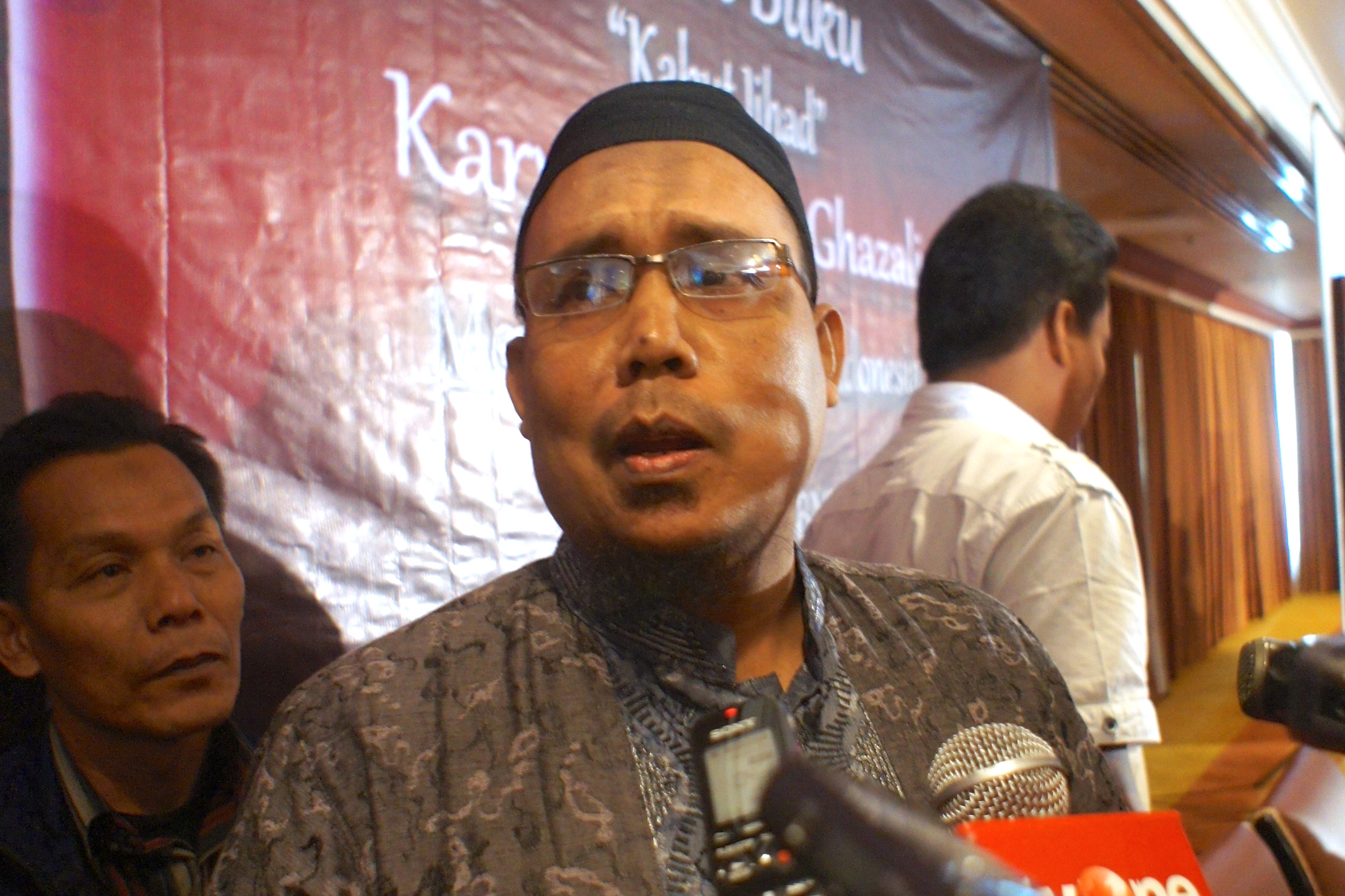
Khairul Ghazali, the author of Kabut Jihad, says he wrote the book to correct misperceptions about the nature of Jihad. He appeared at a book launch in Jakarta on June 20th. [Elisabeth Oktofani/Khabar]

A book launching in Jakarta is the occasion for open discussion among moderates and militants concerning Islamic values and the nature of jihad.

Khairul Ghazali, also known as Abu Yasin, is a former member of the Indonesian Islamic State (NII) militant group. He was allegedly involved in a 2010 bank robbery at the CIMB Niaga branch in

Renouncing the path of violence, however, he has now written a new book aimed at showing the dangers of extremism. The 370-page work, “Kabut Jihad” (“The Cloud of Jihad”), has elicited strong reactions.

A book-launching event, held at the Hotel Borobudur in Jakarta on June 20th, drew not only representatives of the government and Islamic organisations, but also former jihadis and members of the Jemaah Ansharut Tauhid (JAT), which the United States has designated a terrorist group. Its founder, hardline cleric Abu Bakar Bashir, is behind bars after being convicted of supporting a terrorist training camp in Aceh.

The Indonesian National Counterterrorism Agency (BNPT), a non-ministerial Indonesian government institution with a focus on counterterrorism, gave the green light for the book launch in the hope that Khairul, as former extremist himself, is well-positioned to explain why violence is the wrong direction for Muslims.

Khairul, who is serving a five-year prison term, arrived at the launch dressed in a batik and black skullcap. Guarding him at the public appearance was Special Detachment 88 (Densus 88), a special Indonesian counterterrorism squad.

“It needs to be understood that Indonesia is not a war zone because Muslim people are not attacking or fighting an enemy. Jihad must not threaten other people who lead peaceful lives,” he said, explaining that he wrote the book in order to counter mistaken perceptions among some Muslims.

Supporters say dialogue can combat violence

BNPT chairman Ansyaad Mbai said the book would promote a healthy dialogue about values, and in this way help the government reduce and eradicate the threat of terrorism.

“We want to motivate many prominent and influential anarchic ideologue terrorists and Islamic fundamentalist figures to write and publish more books on terrorism and radicalism in a fair kind of way,” he told Khabar Southeast Asia.

“The BNPT will facilitate a public discussion and invite moderate and radical people to sit, discuss, and criticise the book together so they can share their views – especially on jihad,” he said. Such open dialogue, he said, is “better than having anarchic-ideological figures writing and publishing books secretly with the purpose of provoking people.”

A spokesman for Muhammadiyah, the nation’s second-largest Islamic organisation, agreed that a former terrorist writing a book could help minimise the spread of violent ideology.

“I would say that this is a cultural and persuasive way to prevent the growth of terrorism. However, it must be done naturally where individuals truly regret committing acts of terrorism,” the spokesman, Abdul Mukti, told Khabar.

He warned that the Indonesian government must provide extra protection for Khairul and his family because fundamentalist organisations disagreed with Khairul’s decision to share his experience and regret.

“For sure, they will be hated by his former group because he had changed his view and has opposed acts of terrorism through his writing,” Mukti said.

Militant group takes a dim view

The JAT organisation has already criticised the book, with spokesman Son Hadi bin Muhadjir attributing the book to the author’s “confusion”.

“He is under physical and psychological pressure as a convicted terrorist,” the JAT spokesman said.

Abdul Munir Mulkhan, an activist and professor at Sunan Kalijaga Islamic State University, offered a contrasting perspective. In his view, the book does not go far enough in opposing violent jihad,

Even so, he said, it can help prevent the growth of terrorism and radicalism in Indonesia.

“I think the most important thing from Khairul’s book launch was the discussion where BNPT gave space for the radical and moderate Muslims to gather and share their views about jihad,” he said.

Judge: Patek can help deter youth from radical extremism

Khabar Southeast Asia

Judge: Patek can help deter youth from radical extremism

While some criticise the sentence as too light, others say Umar Patek has shown sincere remorse and can help persuade others from making the mistake that he did

The 20-year jail sentence handed down to Bali bomber Umar Patek on Thursday (June 21st) has elicited mixed reactions in Indonesia. Some say his sentence is an adequate warning to terrorists, while others insist he deserved to die for his role in ending so many lives.

“We all hoped that Patek would be given a death sentence because he helped to take hundreds of people’s lives by committing acts of terrorism, and the 2002 Bali bomb was the biggest terrorism attack in Indonesia,” Tony Soemarno of the Association of Bomb Victims in Indonesia (ASKOBI), told Khabar Southeast Asia.

But Noor Huda Ismail, a terrorism expert and founder of the Institute for International Peace Building, said the sentence was appropriate because Patek is a valuable source of intelligence and can help teach youth not to follow the path of extremist violence.

“I think that 20 years in prison is the correct sentence for Patek. He has given a lot of information to the police, especially about terrorist networks sending members to Mindanao, Pakistan and also Afghanistan,” he told Khabar.

“His information will be very useful for the police in tracking down terrorist networks in Indonesia,” Noor said of the one-time leading member of Jemaah Islamiyah, which has been linked to al-Qaeda.

Patek’s public acknowledgement of regret for the terrorist acts in which he participated will help discourage young people from turning to extremism, Noor said.

“Patek has told the public that he did not agree with the 2000 church attack or the 2002 Bali bombing,” he said. “And he has expressed his regret over his involvement.”

The 45-year-old terrorist was convicted on six charges, including premeditated murder of the Bali victims and for bombings at six Jakarta churches on Christmas Eve in 2000, as well as identification fraud and illegal possession of firearms and explosives.

According to the indictment against him, Patek was responsible for assembling the bombs that killed 202 people, most of them foreigners, at a nightclub in Kuta, Bali in October 2002. During his trial, however, he claimed he had only a minor role in the Bali attacks, was against them “from the start” and tried to stop them at the 11th hour.

He also apologised to victims and their families, the Indonesian government and the international community.

Prosecutors had sought a life sentence because he showed remorse during the four-month trial, while Patek’s attorneys asked for less than 15 years.

Encep Yuliardi, presiding judge of the five-member panel that handed down the sentence at West Jakarta District Court, said Patek had to be held accountable for his actions.

“He should know that no matter how small his role, the result was loss of lives,” Encep said at the sentencing. “He says he disagreed with it, but he could have rejected it and could have considered not following the orders of his seniors, or at least reporting [the plot] to the authorities.”

The bombings not only took a devastating human toll but also damaged Indonesia’s economy, the judge said. However, he added, Patek’s expressions of remorse and his public rejection of extremist violence were considered mitigating factors. Encep said he considered Patek’s statements to be sincere.

Patek’s sentence will deter others who might consider following the path of terrorism, while his example serves to show that misinterpretation of jihad creates a bad image for Islam, Encep said.


Indonesia: Sharia law pushes limits of local authority

Khabar Southeast Asia
The home ministry says it will call Tasikmalaya leaders for a meeting about their plans to impose Islamic law, including a requirement for women to wear headscarves in public.
A West Java municipality’s plans to implement Sharia-based laws and set up a police force to enforce them is testing the limits of regional autonomy in Indonesia, encroaching into areas that are typically the domain of the central government.
If enacted, the law in the town of Tasikmalaya would be the first of its kind in Indonesia outside the deeply conservative province of Aceh, where Sharia law was imposed in 2001.
According to Moenek Reydonnyzar, spokesman for Indonesia’s home ministry, Tasikmalaya city leaders would be overstepping their authority if they move ahead.
“Tasikmalaya cannot establish a Sharia police because the regional government does not have the authority to handle religious, legal and defense issues, as stipulated in the 2004 Regional Autonomy Law,” Reydonnyzar told Khabar Southeast Asia.
Indonesia implemented wide-ranging decentralisation in 1999, ending decades of authoritarian control under the Suharto regime. Regional autonomy has since been renewed and refined in subsequent legislation. Several areas remain under the domain of the central government, however, including defence, justice, legal, monetary, national fiscal and religious affairs.
Reydonnyzar said the home ministry will study the Tasikmalaya law – dubbed the “Regulation on Islamic-based Community Life Values” – and convene a meeting with local leaders to examine whether it is aligned with national laws.
“As soon as we study the regulation, the Minister of Home Affairs will invite the chairman of Tasikmalaya Council of Regional Representatives and the mayor to discuss it, especially how the regional regulation can be synchronised with the central government regulation,” he explained.
Aceh a model for Tasikmalaya?
Nasir Djamil, deputy chairman of the committee for the oversight of legal affairs in the Indonesian House of Representatives, said he would support the proposed laws in Tasikmalaya as long as they do not contradict national laws.
“As long as the purpose of establishing the Sharia police is to bring order to society and to protect society from ‘social disease’, I think it is all right and appropriate,” Djamil, a Prosperous Justice Party [PKS] lawmaker, told Khabar.
Aceh also has Sharia law and a Sharia police force, he added.
However, Aceh is one of five special regions that enjoy a greater degree of autonomy due to historic and cultural factors. Tasikmalaya is not among them.
The Sharia-based law was originally approved by Tasikmalaya Mayor Syarif Hidayat on September 24th, 2009 and is slated for enactment this year. It would require women to wear headscarves in public. In addition, it sets forth a list of 15 punishable offenses, including corruption, prostitution, adultery, homosexuality, drugs use and trafficking, consumption of alcoholic beverages, looking at pornography, thuggery, promoting cults, and abortion.
Andri Kurniadi, 31, a Tasikmalayan Muslim, told Khabar that implementing Islamic values in daily life is good, but the government does not need to establish a Sharia police to enforce them.
“Despite the fact that a majority of Tasikmalaya society is Muslim, the idea of establishing Sharia police would create pro and contra [factions] in society,” he said.
“The Sharia police would force people to implement the regulation, and it would just create pressure among us. Even worse, the hardline groups would also force society to implement it,” he added.
Bonar Tigor Naipospos, deputy chairman of the Setara Institute for Peace and Democracy, believes Tasikmalaya’s efforts to establish a Sharia police are inconsistent with the Indonesian constitution, which guarantees religious freedom. The city government, he said, should differentiate between private and social issues.
The idea of establishing a Sharia police is “odd”, Bonar told Khabar. “Before the regulation is adopted, it must be brought to the Supreme Court to be reviewed.”
He urged the Tasikmalayan leaders to collect input about the law from a variety of perspectives, including from women and others whose lives will be most directly impacted by it.

Patek: Bali bombings were "against my conscience"

Khabar Southeast Asia
Insisting that his role was minor and that he was remorseful over the devastation, Bali suspect
Umar Patek, on trial for his alleged role in the 2002 Bali bombings, told the West Jakarta District Court Thursday (May 31st) that he felt deep remorse over the terror attack. Insisting that his role in the plot had been a minor one, he asked the judges for leniency.
“I felt so upset and guilty when I saw the bomb killed many people. I said to [the attackers] that it was my last involvement in this kind of activity,” he told the court.
“It needs to be understood that whether I came or I did not come to Bali, the 2002 Bali bomb incident would have still happened because they had been working on their plan. The bomb which was detonated on October 12th, 2002 was not due to my active involvement, because I had been strongly against the idea,” Patek said.
He said he had mixed only 50kg of chemicals, compared to the remaining 950kg prepared by others, and that he had done so with reluctance. The plot was “against my conscience”, the defendant said, reiterating his earlier expressions of regret.
A total of 202 people died as bombs went off in quick succession at two locations. The first, hidden in a suicide bomber’s backpack, exploded at Paddy’s Pub in the Kuta nightclub district. Twenty seconds later, a massive car bomb destroyed the nearby Sari Club and surrounding areas.
Patek – dubbed “Demolition Man” in the media – had begun his trial with the reputation of having masterminded the attack, but his defense team has argued this was far from the case.
Reading from a 31-page, handwritten defense statement which he said took him two weeks to prepare, Patek drew a sharp comparison between himself and Muhammad Ihsan, also known as Idris, who received a 10-year sentence for his role in the 2003 bombing of Jakarta’s JW Marriott Hotel but acquitted in the Bali attack.
Idris, he alleged, knew what the Bali bombing targets were, had surveyed the area, and received as much as $30,000 to aid with the plot — whereas he, Patek, was mostly in the dark. He voiced hope that the judges would give him a proportionately lighter sentence.
“All this time, the mass media have been reporting that I had a big role in the incident, as if I was the one who assembled [the bomb], Patek told a press conference after the hearing. “But the trial’s facts have proved that my role is minor… I am only a deer, not an elephant.”
In a trial session on Monday, Patek’s attorneys recommended that he be jailed for less than fifteen years. The prosecution disagreed, however, saying a life sentence was appropriate.
The demand for a longer sentence is “based on the facts during the hearing,” prosecutor Bambang Haryadi told reporters, rejecting a claim by Patek that his team had not considered what came to light in the trial.
The trial proceedings will resume on 4 June.