Prosecutors seek life sentence for remorseful Patek

Khabar Southeast Asia

Prosecutors seek life sentence for remorseful Patek
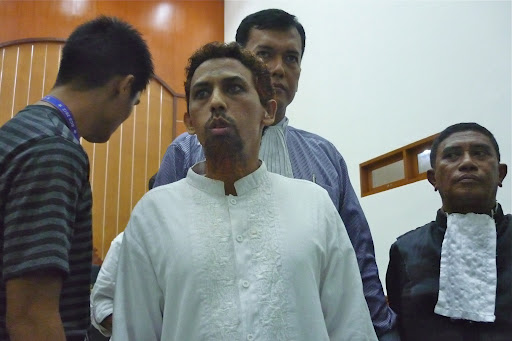
On Monday (May 21st), prosecutors at West Jakarta District Court demanded a life sentence for Umar Patek, accused of involvement in the 2002 Bali bombings. The defendant again apologised to the victims and their families, as well as to the people of Bali, the Christian community and the local and national governments. [Elisabeth Oktofani/Khabar]
The accused Bali bomber’s life should be spared because he regrets his actions and has co-operated with investigators, prosecutors told the West Jakarta District Court.
Prosecutors on Monday (May 21st) said accused Bali bomb maker Umar Patek should spend the rest of his life in jail, but stopped short of seeking the death penalty because they said he had been co-operative and shown remorse.
“We are recommending that Umar Patek be given a life sentence,” prosecutor Bambang Suharyadi said.
Patek, on trial for his alleged role in the 2002 Bali bombings and a spate of attacks on Christian churches two years before that, repeated his apologiesduring his appearance at West Jakarta District Court on Monday.
“I regret what I have done… (and) I apologise to the families of victims who died — Indonesians and foreigners,” said Patek, addressing the victims, their families, the people of Bali, the Christian community, and the local and national governments. “I apologise also to victims who were injured.”
According to Bambang, the defendant should be found guilty of premeditated murder and the use of explosives to commit acts of terrorism, among other charges.
The bombings claimed 202 lives and had a devastating impact on the local people, the prosecutor said, adding that they were rooted in an erroneous interpretation of Islam.
“Patek’s actions, which were motivated by a wrong teaching, caused long and deep suffering among Balinese society,” he said.
However, he added, Patek has acknowledged a role in the attacks and co-operated throughout the judicial process.
“On the top of that, he also regretted his involvement and apologised to the victims and their family in front of the public,” Bambang added.
When his trial began in February, prosecutors said they would seek the death penalty. Imam Samudra and brothers Amrozi and Ali Ghufron, three key figures in the 2002 bombings, were convicted and executed by firing squad in November 2008.
Terrorism expert Noor Huda Ismail said it was important that Patek remain alive because of the information he could still yield, according to AFP.
“Patek is an encyclopedia of information on the who’s who of al-Qaeda in Southeast Asia,” said Ismail, executive director of the Institute for International Peace Building in Jakarta.
“Unlike the executed Bali bombers he showed remorse, meaning there’s little chance he will try to plan future attacks from jail. He can also be used as a figure to speak out against terrorism,” he said.
Patek is accused of being the expert bomb maker for the Jemaah Islamiyah terror network. Once the most wanted terror suspect in Indonesia, he spent nearly a decade on the run but was captured in January 2011 in Abbottabad, Pakistan, where al-Qaeda chief Osama bin Laden was holed up.
During his trial he denied playing a major role in the Bali attacks, saying he only helped mix explosives but did not know how they would be used.
The trial will resume on May 28th, when Patek’s lawyers will read his defense. A verdict is expected June 21st.

Hardline groups introduce new strain of intolerance

Khabar Southeast Asia

Indonesia’s reputation for pluralism and diversity is under threat by militant ideologues and their supporters, civil liberties activists say
Andreas Yewangoe wants to see more effective steps taken to protect religious tolerance in Indonesia.
“Why can’t we live in harmony and peace in this country, where nobody cares about the differences in our religion, race and ethnicity?” the Indonesian Communion of Churches (PGI) chairman told reporters after an incident in which a hardline Islamist group – the Islamic Defenders’ Front – blocked a local congregation from worshipping at their church.
“This kind of action is really contrary to the Indonesian constitution,” he added.
On May 6th, the congregation of the Batak Christian Protestant Church (HKBP) Filadelfia gathered for a service, only to be heckled and bullied by FPI vigilantes. The Filadefia branch is at the center of an ongoing local dispute in Bekasi, West Java, over whether it has the right to hold Christian services at its church building.
A journalist at the scene, Rhesya Agustine, said the mob was intimidating women with threats of sexual violence. “They yelled at us by saying ‘Rape them! Rape them!’ I was so surprised that the situation was so chaotic”.
Another reporter at the scene, Tantowi Anwari, was beaten — allegedly by FPI members angered by a slogan on his T-shirt. It read: “Fight the tyranny of the majority.” Police had to rush him to safety.
According to a video recording of the attack presented at a press conference, the attacks were led by Murhali Barda, a former head of the Bekasi chapter of the FPI. He was jailed for five months last year for inciting an attack in September 2010 that culminated in the stabbing of two leaders of the HKBP Ciketing, also in Bekasi.
On Thursday (May 17th), a mob again disrupted worship services at the Filadelfia church, blocking access to the building as parishioners tried to enter in order to celebrate the ascension of Jesus.
“We [the churchgoers and the mob] were only separated by a barricade of policemen who managed to protect us even though the intolerant people were trying so hard to break through the barricade,” the Jakarta Post quoted the church’s Reverend Palti Panjaitan as saying.
“They threw urine, sewage and frogs at us — all of which also struck the policemen,” he added.
The melee was one of several recent incidents involving aggressive action by hardline Islamist groups. On May 4th, two days before the church rioting, members of the Indonesian Mujahedeen Council – an organisation linked to convicted terrorist Abu Bakar Bashir – disrupted a book discussion at the Institute for Islamic and Social Studies Foundation in Yogyakarta.
The featured speaker that day was Irshad Manji, a liberal Canadian Muslim activist and author.
“They beat the participants and also my assistant,” Manji told the media. “The attackers wore masks and helmets while they beat innocent people and destroyed everything. They are really cowards.”
Her appearances in Jakarta also provoked threats and disruption, prompting the author to suggest that extremists are undermining the country’s longstanding values.
In a statement to the media, Manji recalled how she visited Indonesia four years ago and found it to be a tolerant, open-minded and pluralistic country. She recounted the experience in her book and suggested that Indonesia was an example for other Muslim countries.
“Unfortunately, things have changed,” Manji said.
“Many people told me that the Indonesian National Police and government are powerless towards these gangsters. But Indonesian citizens must not be powerless,” she added.
Citizens’ groups, meanwhile, are campaigning for better protection of civil liberties. On May 10th, a movement calling itself “FPI-free Indonesia Movement” submitted a petition to the national police, demanding serious action.
Over 1,500 people have joined the campaign, organised via blogs and Twitter.

Indonesia’s Shia Muslims face pressure

Khabar Southeast Asia

Indonesia’s Shia Muslims face pressure

 
Amid increased harassment of Shia Muslims and other religious minorities, the country’s moderate Muslim organisations are calling for tolerance.
Numbering around 6 million, Shia Muslims form under 3% of Indonesia’s population. Despite its history of tolerance and religious diversity, they have become the target of intimidation in recent years, even being driven out of villages by mobs of vigilantes.
Some Muslim organisations in the Sunni-dominated country have been calling for the government to impose restrictions on them, arguing the Shia Muslims are not practicing real Islam.
Last month, the Indonesian Ulema Forum (Forum Ulama Ummat Indonesia, FUUI) issued a fatwa demanding that the Ministry of Justice and Human Right and the Ministry of Religious Affairs revoke the licence of all organisations with a Shia viewpoint and ban their activities.
“We’ve been monitoring Shia groups in West Java for more than 20 years and they seem to be braver in practicing their belief openly. Shia is actually a form of blasphemy against Islam because they have different view on the leadership of Muslim people,” FUUI leader Athian Ali Muhammad Da’i told Khabar Southeast Asia.
“Please don’t get us wrong. We respect any religion. But if Shia people want to keep practicing their view, they must establish their own religion without Islam’s name because Shia is not part of Islam,” he said.
“It is just like our demand to [the minority sect] Ahmadiyah to establish their own religion if they want to practice their view,” he added.
But not all Muslim leaders agree. According to Imdadun Rahmat, deputy secretary general of the moderate Islamic organisation Nahdlatul Ulama, Sunni and Shia Muslims have the same God, Allah; the same prophet, Mohammad; and the same holy book, the Qur’an.
“Even though Shias differ on who was to take over the leadership of the Muslim community after the Prophet died, we still consider Shia as part of Islam and we do not dismiss Shia,” he said.
It is not the government’s role to intervene in religions disputes or enforce fatwas, he added.
Religious organisations can issue fatwas or decrees on certain topics but they must not force any individual or government to implement them, Imdadun said.
“Fatwa is a study which is conducted by Islamic jurists (ahli fiqih Islam) on a certain topic,” he went on to explain.
“In other words, a fatwa is a religious opinion that is issued by a religious organisation on any topic and it is not a legally binding instrument. It is implemented by an individual who has a belief in the fatwa,” he said.
“Therefore, no one can be forced to implement a fatwa in his or her life. Or force the government to make it a foundation for public regulation.”
A Shia cleric, Tajul Muluk, is currently on trial in Sampang, East Java for blasphemy. Muluk, the head of a Shia Muslim boarding school on Madura Island, was arrested after the Indonesian Ulema Council (MUI) issued a fatwa describing his teachings as “deviant”.
According to a report in The Jakarta Globe, more than 300 members of Sampang’s Shia community were displaced in December 2011 when a mob of 500 people attacked and burned Shia houses, a boarding school and a place of worship there.
The persecution of religious minorities has little precedent in Indonesian history, Rumadi, a senior researcher at the Wahid Institute, noted in an April 29th article in The Globe.
“One of our conclusions is that society has become prone to intolerance. What used to be considered as acceptable has become unacceptable,” he said, citing mob violence against Shia Muslims in particular.
Abdullah Beik of Ahlul Bait Indonesia (ABI), an organisation that advocates for Shia Muslims, described FUUI’s demand as odd.
“It needs to be understood that even in Saudi Arabia, Shia Muslim has a place and we can go there for Umrah. Therefore, the FUUI demand is very odd,” he told Khabar.
Moreover, Abdullah added, we must not forget that since we live in Indonesia, which has a motto of Bhinneka Tunggal Ika (Unity in Diversity), we must respect each other and live side by side in harmony with other people who have different backgrounds.
Jakarta resident and Sunni Muslim Ahmad Aqiqi, 30, also does not agree with the FUUI edict.
“As long as their religious practice does not violate any human right and regulation, I think every Muslim has the right to choose what kind of Islam they want to believe,” he said.

Bali suspect apologizes to victims, says bombings were wrong

Khabar Southeast Asia
Umar Patek, on trial for his alleged role in Indonesia’s deadliest terror attack, said he was sorry “from the bottom of my heart”.
 
Speaking at his trial on Monday (May 7th), terror suspect Umar Patek made a dramatic apology to victims of the 2002 Bali bombing, saying he was sorry he had not reported the plot to police
“From the bottom of my heart, I sincerely apologise to all the victims, victim’s families, the Bali community, the Christian community in Jakarta, the Bali government and also the Indonesian government,” he said, his voice breaking with emotion.
Patek, 45, is alleged to have played a key role in building the car bomb that killed over 200 people at a nightclub in Bali’s Kuta area in October 2002. He faces terrorism charges that could bring him the death penalty should he be convicted.
“I was very sad and regret the incident happened, because I was against it from the start. I never agreed with their methods,” said the defendant, clad in a white shirt.
He told the West Jakarta District Court that the bombings were a total failure as far as he was concerned, and that he had objected to plans drawn up by the ringleader, Ali Ghufron, also known as Mukhlas.
“Mukhlas said that their intention was to enact revenge for the massacre of Muslims in Palestine, but they targeted the wrong people,” he said, adding that the Westerners and Indonesians killed by the bombings had no connection with the Palestinian issue.
Asked by presiding judge Encep Yuliadi why he did not report the plot to the police if he disagreed with it so strongly, the defendant said he was unable to leave the group and feared harassment if he turned them in.
“I could not leave because I did not have enough money to go back,” Patek said. “[Senior Jemaah Islamiyah militant] Dulmatin paid for my travel expenses and I only had Rp 10,000 (around $10) in my pocket as I had left my money with my wife before I went.”
“Apart from that, if I reported the plan to the police, there would be a great slander against me among the Muslim activists,” he added.
Patek was arrested in January 2011 in Abbottabad, Pakistan – the same city where bin Laden was hiding out at the time of his killing in May of last year. Although many have speculated that the Java native was hoping to meet the late al-Qaeda leader, Patek has denied knowing he was there.
During the course of his trial, two former associates testified that al-Qaeda sent the Bali bomb plotters as much as $30,000 – money which paid for the Mitsubishi used in the attack.
Patek insisted again Monday that he had never met bin Laden in person. While acknowledging that he helped mix the explosives, he insisted that his participation was minimal and occurred under duress.
“As [Bali plotter] Sawat knew that I was really against the idea, he said to me that it is better for me to do what they said because I was just a slave and I could not push them to change their plan,” Patek said.
“I think this is my destiny that I have been captured and I am ready to take all the responsibility for my involvement,” he told the court. “Once again, I apologise to all the victims and their families.”
“I also thank the Indonesian government for bringing my wife and me back to Indonesia so the legal process could be conducted here,” Patek said.
The trial proceedings will resume on May 21st.

Witness: Patek said terror attacks were against Islam

Khabar Southeast Asia
Bali bombing suspect Umar Patek was concerned that violence against civilians went against Islamic teachings and created a bad image for Muslims, according to a fellow militant who testified at his trial
Umar Patek disagreed with the extremist programme of carrying out violent attacks because he felt it represented a misinterpretation of jihad and would create a bad image for Muslims, an ex-militant told the West Jakarta District Court on Thursday (April 3rd).
Patek, alleged to have played a key role in building the car bomb that killed 202 people at a nightclub in Bali’s Kuta area in October 2002, faces terrorism charges that could bring him the death penalty should he be convicted.
According to a court document, Patek fled to the Philippines after the 2002 blast and joined the Moro Islamic Liberation Front (MILF), which has been waging an armed campaign for autonomy. The Philippines insurgents, who deny being connected to al-Qaeda or Jemaah Islamiyah (JI), are currently in peace negotiations with the Philippines government.
“I did not know if Patek was involved in the 2002 Bali bomb attack because he never told me about it,” testified Iqbal Huseini, an Indonesian jihadist, who joined the MILF in 2003.
“But he always said that he disagreed with all the attack programmes in Indonesia because Indonesia is not a war zone and it is against the message of jihad,” he said.
Moreover, Iqbal said, Patek on one occasion quarreled with JI cell leader Sayid Ali, nicknamed Dulmatin, over the latter’s plan to explode bombs at several locations as a form of revenge against Indonesian security forces.
“Although Sayid was the leader, Patek was strongly against the idea. It was because those targeted points are Islam-majority areas and he reminded us that our enemy is not civil society,” he continued.
Mass casualty attacks by al-Qaeda-linked extremists jolted Indonesia during the past decade, but the capture or killing of key JI leaders as well as public revulsions against the carnage has blunted the trend.
Al-Qaeda itself is believed to be in disarray, suffering the loss of personnel and a steadily deteriorating reputation among Muslims. Thursday’s testimony came amid revelations that Osama bin Laden himself was deeply concerned about the trend during the months leading up to his death in May 2011.
A selection of memos found at the bin Laden’s Abbottabad hideout was released Thursday by the US government. In one document, dating from 2010, bin Laden expresses alarm that al-Qaeda has become stigmatised because of its role in killing thousands of Muslim civilians.
A 2006 letter addressed by a “loving brother whom you know and who knows you” complains that the word jihad has fallen into disrepute due to al-Qaeda’s tactics, and calls for bin Laden to change his ways.
Although Patek was captured in Abbottabad in January 2011, not far from bin Laden’s compound, it has not yet been established whether or not he had tried to contact the al-Qaeda leader.
Thursday’s testimony provided possible insights into the shadowy world of militant extremists, who cross borders to wage religious warfare. The MILF fighters he met included Malaysians as well as Indonesians and Filipinos, Iqbal told the court.
He said he was taught to use many kinds of weapons after arriving at the MILF camp.
“While I was there, I was trained to use arm guns such as M16 rifles, long rifles and also mortars, to read a map and also about war strategy. MILF provided all the arm guns with a registration number. Therefore if we left the camp, we had to return it back to them,” he said. “However, we were not trained to build any bomb at all.”
Patek often gave briefings to Indonesian volunteers with the MLIF, especially on the topics of war strategy and the purpose of jihad. He believed jihad should only be carried out in areas of conflict, Iqbal said.
The trial proceedings will resume on Monday.

Muslim leader: terrorists must stop undermining Islam’s image

Khabar Southeast Asia
A witness at the trial of Umar Patek said extremists have taken the lives of innocent Muslims and are undermining Islam.
Attacks by radical extremists have cost the lives of Muslims and tarnished the image of Islam, a Muslim community leader from Kuta testified Thursday (April 24th) before the West Jakarta District Court during the trial of Umar Patek.
Speaking of his emotions following the 2002 bomb attack in Kuta that cost the lives of over two hundred people, he recalled the story of one victim, Mohammad Taufik.
“Taufik was such a genuinely nice, religious man and he had actually planned to perform umrah [pilgrimage] in 2003 with his wife. They had already paid the expenses. But unfortunately he was killed in the 2002 Bali bomb attack,” Agus Bambang Priyatno, the community leader, told the court.
He said such acts of violence have undermined Islam’s reputation as a religion of peace.
“The 2002 Bali Bomb attack has been destroying my religion’s image across the globe. It has been creating a bad image that Islam is identical with terrorism and violence,” he said.
“Therefore I’m demanding to all the radical Muslims to stop any violent action and terror attacks conducted in the name of Islam,” Agus said.
“It will destroy Islam’s image as if Islam is a religion, which is identified with terrorism and violent actions.”
“Besides that, this is also destroying Indonesia’s credibility as a moderate Muslim nation internationally.”
Patek, alleged to have played a key role in the bombings, faces terrorism charges that could bring him the death penalty should he be convicted. He appeared to listen attentively to the testimony by Agus.
Patek then briefly responded, saying that he too regretted the incident’s impact.
Also testifying was Ruqqayah, Patek’s wife. She said she knew nothing about Patek’s relations with the late al-Qaeda leader Osama bin Laden, and was in the dark about her husband’s alleged role in the Bali bombing or the Christmas Eve bombings two years earlier, in which 18 died.
“My husband did not tell me anything about it,” she said, describing herself as an obedient wife who always did what she was asked to do.
Even when the couple fled to Pakistan, using aliases to conceal their identities from authorities, she did not know why they were using false names and did not ask her husband to explain, Ruqqayah said.
“I just did what I was asked by my husband and I did not question anything about it,” she said, describing Patek as a genuinely nice man who loved her.
“When we arrived in Pakistan, we were picked up by a man whom I just met for very first time, and we went to Lahore then continued the trip to Multan. And I did not know where we went next and we just lived there for couple months until we were arrested,” she continued.
“In that city [Abbottabad], we were told to not leave the house at all by the person, whose name I did not know. So we just stayed inside to study the Qur’an and pray a lot,” Ruqqayah testified. Following her testimony, Presiding Judge Encep Yuliadi allowed the couple to embrace each other.
The trial proceedings will resume on Thursday.

Witnesses: Loopholes in system helped Patek flee

Khabar Southeast Asia
 
A former immigration officer who approved Umar Patek’s passport said no red flags came up in his application.
Terror suspect Umar Patek was able to flee Indonesia in 2009 because he went unrecognised by immigration authorities, witnesses testified Monday (April 23rd) before the West Jakarta District Court, citing deficiencies in communication and the fact that he was using an alibi.
“Our travel-ban list system is only in the form of a name list and identification without any photograph,” said former immigration officer Asni Redani Suandi, who interviewed Patek when he applied for travel papers in 2008.
“As long as they meet the entire requirements and they are not listed on the travel-ban name list, any Indonesian citizen could be granted a passport,” she said.
Although a police most-wanted list was placed in her office, Suandi said, she did not recognize Patek – who was going by the name Anis Alawi.
His application was complete and he passed the interview. As a result, her office issued a passport, which he then used to leave the country.
Patek is charged with participating in a succession of terrorist attacks, including the 2002 bombing of two nightclubs in Bali. A total of 202 people died in that incident, for which he faces the death penalty if convicted.
Nine years later, he was captured in Pakistan. Indonesian authorities, whose counterterrorism efforts have largely reined in the Jemaah Islamiyah extremist group, have been struggling to pin down the sequence of events that allowed Patek to make it so far.
Monday’s trial proceedings largely focused on vulnerabilities in the passport system, with judges saying procedures must be tightened and communication improved.
Asni told the court that, according to standard operating procedure, a passport applicant must submit a copy of his or her identity card, family card, and birth or marriage certificate. Once all the required material is provided, he or she will be called in for an interview and asked to bring the original documents for verification.
During the interview stage, applicants are asked several questions, she said. They may be asked to give their name, address and birthday, as well as to state their purpose in applying for a passport.
“If I was not mistaken, the defendant told me that he would use the passport for Umrah [pilgrimage to Mecca],” she told the court.
Muhammad Marsudi Rasyid, who heads the intelligence department at East Jakarta Immigration Office, told the court that the name Anis Alawi did not appear in the travel ban list in connection with terror activities. But the name Umar Patek did appear, he said.
“Our travel-ban list system only takes the form of a name list without photograph. If somebody has a different name, they can just pass through immigration and we cannot verify based on their pictures,” Marsudi told the court.”Even today, the travel-ban list system is only in the form of a name list without photograph.”
According to the panel of judges hearing the case, Monday’s testimony shows the need to improve co-ordination from ward level to immigration level.
In particular, they said, it is crucial to make sure that key documents cannot be falsified any more.
“What would the world say if this kind of thing keeps happening in Indonesia?” judges said as the hearing closed. Proceedings will resume on Thursday.

Mob damages minority sect mosque

Khabar Southeast Asia
 
Responding to last week’s ransacking of an Ahmadiyah mosque, Indonesian authorities warn that violence will not be tolerated.
Government officials are promising a thorough investigation and legal action after a mob attacked and ransacked a mosque used by the minority Ahmadiyah sect just before Friday prayers (April 20th)
Co-ordinating Minister for Political, Legal and Security Affairs Djoko Suyanto said West Java police were handling the case and that legal action would be taken against those responsible.
“Violence is not allowed. Whoever did this will be dealt with,” Djoko told reporters outside the State Palace in Jakarta on Friday, according to a Kompas report.
Separately, Home Minister Gamawan Fauzi ordered local police to thoroughly investigate the attack.
At least 80 people broke into the Baitul Rahim Mosque in the Singaparna subdistrict of Tasikmalaya, West Java, about 260 km southeast of Jakarta. They damaged the roof, broke windows, and burned the carpet and prayer mats, police said.
No one was reported injured in the attack, which took place around 10 am on Friday and lasted 20 minutes.
Firdaus Mubarik, an Indonesia Ahmadiyah Congregation (JAI) spokesman, told Khabar Southeast Asia, that the Islamic Defenders Front (FPI) carried out the attack.
“This is actually not the first attack that happened to Ahmadiyah Mosque in Singaparna because they also did it on April 12th,” Firdaus said.”The attack began when they handed a letter of objection regarding use of the mosque,” he said.
Although Muslim-majority Indonesia is a secular country where freedom of religion is protected under the constitution, some religious minorities in recent years have been targeted by hardline Islamist groups.
Such groups say the Ahmadiyah sect, which follows the teachings of a 19th century religious figure from India, should be banned. Regional governments have placed restrictions on the sect, and the central government in 2008 issued a decree restricting Ahmadis from spreading their beliefs.
A spokesman for the West Java Police, Senior Commander Martinus Sitompul, denied allegations by the JAI that the local authorities failed to step in.
“It is not true we let it happen without any prevention,” he told Khabar. “As a notification [of plans to deliver the letter] had been given to us, we deployed our officers to prevent any violence that might occur. But during the handing of the letter, [the] Ahmadis said something which was provocative and we tried to prevent the violence which occurred,” he said.
Awid Mashuri, deputy secretary general of the FPI, denied the group’s involvement amid reports some mob members were carrying FPI flags or dressed in the group’s trademark white and green.
“It was Singaparna neighbouring residents that attacked the Ahmadiyah mosque. It is because the Ahmadiyah congregation has broken the agreement for not holding any activities anymore in their mosque,” he told Khabar.
“If there were FPI accessories worn by any of the mob, it does not mean that they are FPI members because they might just buy accessories from the shop,” he said.
If FPI involvement is proven, the group could be banned, because it has already been warned twice over use of violence, Home Minister Gamawan said.
“Another [incident of] big-scale violence by the FPI would meant that the organisation is eligible to be frozen,” The Jakarta Post quoted him as saying.

Lawmaker: Police must do more to protect religious minority groups

Khabar Southeast Asia
Indonesian police ask minority groups to “give up” to avoid conflict, rather than protecting their rights, legislator charges
The National Police force has not sufficiently improved its ability to protect religious minority groups, experts agreed at a recent Jakarta panel discussion.
Although Muslim-majority Indonesia is a secular country where freedom of religion is protected under the constitution, some religious minorities in recent years have come under attack by hard-line Muslim groups.
Reform measures tend to focus on expanding the central police administration rather than strengthening the capacity of local forces to handle violence against minority groups like Ahmadiyah and GKI Yasmin, said Eva Kusuma Sundari, a member of House of Representatives (DPR) and its legislative committee overseeing legal affairs.
In handling such violence, police often emphasise preserving social order over protecting the minority groups, Eva told a meeting at the Jakarta Foreign Correspondents Club on March 28th.
“Instead of providing protection, police often asked the minority group to give up, to prevent a physical conflict,” she said. “They argue that they cannot guarantee [a] radical group will not come back to attack again, as they cannot mobilise and provide protection all the time.
“However, as a law enforcement agent, police must focus on providing a protection of human rights [rather] than accommodating a social order.” The Islamic minority sect Ahmadiyah has been a target of deadly attacks in Indonesia, and members of a small Christian parish in Bogor, GKI Yasmin, have been prevented from worshipping in their church.
Congregants celebrated Easter in secret this year, and did not notify police of the location, since police presence did not stop dozens of hard-liners from the Reform Movement (Garis) and the Muslim Communications Forum (Forkami) from disrupting their Christmas services, GKI Yasmin spokesman Bona Sigalingging recently told The Jakarta Post.
“The police were there, but they did not do much to help us. Ever since, we have found no point in telling the police about our activities,” Bona said.
Eva said she was frustrated that her colleagues in the House of Representatives often view violence against minority groups as a local matter rather than a law enforcement issue.
“However, it is a must for the police to change their policy and strategy to improve the community police,” she said.
Responding to the criticisms, National Police spokesman Sr. Comr. Boy Rafli Amar said police are committed to enforcing Indonesian laws and to pursue anyone who violates them.
Indonesians have the right to form mass organisations, he pointed out, also noting that police investigated Islamic Defenders Front (FPI) leaders in 2008.
Known for raiding bars, clubs and gaming halls during Ramadan, the FPI reached a new level of visibility in January when its members threw rocks at the Home Affairs Ministry to protest its decision to annul local laws banning alcohol sales.
“Even nowadays, we are still communicating with FPI leaders to guide them to not violate the law anymore,” Boy said, adding that “the FPI are no longer conducting sweeps in night clubs.”
He said the police had to work to educate segments of the population who remain unaware of some aspects of the law and human rights within the still-developing country.
Johnson Panjaitan of Indonesian Police Watch urged national police to train local forces in handling religious conflict, especially in regions where the potential for such conflict is high.
Police intelligence must be strengthened to prevent religious conflict in the first place, he said.
Beyond that, the police are hobbled by a lack of action from the government, in his view.
“Sadly enough the state is actually not brave enough to disband a hardline group such as FPI,” he said.
“Therefore it needs to be understood that this is not only a police problem but the government’s problem as well. And we need to support the Indonesia National Police,” he added.
Research conducted by Jakarta’s Paramadina University and Gadjah Mada University shows that police were present only 25% of the time in 718 violent incidents between 1990 to 2008.
In 1999, shortly after the end of the Suharto regime, new laws formally separated the Indonesian National Police from the military, which had controlled the force for decades.

Witnesses detail impact of Bali bombings

Khabar Southeast Asia
The attacks that killed 202 also dealt a massive blow to the region’s economy, Balinese officials said Thursday.
Testifying Thursday (April 12th) in the trial of accused Bali bomber Umar Patek, Balinese officials spoke of the impact the 2002 attacks had on the island’s tourism industry, while a forensic doctor recalled the horrific aftermath.
“At the very beginning, we could not identify the victims because many of them were damaged and could not be recognised anymore,” said the doctor, Ida Bagus Putu of Denspasar’s Sanglah Hospital.
“After three months of identification processes, we could identify 199 out of 202 people.”
The bodies had burns as well as wounds showing that objects had penetrated them at high speed, he said.
“Other than that, we also received 325 body parts from the victims, but we could not identify 140 body parts because they had become rotten,” he told the court.
Doctors were able to distinguish 78 women and 117 men among the victims, but others could not be identified by gender, the doctor testified.
The twin bombings on the night of October 12th, 2002 – one carried out by a suicide bomber wearing an explosives-laden vest, the other a massive car bomb detonated outside a crowded nightclub – are considered Indonesia’s worst-ever terror attack. According to Balinese officials who spoke during Thursday’s trial proceedings, they also increased poverty on the island by disrupting a vital sector in its economy.
“Compared to the hotel occupancy in October and November 2001 and 2002, the number dropped significantly [after the bombings]. The bomb attack was really an impoverishment process for Bali,” testified I Gusti Ngurah Oka Darmawan, the former head of the tourism department in Badung.
Eighty percent of district revenues come from the hotel and tourism industries, which also have an economic impact on surrounding localities, he said.
“It took us two years for recovery,” he added.
Ngurah Mas Wijaya Kusuma, an immigration officer from Ngurah Rai Airport, told the court that the bombings had significantly affected the number of tourists coming from abroad.
“According to our data, the number of foreign tourist dropped 70% compared to 2001. Before the attack, the number of foreign tourists stood at around 100,000 to 159,000 visiting Bali every month,” he said.
As of September 2002, the number stood at 153,000. But the figure dropped to 81,063 in October and 31,477 the following month, Ngurah said.
Patek, the defendant in Thursday’s proceedings, is the last Bali bombing suspect to go on trial and faces the death penalty if found guilty. His trial began in February and is expected to last four months.
The main actors in the bombings – Mukhlas, Amrozi and Imam Samudra – were convicted and executed in 2008.
Prosecutors on Thursday called to the stand two men convicted for their supporting roles in the attack, hoping to shed more light on how much Patek knew about the plot. He has acknowledged mixing the bombs but insists he was in the dark concerning the actual plans for their use.
One of the men, Sarjiyo, confirmed that he and Patek attended a military training camp in Pakistan, where they studied war strategy, bomb making, and mapping.
In September 2002, as Sarjiyo was busy mixing 700kg of explosive materials, he requested Patek’s help, the witness said.
Patek’s role in the bomb preparation was minimal and limited to the final stages, he explained.
“When Patek arrived, I was about to finish mixing the material and there were 50kg of explosive material left over. So I asked him to help me to finish it because I knew that Patek has similar knowledge,” Sarjiyo said.
The trial proceedings will resume on Monday