The Jakarta Globe
Reaching for the Stars With Down Syndrome
The Jakarta Globe
A Second Shot at an Education
The Jakarta Globe
Indonesian Women in Their Own Words
The Jakarta Globe
Reproductive Health 101 For Students
The Jakarta GlobeMaking a Home For Indonesian Prose Online
The Jakarta GlobeKenyan Safari Offers Glimpse of the Wild
The Jakarta Globe
Indonesian Entrepreneurs Chasing Dollars in East Timor
The Jakarta GlobeElisabeth Oktofani

Indonesian-owned restaurants, such as the bakso eatery above, are popular in East Timor. (AP Photo)
Indonesian Entrepreneurs Chasing Dollars in East Timor
Previously known as an area of conflict, East Timor is becoming a land of opportunity. Indonesians often go abroad to take menial jobs such as cleaners or laborers. But in East Timor, they are able not only to create happy lives for themselves and their families, but to participate in building that country’s economy.
Meina Sumino from Tulung Agung in East Java owns a Javanese restaurant in Fatuhada, Dili, and said she is better off “earning gold” in East Timor than suffering as a cleaning lady in Malaysia.
“When my husband and I first arrived in Dili, we were very apprehensive about how we would survive in this country,” she said. “But we had heard many good things from people in Indonesia.
“When we got here, we found it is a hard and dry land, and there were many United Nations police on the streets. That frightened us a little, but did not deter us. The presence of the United Nations comforts us, although they remind us that while things are stable now, they were not so in the past.”
East Timor’s president, Jose Ramos-Horta, spoke about the large number of Indonesian migrants in the country last month in an address to the nation on the 10th anniversary its vote for independence from Indonesia.
“Of the foreign workers who are flocking into our country, many have come from Indonesia,” he said. “Some are here on work visas. Others entered on tourist visas. Many are here illegally. When I drive around and see their faces, observe their hard work in trying to earn a modest income, I think of the villages and families they left behind pursuing the dream and what is often the illusion of a better life elsewhere. How they end up here is still a mystery to me. But here they are, many thousands of them. We welcome them and must find ways to legalize their stay.”
“One thing that is quite difficult to handle here is working permits,” said 50-year-old Haji Baharudin, who started a shoe business in Kampung Alor in 2001. He said Indonesians could establish businesses only after obtaining a work permit from the Department of Immigration in the Ministry of Defense and Security, and registering with the Ministry of Tourism, Commerce and Industry.
Baharudin left East Timor in 2004 when business started slowing down and returned to his family in Soe, East Tusa Tenggara. However, he went back to Dili in 2007 because, he said, the opportunities are better there.
“I will say people [in East Timor] don’t know how to spend their money wisely,” he said. “After they get their salary at the end of every month, they appear to spend it very quickly on things that may or may not have much value to them. They are not yet very savvy consumers. That’s very different from most Indonesians.”
The government is the largest employer in East Timor and salaries are high compared to Indonesia. A senior civil servant earns approximately $700 per month, while the same position in Indonesia pays only half that. In Dili, small restaurant owners said they could take in $100 per day, more than twice what they could earn in Indonesia.
Baharudin said he could buy shoes in Indonesia for as little as $4 and sell them in East Timor, where the US dollar is the official currency, for as much as $20.
“But if a customer comes with less, I will bargain and perhaps drop my price to $18 or $15, as I want them to keep coming back. But even at that price, I am still making good money.”
Rudi Hartono also owns a shoe shop in Kampung Alor. He moved to East Timor after one of his friends returned from Dili to their hometown of Atambua, in East Nusa Tenggara. The friend encouraged Rudi to try his own luck in East Timor, saying there were many opportunities there for Indonesians.
“I am happy that I made my way here because now I can see a brighter future for my family even after just six months,” he said. “I admit that building a successful business here in Timor is not easy, but it is not nearly as difficult as it is at home in Indonesia.”
Suparman moved from Semaran in Central Java to Fatuhada, Dili, where he now has a Javanese restaurant, called Amor.
“If I was still in Java, I might just be a construction laborer and only earning a very small salary that wouldn’t even pay for my own food, let alone my family, each month,” he said. “But it is very different here. By opening Amor, I am not only feeding my wife and my daughter, but also the local people who work for me.”
There are many Javanese restaurants in Dili, Suparman said, although most adapt their menus to local tastes.
“If I served authentic Javanese food, I might not have as many customers as I do now. In my experience, authentic Javanese food is not as popular as a more Timorese menu,” he said.
Indonesians are not always instantly accepted by the locals, however.
“The first time I stepped foot in Timor Leste, I felt worried and insecure,” Suparman said. “I was worried the conflict would start again, but then as time passed and as I settled into life here, I realized that people were more afraid of me than I was of them. This was because they thought I might be ABRI [Indonesian military from the New Order era] from my appearance as a bodybuilder, and my short haircut.
“I came here with optimism and not a gun. I came here to build a better future for my family, and to offer friendship and not animosity. However, as time passed, I realized that the past is still very fresh in their minds. I admit, it hurt me to be suspected and avoided. But I wanted to persist, as I was sure that their reception would improve, as indeed it has. They are friendly to me and we are all friends here.”
Fellow restaurant owner Meina initially had some problems also.
“One day, a few Timorese men ate at one of my restaurants and refused to pay the bill,” she said. “They argued that they shouldn’t have to pay in an Indonesian restaurant in East Timor. That didn’t make any sense at all because I came here not as a social worker but as a legitimate businessperson.
“They should realize that we have come to Dili with good intentions. We pay our taxes, our utility bills and fulfil our other obligations, so why discriminate against us?”
Over time such problem have receded, she said, and she now has a good relationship with her customers, suppliers and the East Timorese in general.
“We never know where our luck lies until we seize our opportunities, even though this is a country living in the wake of conflict.”
A Bloody History: East Timor and Indonesia
East Timor, after nearly 400 years as a Portuguese colony, found itself practically abandoned by its colonizers in 1975 and on Nov. 28 of that year, declared its independence.
Nine days later, Indonesia invaded the territory — in an action that was supported by the United States and Australia in the belief that occupation by a pro-Western nation would help stop the spread of communism in Southeast Asia — and East Timor became its neighbor’s 27th province the following year.
During the Indonesian occupation from 1974 to 1999, it is estimated that 100,000 lives were lost through fighting, disease and starvation.
When the East Timorese voted for independence in a 1999 referendum, pro-Indonesia militias wreaked havoc in the territory, killing about 1,400 more people.
Three years later, in May 2002, East Timor formally became independent.
Indonesia and East Timor have tried largely to put this bloody past behind them and when East Timor celebrated the 10th anniversary of the referendum earlier this year, President Jose Ramos-Horta again ruled out any possibility of an international tribunal to try the Indonesian generals and militia leaders responsible for the deaths in the aftermath of the historic referendum.
“My stated preference, both as a human being, victim and head of state, is that we, once and for all, close the 1975 to 1999 chapters of our tragic experience and forgive those who did harm to us,” he said in a speech.
The Australian Federal Police recently said it would open a war crimes investigation into the “Balibo Five” incident in 1975, in which five foreign journalists died during the Indonesia invasion. Earlier this month, Indonesian President Susilo Bambang Yudhoyono said such an investigation would be a backward step.
“This is not in line with our spirit to look to the future between Indonesia and East Timor to end all issues that disrupt the relationship between the two countries,” he said.
Finding Soul in Siter Strings
The Jakarta GlobeDalih Sembiring & Elisabeth Oktofani
All the seats on the porch of the Banana Cafe are taken. The occupants of the cafe, in the first kilometer of Parangtritis Street in Prawirotaman, Yogyakarta Province, are mostly men, including Western tourists, enjoying a night out over cold beer and cigarettes.
A remixed dance track is playing loudly through the speakers, its beats blasting the warm air, permeating conversations of amplified voices that every so often break into hoots and laughs.
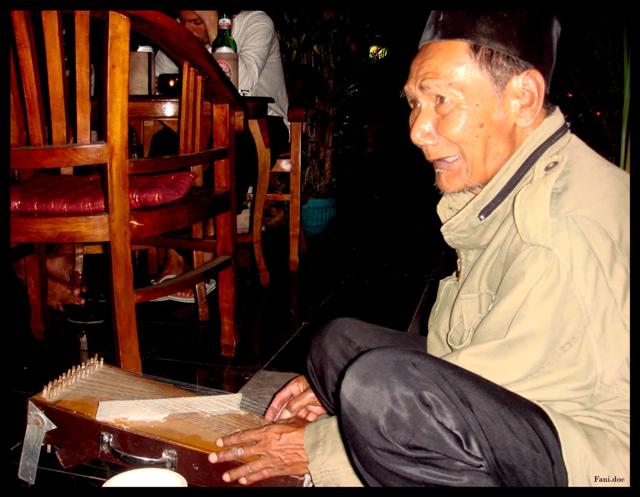
From a distance, a man wearing a jacket and a pici, a rimless, black velvet cap, is seen striding slowly along the sidewalk with a musical instrument in hand. Stepping from the showering street lights onto the cafe’s dim terrace, the old man puts down the small wooden siter. His wrinkled fingers begin to tango upon the strings that let out piercing notes of an old Javanese song called asmarandhana. The dance track stops as he begins to sing.
“Excuse us for killing the music, but we appreciate his presence here,” whispers Peter Yohanis, one of Banana’s waiters, to the customers.
The cafe visitors lower their voices. All eyes have turned to Pak Gareng as he croons his sharp, trembling voice while the tunes from his siter cords dive, swish and soar melodiously. A few moments later, even though Gareng has not finished playing, raucous conversations resume.
Gareng — one of many Javanese whose names consist of a single word — and his music may seem out of place here. He is used to receiving pitying looks more than appreciative attention.
Sometimes, when the Banana Cafe is crowded, none of the waiters move to turn off the deafening music from the bar. “It has happened twice” said Peter, who has been working at the cafe for five months. “Out of annoyance for his coming on busy nights, we did not turn off our music.”
Maria Retnaningrum, one of Banana’s regulars, said that she was not a fan of traditional music, “But Pak Gareng’s piece was interesting.”
“His voice and his music blended beautifully,” she continued. “So I thought I should show some appreciation by giving him money.”
Every time he has the chance, which usually depends on his health, Gareng heads to Prawirotaman, one of the several areas where many foreign tourists stay in Yogyakarta. He goes into a cafe, plays one song, walks around to every table and silently asks the audience to put money into a small can that he takes from under his jacket. He then heads to the next cafe and repeats the sequence.
“I love playing siter,” said the 78 year old after sipping on some hot lemongrass tea. “And I’m not ashamed to have this profession.”
“I’m doing this for myself. I don’t have to provide for anyone else since my son is able to support himself, his wife and their children,” he added.
Gareng used to accompany a dalang, or master puppeteer, in wayang performances by playing his siter as part of a gamelan, a traditional Javanese ensemble. When the dalang died more than 10 years ago, members of the orchestra went their own way and Gareng lost his steady income. No one would hire only a siter player to complement a puppet show.
“My wife and I decided to roam the streets. She would sing to my music,” Gareng said softly in a delicate dialect of kromo Javanese. But before they could busk, Gareng had to go to Solo, Central Java, to purchase his own siter as the instrument he used to play belonged to someone else.
“I bought two, medium and small, for Rp 500,000.”
The medium-sized instrument Gareng bought is called a celempung, which has 13 strings. A siter, which is related to the kecapi in a Sundanese gamelan, has 11 or 12 strings attached to both ends of a resonator box. The box, propped up by four legs, is usually 30 centimeters long but has varying widths. To play the instrument thumbs twang the strings in rapid succession while other fingers muffle the vibrations by holding down the strings that are not being plucked.
“I only bring the siter when I go busking because of its lightness,” said Gareng, with a smile ever present on his face. He has become used to employing the singular pronoun, since his wife died four years ago. As he lives alone in Mantub village in the southern district of Bantul, he often stays at the house of his friend Slamet, a pedicab paddler, after his nightly tours which usually end shortly after midnight.
Making an average of Rp 75,000 a time, Gareng does not spend a penny on changing his siter strings even when they start producing stifled sounds. Instead, he simply heads to a vehicle repair shop to ask for used motorcycle brake wires with which to replace the strings. These wires are not only free, but also durable. Asked about his life motto, he answered: “Tiyang nyambut damel menika dipun kanteni remen” — You should be happy with what you’re doing.
At around 11:30 p.m., Gareng said thank you for the tea and, clutching his long-time companion to his chest, left the cafe to carry on playing popular dance tracks for another few hours.
Some weird advice about learning once came from an extraordinary man. His name is Hadi Subiyanto, a siter player, whose life motto has been: “The best teacher is the best student, and to be the best student, you have to learn like a mad man.”
Hadi was able to say those words in perfect English, and then gave an example of what he meant. “You, celempung, when did the Diponegoro War take place? No, 1908 was when the Budi Utomo organization was founded. You, siter? Right, 1825 to 1830! You, saronen [a traditional wind instrument], where was Cut Nyak Dhien, the Acehnese heroine, buried? No, not Aceh. She was buried in Sumedang, West Java,” he rattled on to the instruments, as his motto goes, like a mad man.
“In learning, everything has to be exerted — eyes, hands, mouth, mind,” Hadi proclaimed. Hadi was a teacher for almost 10 years.
“I graduated from senior high school in 1963, and then I taught English, German, geography and other subjects at a technical school,” he recalled.
“At the same time, I also worked as a civil servant for a koperasi [small cooperative economic enterprise] and taught at a pesantren for no pay in the morning,” Hadi added. A pesantren is a traditional Islamic boarding school.
Hadi took on many other occupations before an offer came to him to play siter at Dharmawangsa Hotel in Kebayoran Baru, South Jakarta. Moving to Jakarta in 1973, he found work as a technician for the construction of the sky lift in Taman Mini Indonesia Indah, or TMII, a culture-based recreational park. Here he also joined the Tanduk Majeng musical group, where he played various Madurese musical instruments in the East Java section.
“In 1980 I went to Aceh and worked for the liquefied natural gas mill in Arun until 1985. After that, I traveled to Palembang, Lampung, Suralaya and Batam. In 1997, I returned to Jakarta,” said Hadi, who heads the arts and culture division of Rampak Naong, an association of Madurese people in Jakarta.
“Months later — it was in 1998, I think — someone asked me if I could play East Javanese musical instruments at Dharmawangsa Hotel,” he continued. “Apparently, the hotel people had asked the TMII people, and the TMII people mentioned my name.”
Hadi and other traditional musicians then formed a group called Gema Palapa. The members have been taking shifts performing at the hotel’s Majapahit Lounge ever since. Five people play Sundanese musical instruments, and four, including Hadi, focus on the Madurese ones. But his range of musical knowledge is not limited to traditional compositions.
“I was once invited to play in Singapore. There were artists from various countries, and I saw a flag throwing group from Italy perform in the accompaniment of the song Gondola. During a break, I played my saronen to the Gondola tunes, and one of the Italians was really surprised. The truth was, I already knew the song,” he said with a big laugh, showing the four front teeth he had left. His group has also performed in Malaysia, Japan, Australia and Canada. Back in Indonesia, they get invitations to play at big events from time to time.
“I taught myself how to play siter. Most traditional musicians learn by doing,” said Gareng. “You pluck a string, you remember how it sounds, you pluck other strings, and then you try to combine everything.”
Gareng believes he inherited the artistic talent of his grandfather, who ran a reog performance group.
“As a kid, I found entertainment in sounds — the sounds of the rain and the wind, the croaks of frogs in the rice field,” said Hadi, who just turned 66 this month, describing his earlier interest in music.
“I tried all the instruments lying around in the house,” he continued. “Now I can play siter, celempung, the flutes, gender [a percussion instrument], angklung and several others.”
Hadi rose from the sofa in his living room, located on the second floor of his house in Lubang Buaya, East Jakarta. He grabbed his siter, sat on the carpet spread on the green-tiled floor and started playing a Chinese composition. In this abode that he built bit by bit, artistic skills are nurtured.
“One day I found my son playing the angklung. I never taught him how to use the instrument, but he played it quite well. He’s a member of my group now,” Hadi said.
Angklung is an instrument consisting of bamboo tubes that produce sounds when shaken from side to side. “My youngest child, Ayu, teaches traditional dances there,” the father of four said, pointing at the balcony, his siter now placed by his side. Hadi believes that not many people in Indonesia know what a siter is, let alone know how to play it. As part of a gamelan ensemble, its presence is not of the highest necessity so it often gets ignored, and it is occasionally left out of the group.
Agus Suseno, a Javanese ethnomusicology professor at the Indonesian Arts Institute in Yogyakarta, said that there is only a small number of siter players left in Indonesia.
“It is very difficult to learn how to play siter. Besides, most people are interested in contemporary music,” Agus said, referring to the decreasing number of applicants for ethnomusicology studies.
Hadi goes even further by claiming that his group members are the only professional Madurese-style siter players left.
Professional siter players, Agus said, use special strings, “Others use guitar cords, but most siter buskers prefer the cheaper motorcycle brake wires, which do not produce the best tunes.” However, like Gareng’s, the strings of Hadi’s siter are also recycled from brake wires.